Event · 1665 CE – 1884 CE · Central African Kingdoms
Kingdom of Lunda
- Also known as
- Dola la Lunda
- Empire Lunda
- Imperi Lunda
- Imperio lunda
- Imperiu lunda
- Kerajaan Lunda
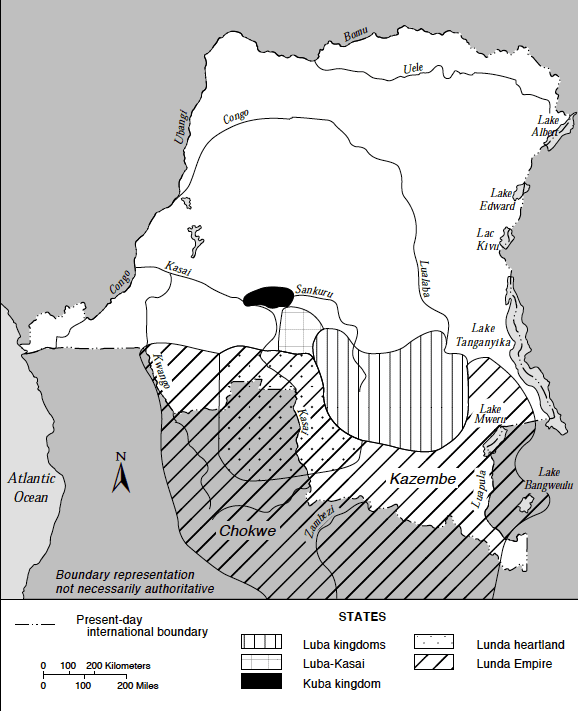
The rulers of the Lunda Commonwealth did not merely succeed their predecessors; they became them.
In the damp, forested river valleys of the southern Congo Basin, power was once an intimate, localized affair. Communities known as N’Gaange clung to the fertile margins where traditional farming was possible, surrounded by vast, inhospitable interfluves that resisted cultivation. In this landscape of fragmented valleys and shifting alliances, authority was personal, bound to the soil and the immediate lineage. Yet by the late seventeenth century, a profound political mutation occurred. Through a deliberate mechanism of political theater and administrative genius, these isolated valleys were woven into a vast confederation that would eventually span three hundred thousand square kilometers across what is now the Democratic Republic of Congo, northeastern Angola, and northwestern Zambia. This was the Kingdom of Lunda, an empire built not on the erasure of local identities, but on their systematic, almost magical absorption.
At the heart of this transformation was a concept known as perpetual kingship. In the Lunda state, when a new sovereign ascended to the throne, he did not merely succeed his predecessor; he became him. The new monarch adopted the deceased king’s name, assumed his exact place in the family genealogy, and inherited his kinship relations and duties. To the outside world and to his subjects, the lineage was unbroken, rendered immortal by a continuous reincarnation of authority. The physical manifestation of this eternal state was the musumba, a royal center that was rebuilt by successive rulers. Each musumba was a meticulously designed sacred space, enclosed by defensive moats and massive earthen walls. Within these ramparts lay paved roads, spacious courtyards, and highly specific zones demarcated for state rituals. It was a cosmos in miniature, designed to project absolute order over a fractured landscape.
The genesis of this political structure is shrouded in the fertile ambiguity of oral tradition, where history merges with foundational myth. One prominent narrative attributes the birth of the empire to a marriage of cultures: Ilunga Tshibinda, a royal prince from the neighboring Luba kingdom, traveled south and wedded Lueji A’Nkonde, a local noblewoman. Their son, born of Luba statecraft and Lunda soil, is said to have assumed the title of Mwane-a-Yamvu around 1665, inaugurating the imperial dynasty. Other accounts place the true historical crystallization of the state slightly later, around 1695, with the reign of Nawej. This ruler, whose father hailed from the Luba-speaking state of Kalundwe, is credited with formalizing the intricate court offices that stabilized the Lunda state. Nawej established the Rukonkesh, the powerful office of the Queen Mother, whose primary duty was to guide the treacherous process of succession. He also created the Swan Mulond, a title bestowed upon his mother Ruwej, and the Swan Mulop for the heir apparent. Through these interlocking titles, Nawej distributed power among key stakeholders, ensuring that the death of a monarch would not plunge the realm into chaos.
The survival of this nascent state, however, was repeatedly challenged by its neighbors. To the north and northwest lay formidable Luba-speaking populations: the loose, shifting confederations of the Sala Mpasu and Kete, and the formidable Kanyok Kingdom. Nawej’s early reign was defined by these northern struggles. Seeking to pacify the Sala Mpasu, he pushed north and constructed a massive fortress in their territory, yet he could not pacify them before a sudden invasion by the Kanyok forced him to withdraw. In the ensuing clash, the Kanyok forces killed Nawej and established their own stronghold within the Lunda heartland. It fell to Muland, a leader elected by the state's council, to rally the Lunda forces and expel the Kanyok invaders. Recognizing the need for stability, Muland eventually stepped aside in favor of Nawej’s son, Muted, establishing a hereditary line of succession within Nawej's lineage. Under Muted and his successor, Yava a Nawej, the Lunda went on the offensive. Guided by Mai, a prominent member of the karula—the elite class responsible for choosing the emperor—Lunda armies pushed west across the Kasai River in the 1720s, while another wave under Muteb, the son of the former ruler Muland, marched northwest along the Kwilu River to bypass the resisting Lulua people.
By the nineteenth century, this military and diplomatic momentum had transformed the Lunda Kingdom into a towering regional power. From a core population of some 175,000 inhabitants, the Mwane-a-Yamvu commanded a formidable military apparatus, eventually enhanced by the arrival of Muslim military advisors and firearms acquired from the distant trading hubs of Nyangwe and Kabambare. The empire expanded through a brilliant combination of conquest, marriage alliances with Luba dynasties, and colonization. Rather than imposing a rigid, centralized tyranny, the Lunda created a sophisticated commonwealth. Conquered chieftainships were allowed to retain a high degree of local autonomy and their own customs, provided they acknowledged the paramount authority of the Mwane-a-Yamvu and paid regular tribute. To manage this vast network, the emperor relied on a ruling council adapted from the Luba model.
This model of expansion was so successful that it replicated itself far beyond the original borders of the empire. Lunda migrants and adventurers pushed south of Lake Tanganyika, giving rise to new dynasties like the Bemba of northern Zambia. Most famously, a Lunda warrior-chief named Mwata Kazembe carved out a powerful, semi-autonomous eastern branch of the empire in the fertile Luapula River valley. Back in the western heartland, the Lunda capital stood as a testament to this sprawling influence—a sophisticated center of diplomacy and trade that linked the interior of the continent to global networks.
Yet the very networks of trade that empowered the Lunda would ultimately sow the seeds of their undoing. During the nineteenth century, the Chokwe people, historically subordinate neighbors, leveraged their access to European trade routes to acquire significant quantities of firearms. Armed with these devastating new weapons, the Chokwe launched a series of invasions into the Lunda heartland. The traditional Lunda forces, reliant on older military structures, were overwhelmed. The Chokwe dismantled the political supremacy of the Mwane-a-Yamvu, establishing their own hegemony and spreading their language and customs across the region. Though the Lunda chiefs and their people remained in their ancestral lands, their grand political experiment was shattered, their paramount authority reduced to a shadow of its former self.
The final dissolution of the Lunda world was codified not by African rivals, but by European cartographers. At the Berlin Conference of 1884, which inaugurated the colonial partition of the continent, the historic Lunda heartland was sliced into three distinct imperial spheres. It was divided between Portuguese Angola, King Leopold II’s Congo Free State, and the British territory of North-Western Rhodesia. These artificial colonial borders eventually hardened into the modern frontiers of Angola, the Democratic Republic of Congo, and Zambia. In Northern Rhodesia, Lunda identity survived through the preservation of local chieftainships, such as those of Ishindi in the northwest and Kazembe in the northeast—remnants of a once-unified commonwealth. What had begun as a collection of isolated farming communities in the river valleys of Katanga had, for over two centuries, defined the political geography of Central Africa, leaving a legacy of shared statecraft, titles, and lineages that survived long after the earthen walls of the musumba had returned to the dust.
Connected to
1 link to entries not yet ingested in the Library.