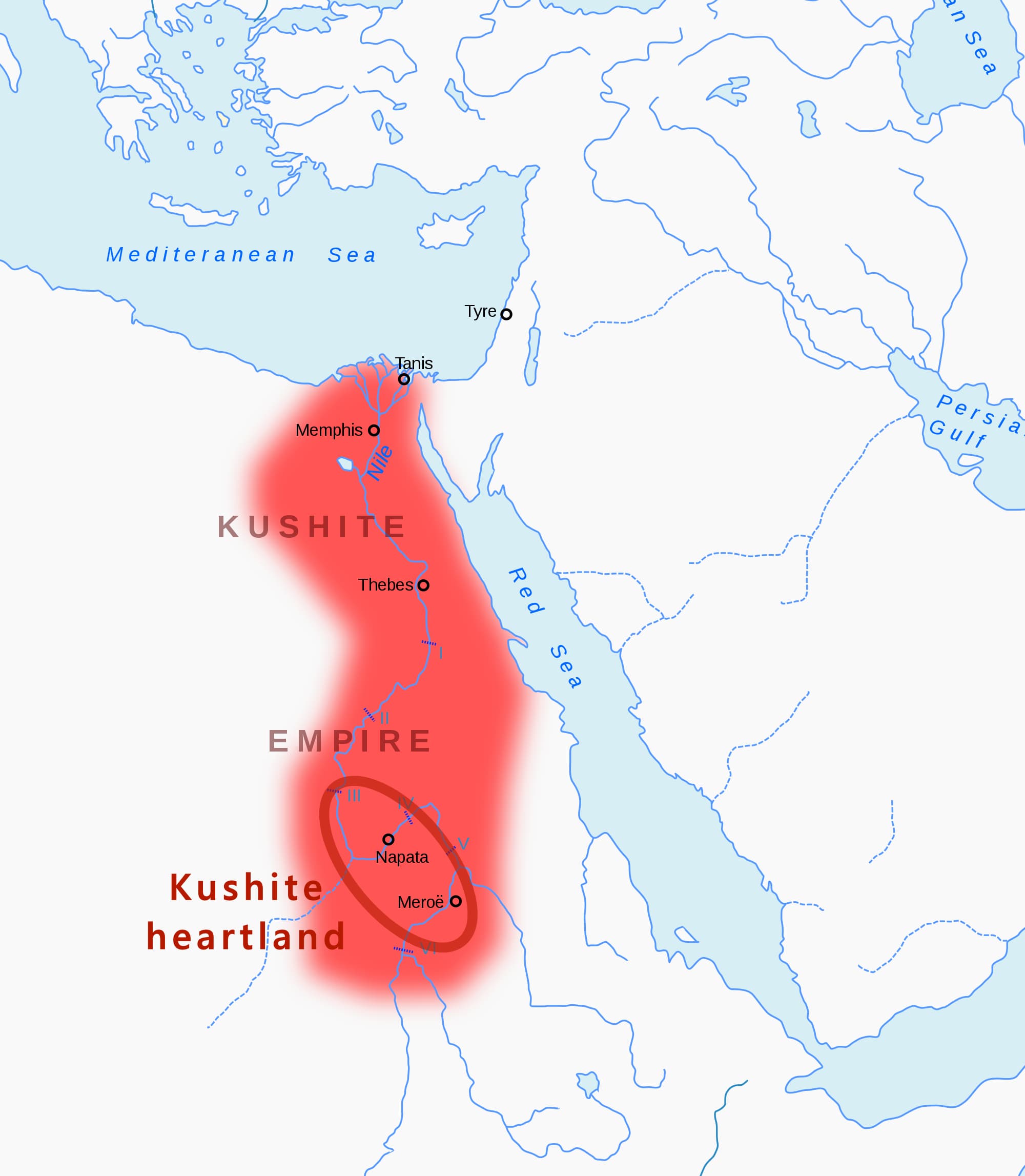
To the ancient Egyptians, the lands south of the Nile’s first cataract were known as Kush, a distinct world of sophisticated trade, industry, and power that repeatedly challenged and reshaped the destiny of the Nile Valley.
South of the first cataract of the Nile, where the river bends through the sun-scorched sandstone of modern Sudan and southern Egypt, there existed a civilization that the ancient world regarded with a mixture of reverence, dependence, and dread. To the pharaohs of Egypt’s Middle and New Kingdoms, this territory of Nubia was known as Kush—a land of peerless archers, vast gold reserves, and deep spiritual power. For millennia, the relationship between Egypt and Kush was defined by an intense, cyclical rhythm of conquest and cultural osmosis. Yet, long overshadowed in modern imagination by their northern neighbors, the Kushites created an empire that was entirely their own: an advanced urban society that not only survived the collapse of the Bronze Age but eventually marched north to claim the throne of Egypt itself, ruling as the pharaohs of the Twenty-fifth Dynasty.
The roots of this civilization lay in a deep, indigenous antiquity. Thousands of years before Kush became an empire, the Neolithic peoples of Nabta Playa were erecting sophisticated megalithic stone circles to map the stars—predating Stonehenge by nearly two millennia—and digging deep, year-round wells that sustained planned village layouts. By 2500 BCE, this organizing genius had coalesced into the Kingdom of Kerma in Upper Nubia. Centered between the first and fourth cataracts, Kerma grew into a populous, formidable empire that rivaled Egypt. It was during this Classical Kerma period that the Egyptians first coined the term Kush, likely derived from the indigenous ethnonym Kasu. The Kushites of Kerma constructed distinctive, rounded architecture, as seen at the nearby settlement of Doukki Gel, which hosted a coalition of southern African rulers. The relationship was fraught; Egyptian pharaohs like Mentuhotep II launched campaigns against Kush in the twenty-first century BCE, and by 1504 BCE, Thutmose I had destroyed Kerma, annexing Nubia into the Egyptian New Kingdom.
For nearly five centuries, Kush was governed by an Egyptian viceroy. During this long colonial occupation, the culture of Kush was profoundly Egyptianized. The Kushites adopted the veneration of the state god Amun, establishing a massive religious sanctuary at the sacred mountain of Jebel Barkal near Napata. Yet, Kushite identity was never erased. Egyptian artists meticulously recorded the distinctions, portraying the people of Kush with unique dress, physical features, and modes of transportation. Kushite warriors were renowned throughout the Near East as legendary bowmen; early Egyptian soldiers like Ahmose, son of Ebana, wrote of traveling south specifically to "destroy the Nubian bowmen" who resisted Egyptian hegemony. Indeed, the region remained a volatile frontier, with major rebellions flaring against Egyptian rule for over two centuries.
+ 2 further connections to entries not yet ingested
When the New Kingdom disintegrated around 1070 BCE amid the wider Late Bronze Age collapse, the imperial apparatus of Egypt withdrew, leaving behind a highly centralized, deeply pious, and militarily potent Nubian elite. From the ashes of colonial rule, the Kushites reestablished an independent kingdom centered at Napata. By the eighth century BCE, a chieftain named Alara—remembered by his successors as the foundational patriarch of their dynasty—unified the region and transformed Kush from a collection of chiefdoms into a highly organized state. Alara and his successor, Kashta, utilized their shared devotion to Amun to project power northward. Kashta peacefully extended Kushite influence into Upper Egypt, installing his daughter, Amenirdis, as the Divine Adoratrice of Amun in Thebes—a position of immense economic and political authority.
It was Kashta’s successor, Piye, who realized the ultimate reversal of imperial fortune. In 727 BCE, finding Egypt fractured into four competing kingdoms and vulnerable to foreign encroachment, Piye marched north. He conquered Lower Egypt, establishing the Twenty-fifth Dynasty of Egypt. In his victory stela, erected at the temple of Amun at Jebel Barkal, Piye framed his conquest not as a foreign invasion, but as a holy crusade to restore the neglected purity of Egyptian religion and unify the Nile Valley. For over a century, these Black Pharaohs ruled an empire stretching from the Mediterranean to the borders of modern Khartoum. They built pyramids, revived classical art, and successfully integrated the two cultures. However, their northern expansion brought them into direct conflict with the terrifying military machine of the Neo-Assyrian Empire. Kushite attempts to back anti-Assyrian rebellions in the southern Levant drew the wrath of Esarhaddon and Ashurbanipal, whose campaigns eventually drove the Kushites out of Egypt in the mid-seventh century BCE.
Withdrawing south to their ancestral heartland, the Kushites severed their political ties with Egypt and shifted their capital further south to Meroë around 591 BCE. In this southern savannah, known to the Greco-Roman world as Aethiopia, Kush entered its golden age. Meroë was a sprawling cosmopolitan metropolis powered by iron-smelting industries and far-reaching trade networks that connected sub-Saharan Africa with the Mediterranean and India. The Meroitic period saw Kushite culture shed much of its Egyptian veneer. They developed their own unique, presently undeciphered cursive script and alphabet to replace hieroglyphs. While they continued to build steep-sided royal pyramids, they also constructed temples to indigenous, lion-headed warrior gods like Apedemak.
Meroitic society was remarkably egalitarian in its distribution of power, characterized by an exceptionally high degree of female participation in statecraft. Kush was frequently ruled by Kandakes—powerful queen-regents who governed in their own right, commanded armies, and conducted international diplomacy. When the Roman Empire conquered Egypt, they pushed south into Nubian territory, occupying the northern borderland known as the Dodekaschoinos. The Kushites fought back fiercely. Eventually, a diplomatic and military balance was struck, and by the late third century CE, the Kushite king Yesebokheamani successfully reclaimed the Dodekaschoinos from a declining Roman Empire.
Yet, the end of Kush was not brought about by a single, catastrophic conquest, but by a slow convergence of ecological and geopolitical shifts. By the fourth century CE, worsening climatic conditions and the over-exploitation of local woodlands for the iron industry began to desiccate the land around Meroë. Internal rebellions fractured the state, while nomadic Noba peoples migrated into the region, eventually introducing the Nubian languages. Seizing upon Kush's domestic instability, the neighboring Christian kingdom of Aksum, based in the highlands of modern Eritrea and Ethiopia, launched invasions. The Aksumite king Ezana captured Meroë, looted its legendary gold, and claimed the historic title "King of Ethiopia."
By 350 CE, the Kingdom of Kush had dissolved, fracturing into three successor Nubian kingdoms: Nobatia, Makuria, and Alodia. Though the grand stone temples and pyramids of Meroë slowly filled with desert sand, the legacy of Kush remained etched into the history of the Nile Valley. Kush was never a mere provincial reflection of Egypt; it was a distinct, highly resilient African empire that, for over two thousand years, stood as a towering bridge between the Mediterranean world and the rich interior of the African continent.