Kingdom of Aksum
- Also known as
- Aksoumite
- Aksum
- Aksum
- Aksum
- Aksum
- Aksum Erresuma
Long before the medieval world shrank into isolated pockets of power, a single merchant empire commanded the critical maritime arteries linking Rome to India.
To the third-century Persian prophet Mani, the architecture of global power was held up by four great pillars. Writing in his Kephalaia, he named them with the confidence of an imperial cartographer: Rome, Persia, China, and Aksum. Today, the first three names evoke a continuous, vivid lineage of monuments, laws, and literature that shaped the modern world. The fourth name, Aksum, has largely slipped into the quiet margins of history, remembered chiefly for the towering, monolithic stone needles it left stabbed into the highland skies of the Horn of Africa. Yet for nearly a thousand years, this highland empire governed the crucial maritime choke point where the Red Sea meets the Indian Ocean, orchestrating a vast commercial symphony that connected the Mediterranean basin with the markets of India and Ceylon.
The rise of this African superpower began in the misty, temperate plateaus of northern Ethiopia and Eritrea, emerging from the older Dʿmt civilization around the first century CE. Its capital, the city of Axum, was nestled in a fertile basin flanked by two protective hills and watered by twin streams—a geography Carlo Conti Rossini suggested gave the kingdom its name, deriving from a Semitic root meaning "a green and dense garden." Before it became a highly centralized empire, Aksum likely operated as a loose confederacy of regional chieftaincies. Power was fluid; upon the death of a "king of kings," a successor was not chosen through strict primogeniture but elected from among the petty rulers who commanded the surrounding valleys. But the isolation of the highlands could not hold back a population sitting so close to the sea. Through the port of Adulis, situated on the baking coast of the Red Sea, this inland confederacy found its doorway to the world.
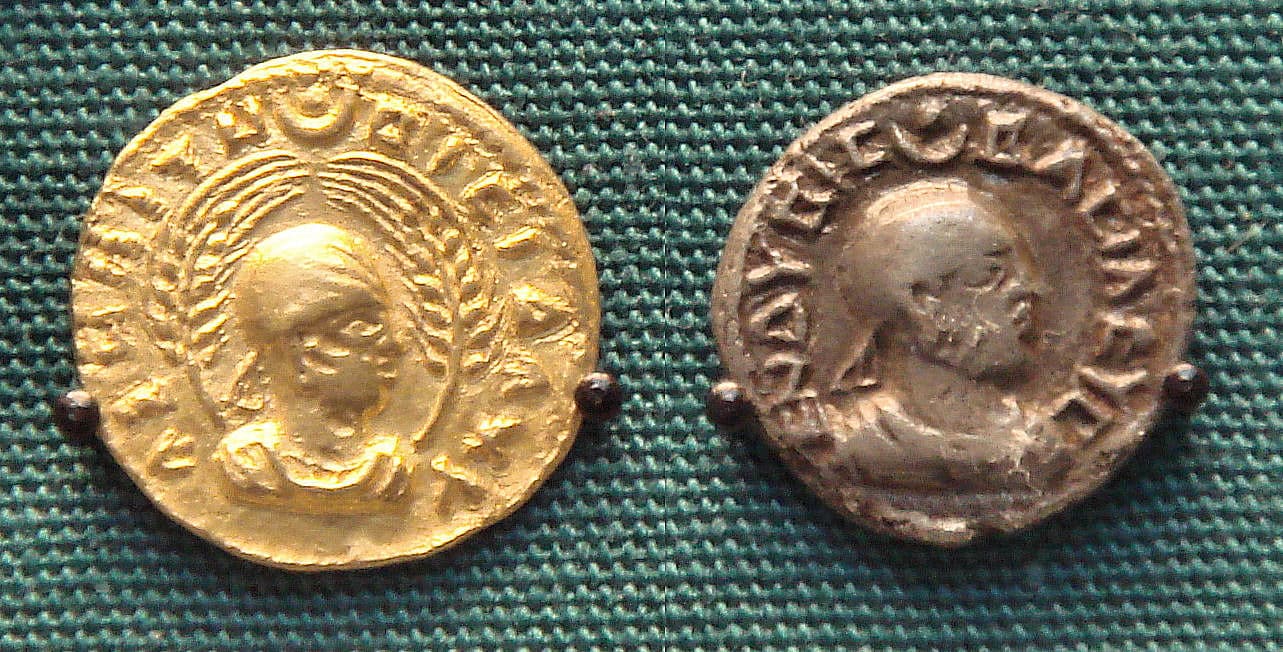
By the mid-first century CE, the Periplus of the Erythraean Sea, a Greek merchant’s guide to the waters of the Indian Ocean, noted that Aksum was already funneling the riches of the African interior into the global market. Ivory was the engine of its early growth, supplemented by rhinoceros horn, hippopotamus hide, tortoise shells, monkeys, and enslaved people. In return, the ships of the Roman Empire and India unloaded iron, glass, and fine textiles at Adulis. By the late third century, during the reign of Endybis, Aksum became the first sub-Saharan African state to mint its own coinage. Struck in gold, silver, and copper, and bearing the names and likenesses of its kings, these coins were designed to conform to the weight standards of Rome. They were not merely currency for domestic use but physical instruments of foreign policy and trade, circulating so widely that archaeologists have unearthed them in places as distant as Caesarea in the Levant and the temples of southern India.
As wealth accumulated in the highland capital, the Aksumite elite transformed their city into a theater of monumental stone. They developed a unique architectural style characterized by massive dressed granite blocks, mud mortar, and a distinct timber-framing technique where square wooden corner beams—known as "monkey-heads"—extruded from the walls to anchor the masonry. Palace complexes, like those described by the sixth-century traveler Cosmas Indicopleustes, boasted four corner towers and central courtyards adorned with bronze statues of unicorns. To honor their dead, the pre-Christian rulers erected colossal granite steles. These were not merely flat slabs, but virtuosic representations of multi-story towers, carved with false doors, windows, and structural beams to mirror the palaces of the living. The largest of these, which eventually collapsed under its own immense weight, stood over thirty-three meters tall and weighed several hundred tons—one of the largest single pieces of stone ever quarried and erected by humanity.
The fourth century brought a transformation that permanently anchored Aksum within the cultural orbit of the Mediterranean. Under King Ezana, who ruled in the 320s and 330s, the kingdom underwent a profound religious transition. Ezana’s early coins and inscriptions feature the crescent and disc of traditional South Arabian and Semitic deities. By approximately 340 CE, however, these symbols were replaced by the Christian cross. The conversion, recorded on the famous Ezana Stone in Ge'ez, Sabaean, and Greek, made Aksum one of the earliest empires to adopt Christianity as its state religion. This was a masterstroke of both faith and diplomacy, establishing a deep cultural and political alliance with the Byzantine Empire, which viewed itself as the global guardian of the Christian faith. It was during this period of expansion that Aksum pushed westward, defeating the neighboring Noba and Kushite forces at the junction of the Nile and Atbara rivers, and inheriting the ancient Greek exonym "Ethiopia."
At its zenith in the sixth century, Aksum’s geopolitical reach transcended the African continent. Under King Kaleb, the empire turned its gaze across the Red Sea toward the southern Arabian Peninsula. In the early 520s, the Jewish Himyarite king Dhu Nuwas began a violent campaign of persecution against the Christian communities of modern-day Yemen. Urged on by the Byzantine Emperor Justin I, who lacked the naval reach to intervene directly, Kaleb assembled a massive fleet, crossed the Bab-el-Mandeb strait, and invaded Yemen. The Aksumite forces defeated Dhu Nuwas, and Kaleb established a protectorate over the region, appointing a local Christian viceroy. For a brief window, the Aksumite Empire reached its greatest territorial extent, claiming dominion over Eritrea, northern Ethiopia, Djibouti, parts of Sudan, and the fertile highlands of Yemen.
Yet, this transcontinental dominance was fragile. The Aksumite grip on Arabia quickly slipped when the viceroy was deposed by Abraha, a rebellious Aksumite general, and the territory was eventually lost entirely during the subsequent Aksumite-Persian wars. By the seventh century, the geopolitical tides that had lifted Aksum to prominence began to turn against it. The rise of Islam and the expansion of the Umayyad Caliphate altered the trade networks of the Red Sea. Byzantine influence waned, and the old Roman trade routes that had once filled the coffers of Adulis began to dry up. Cut off from its primary maritime partners, Aksum’s economic lifelines withered. The minting of gold and silver coins, once the proud signature of its global integration, ceased entirely.
The decline was slow, quiet, and compound. Deprived of trade, the empire retreated into its mountainous interior. The city of Axum, once a bustling metropolis of diplomats, merchants, and stonemasons, saw its population shrink as the center of political gravity shifted south into more defensible, agricultural highlands. Environmental degradation, soil exhaustion, and shifting rainfall patterns further weakened the agrarian base that supported the urban centers. The final three centuries of the kingdom are shrouded in what historians call a dark age, characterized by sparse archaeological records and fragmented traditions. Around 960 CE, under circumstances that remain deeply mysterious, the old kingdom finally collapsed.
Though the empire vanished, it left an indelible blueprint for the medieval Christian kingdom of Ethiopia that succeeded it. The Ge'ez script, developed from ancient South Arabian characters, remained the liturgical and literary language of the region for centuries. The memory of Aksum’s glory, its conversion to Christianity, and its architectural triumphs preserved an unbroken sense of identity that allowed the Ethiopian highlands to remain a distinct Christian redoubt throughout the Middle Ages, long after its contemporaries had faded into dust.
Connected to
4 links to entries not yet ingested in the Library.