Organization · Southern African Civilizations
Khoisan
- Also known as
- Bosquímano
- Bosquímanos
- Boximane
- Boxímanes
- Buschleute
- Capoide
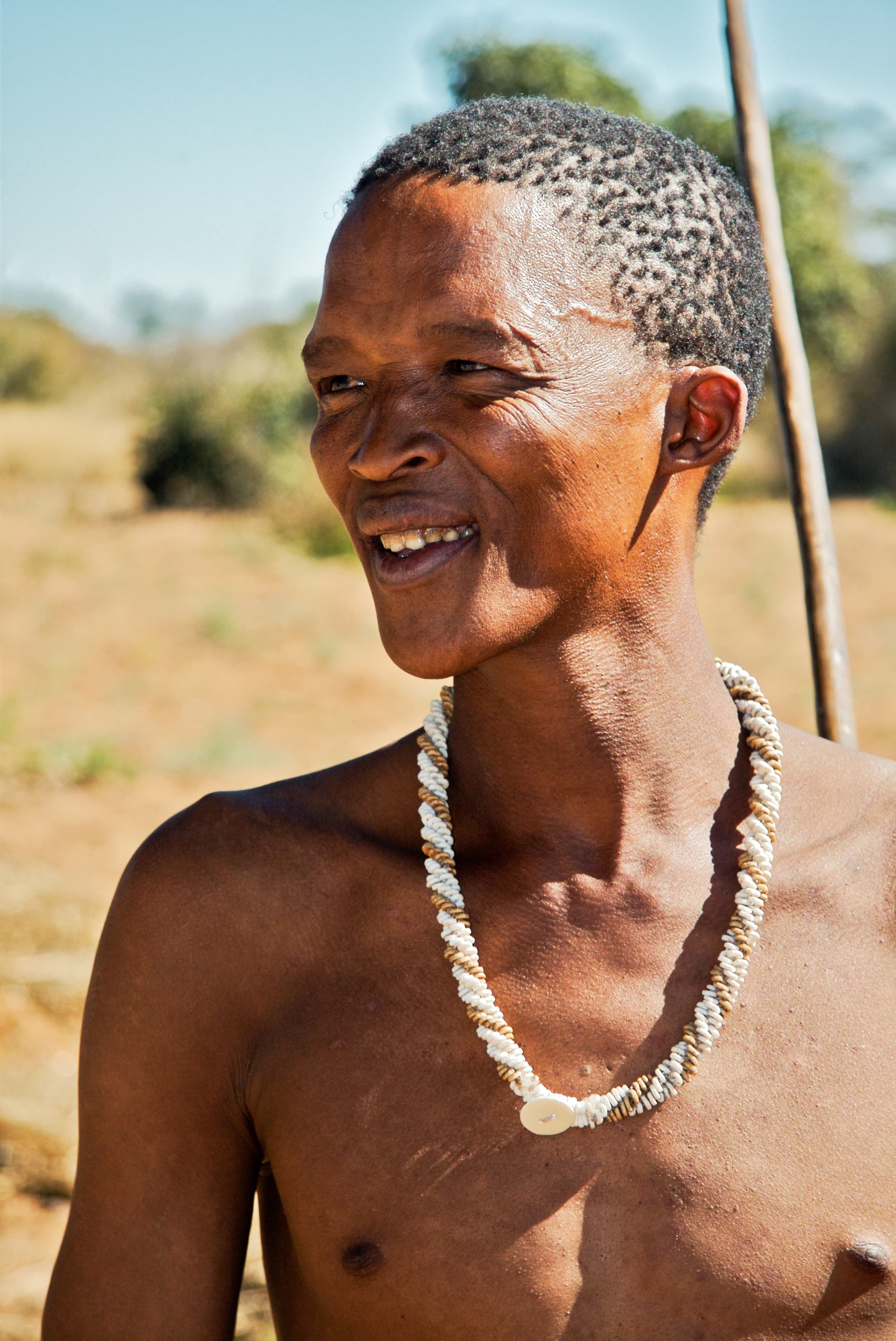
Long before the expansion of Bantu-speaking farmers and the arrival of European colonizers, the vast arid stretches of Southern Africa belonged to the Khoekhoen and the Sān.
For the vast majority of the timeline of anatomically modern humans, the largest population on Earth did not live in the fertile valleys of the Fertile Crescent, nor along the yellow waters of the Yangtze, but across the sweeping, semi-arid expanses of Southern Africa. Before the great migrations out of Africa some 70,000 years ago, and stretching back perhaps 150,000 to 260,000 years, the ancestors of the peoples we now group under the umbrella term "Khoisan" represented the dominant branch of humanity. While the ancestors of every other modern human population were clustering in eastern and central Africa, the bearers of the mitochondrial DNA haplogroup L0 were already adapting to the diverse landscapes of the south. They thrived across territories that would later prove climatically unfavorable to the sorghum-based agriculture of expanding Bantu populations, carving out an existence that relied on an intimate, highly specialized knowledge of the earth. Today, their legacy is preserved not only in the ancient archaeological record but in the very structure of southern African speech—most famously in the sharp, percussive click consonants that represent some of the most linguistically complex sounds in human language.
The term "Khoisan" is itself a modern, twentieth-century academic construction, coined in the 1920s by Leonhard Schultze-Jena and popularized decades later by the anthropologist Isaac Schapera and the linguist Joseph Greenberg. It artificially fuses two distinct groups who shared geographic proximity but possessed fundamentally different socioeconomic realities: the Khoekhoen and the Sān. The Sān—historically referred to by the Khoekhoen as "those who pick things up from the ground"—were hunter-gatherers who did not own livestock. This designation was less an ethnic label than an economic descriptor for a nomadic, foraging lifestyle that spanned the Kalahari Desert, Namibia, Botswana, Angola, Zambia, Zimbabwe, Lesotho, and South Africa. The Khoekhoen (or Khoi), by contrast, were pastoralists who owned cattle and sheep. While older anthropological theories viewed the Khoekhoen and Sān as sharing a singular, ancient origin, modern linguistic and genetic evidence suggests a more complex story. The ancestors of the Khoi may have been relatively recent, pre-Bantu agricultural immigrants who entered Southern Africa roughly 2,000 years ago, eventually abandoning crop cultivation as the climate dried, turning instead to pastoralism or adopting the foraging lifestyle of the indigenous San. This distinction remains politically and culturally sensitive; many contemporary San object to being grouped under a single moniker with the historically more powerful, pastoralist Khoekhoen, pointing to a fraught history that even included Khoekhoen participation in colonial-era commandos directed against San communities.
Long before European sails appeared on the horizon, the demographic map of Southern Africa was irrevocably redrawn by the Bantu expansion. Beginning roughly between 1,500 and 2,000 years ago, iron-working, agriculturalist Bantu-speaking communities began pushing southward. As they advanced, they absorbed, displaced, or marginalized the indigenous Khoe-San populations. Yet this was not a simple story of replacement; it was one of profound cultural and genetic synthesis. The incoming Bantu-speakers adopted the distinctive click phonemes and numerous loanwords from the ancient Khoe-San languages, embedding them into what would become major modern languages such as Xhosa, Zulu, Sotho, and Tswana. Today, the millions of people who speak these languages carry a massive, admixed genetic heritage from the ancient Khoe-San, making them the quantitative majority of their descendants.
When Portuguese explorers first rounded the Cape of Good Hope, they encountered the Khoikhoi, marking the beginning of a catastrophic historical chapter. The introduction of European diseases, most notably smallpox, decimated the local indigenous populations, who lacked immunity. The establishment of the Dutch East India Company at the Cape in the mid-seventeenth century escalated these tensions into open warfare. As Dutch settlers enclosed traditional grazing lands for private farms, the Khoikhoi launched frequent retaliatory attacks, culminating in the "Bushman Wars" of 1673–1677. Over the next century, colonial land expansion north of the Berg River into the Tulbagh Basin systematically stripped the Khoikhoi of their livestock and territories. By the close of the eighteenth century, the traditional social, economic, and political structures of the Khoekhoen had been shattered. Many were reduced to working as low-wage laborers, living in conditions barely distinguishable from slavery. Others fled the colonial frontier, integrating into Xhosa clans or intermarrying with European settlers to form new, distinct populations such as the Griqua, who eventually migrated further inland to establish Griqualand East.
In response to these displacements, some colonial authorities and missionaries attempted to create autonomous spaces for the surviving indigenous populations. In 1738, Georg Schmidt, a Moravian Brother from Saxony, founded Genadendal in the Riviersonderend Mountains—the first Christian mission station in Southern Africa—aimed at ministering to the Khoi. Nearly a century later, the British colonial administrator Andries Stockenström facilitated the establishment of the Kat River settlement near the eastern frontier of the Cape Colony. This autonomous, predominantly Afrikaans-speaking Gonaqua Khoi settlement thrived for a time, attracting a diverse mix of Khoi, Xhosa, and mixed-race families. In 1853, following the defeat of a major Xhosa rebellion, the newly established Cape Parliament enacted a franchise that, on paper, allowed any male citizen to vote regardless of color, provided they met a low property qualification. In practice, however, because the vast majority of land and wealth remained concentrated in European hands, this property test functioned as an indirect, racially discriminatory barrier that preserved white political dominance. Farther north, the turn of the twentieth century brought even darker horrors. During the Herero and Nama genocide of 1904–1908 in German South-West Africa (modern-day Namibia), colonial forces systematically slaughtered more than 10,000 Nama people, a devastating blow to one of the largest remaining Khoekhoe populations.
While the Khoekhoen suffered the disintegration of their pastoralist societies, the San of the deep interior remained largely insulated from direct colonial administration until the twentieth century, preserved in the popular imagination as timeless, primordial foragers. Their rich oral traditions and complex cosmologies were meticulously documented in the late nineteenth and early twentieth centuries by Wilhelm H. I. Bleek and Lucy C. Lloyd in their seminal work, Specimens of Bushman Folklore. In the 1950s, the South African author Laurens van der Post brought the San to global attention through a landmark six-part television documentary, framing them as a fragile window into humanity’s distant past.
Yet this romanticized, global fascination did little to protect the San from modern state policies. In 1961, the British colonial administration established the Central Kalahari Game Reserve in Botswana to protect wildlife, while initially permitting the resident San to maintain their traditional hunter-gatherer lifestyle. By the 1990s, however, the government of independent Botswana began a systematic campaign to relocate the San outside the reserve, culminating in the complete termination of basic services to the residents in 2002. This sparked a landmark legal battle. Although the High Court of Botswana ruled in 2006 that the forced removals were unconstitutional, the relocation policies persisted, prompting the San to appeal to the United Nations in 2012 for the recognition of their ancestral land and resource rights.
In post-apartheid South Africa, the term "Khoisan" has undergone a dramatic political resurrection. Reclaimed in the late 1990s as a self-designation, it has served as a rallying cry for an active contemporary rights movement. Since the 2010s, Khoisan activists have increasingly mobilized to demand formal constitutional recognition and the restitution of ancestral lands from both the South African government and the white minority that still owns vast swaths of the country's private agricultural land. What began as a clinical, twentieth-century anthropological term has thus transformed into a powerful political identity. The Khoisan, whose ancestors once dominated the southern African landscape for millennia, continue to navigate the profound disconnect between their status as the continent's first peoples and their ongoing struggle for visibility, land, and self-determination in the modern world.
Connected to
2 links to entries not yet ingested in the Library.