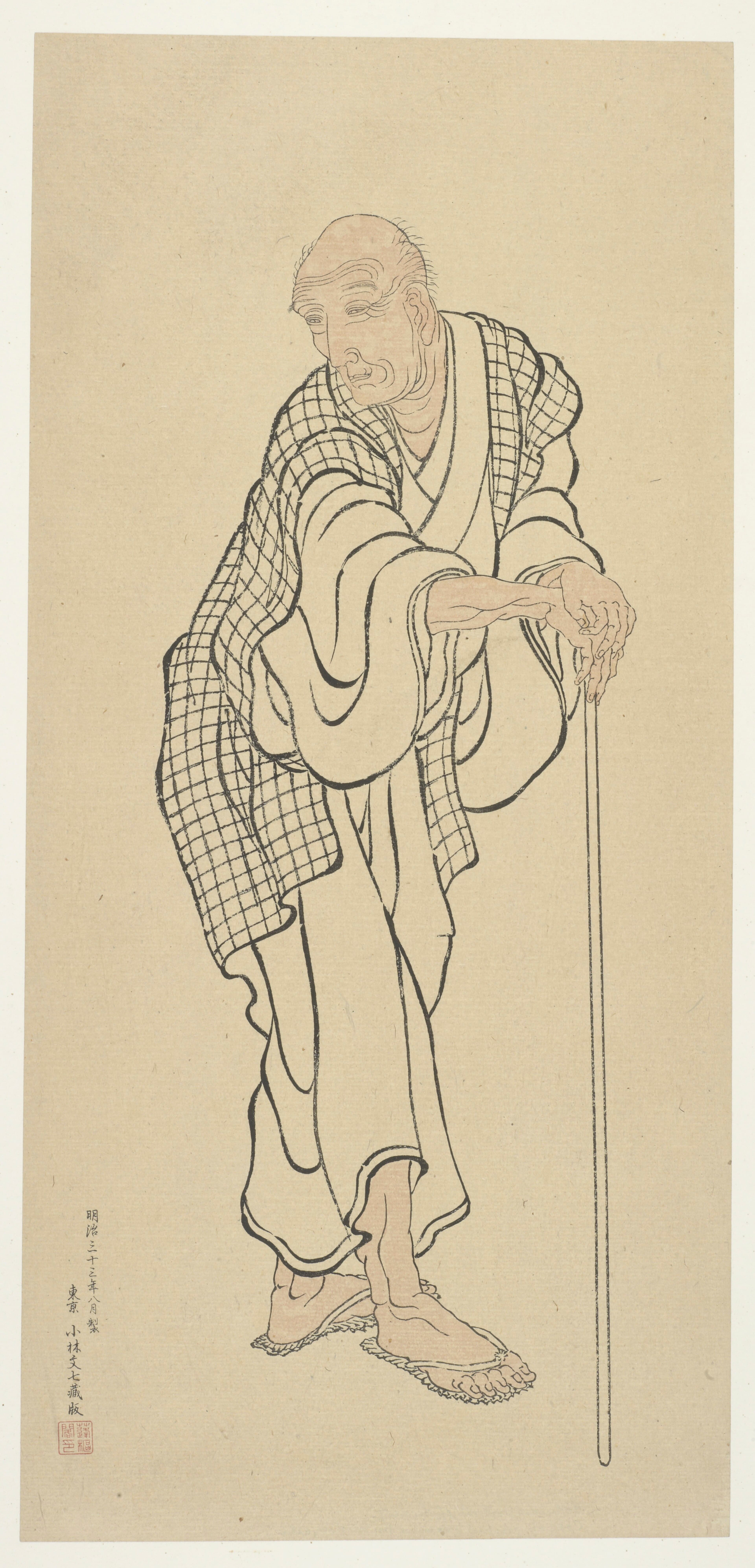
By the time he was six years old, the boy who would eventually be known as Katsushika Hokusai was already painting, perhaps learning the brush by tracing designs onto the mirrors his father crafted for the shōgun in Edo.
In the early autumn of 1804, a massive crowd gathered in the courtyard of a temple in Edo, the bustling, canal-veined capital of the Tokugawa shogunate. Before them lay a sheet of paper measuring some two hundred square meters. Armed with buckets of ink and a broom-sized brush, a middle-aged artist named Katsushika Hokusai strode across the paper, executing broad, wet sweeps of black. When he finished, the bewildered onlookers climbed to the rooftops to look down upon the image: a colossal, staring portrait of Daruma, the Zen patriarch. A decade later, invited to perform before the shōgun Tokugawa Ienari, the same artist laid down a long blue brushstroke on paper, dipped the feet of a live chicken in red paint, and let it run across the surface. He bowed and named the resulting work The Tatsuta River with Maple Leaves Floating on It.
Hokusai was a master of the spectacle, but these theatrical displays were merely public ripples of a quiet, lifelong obsession. Born in the Katsushika district of Edo in 1760, he entered a world defined by the strict social hierarchies of the shogunate and the hedonistic, transient culture of the urban middle class. This culture found its artistic expression in ukiyo-e—"pictures of the floating world"—a genre of woodblock prints and paintings that had long been dominated by portraits of glamorous courtesans and stylized kabuki actors. Hokusai, however, would radically expand this narrow frame, turning the gaze of Japanese art outward to the roads, the rivers, the labor of common people, and the eternal silhouette of Mount Fuji.
This transformation did not happen quickly, nor did it follow a straight line. Hokusai was born into an artisan family; his suspected father, Nakajima Ise, made mirrors for the shōgun, a craft that involved painting decorative designs around glass. Though never named Ise’s heir—perhaps because his mother was a concubine—Hokusai began drawing at age six, absorbing the precise, reflective world of his father’s workshop. By twelve, he was working in the city’s popular lending libraries, handling the woodcut-printed books that served as the primary entertainment of the literate urban classes. This led to a four-year apprenticeship with a professional woodcarver, an invaluable training that taught him exactly how a brushstroke translated into a carved wooden block. At eighteen, he entered the studio of Katsukawa Shunshō, the preeminent ukiyo-e master of the day.
Under Shunshō, the young artist took his first professional name, Shunrō, and produced conventional portraits of actors. But Hokusai was restless. Following his master’s death in 1793 and his own subsequent expulsion from the Katsukawa school—the result of a bitter rivalry and his illicit studies of the rival Kanō school—Hokusai found himself adrift. Rather than a setback, he later recalled this disgrace as the crucible of his career, the humiliation that forced him to forge an independent style. He began digesting foreign influences, studying French and Dutch copper engravings smuggled into the country through the Dutch trading post at Dejima. From these, he absorbed Western ideas of linear perspective and shading, techniques that were entirely foreign to the flat, stylized planes of traditional Japanese art.
12 links to entries not yet ingested in the Library.
As he wandered through Edo’s artistic landscape, Hokusai changed his name with a frequency that baffled his contemporaries. Over his eighty-eight years, he would use at least thirty different pseudonyms, each marking a distinct shift in his aesthetic philosophy. In 1800, he adopted the name Katsushika Hokusai—"North Studio"—paying homage both to the district of his birth and to the North Star, a central deity in his Nichiren Buddhist faith. Under this name, he began publishing landscapes that moved beyond the theater districts to capture the lived reality of Japan: fishermen casting nets, travelers struggling against the wind, and peasants hauling timber.
By the 1810s, Hokusai’s reputation was such that he was flooded with students. In response, he began publishing the Hokusai Manga in 1814. These "random drawings" were originally intended as quick, simplified instructional manuals for aspiring painters, but they soon exploded into a multi-volume publishing phenomenon. Within their pages, Hokusai cataloged the world with exhaustive, manic energy: fat wrestling coaches, bathing women, diving beetles, wind-twisted trees, ghosts, and mythical monsters. The Manga revealed an artist who viewed the entire universe as worthy of study, laying the groundwork for the monumental landscapes that would define his old age.
That old age yielded his most famous work. In the early 1830s, now working under the name Iitsu, Hokusai responded to a domestic travel boom in Japan by publishing Thirty-Six Views of Mount Fuji. The series was a revolution in color and composition. Utilizing a newly imported, chemically stable pigment known as Prussian blue, Hokusai rendered the sacred volcano from dozens of unexpected angles: peeking through the timbers of a half-built temple, framed by the legs of a cooper working on a giant tub, or glowing red under a summer sky in Fine Wind, Clear Morning.
The masterwork of the series, The Great Wave off Kanagawa, remains one of the most recognized images in human history. Here, Hokusai’s decades of experimenting with Western perspective culminated in a terrifyingly dynamic composition. The viewer is suspended low on the water, staring into the maw of a towering, claw-like wave that threatens to swallow three fragile cargo boats. In the background, tiny and serene, sits Mount Fuji, its triangular form mirrored by the shape of the wave’s crest. It is an image of profound tension—the transient, violent power of the ocean contrasted with the immutable stillness of the mountain. The series was so immensely popular that the publisher demanded ten additional prints, bringing the total of the "Thirty-Six Views" to forty-six.
Hokusai followed this success with other brilliant landscape series, including A Tour of the Waterfalls of the Provinces and Unusual Views of Celebrated Bridges in the Provinces, before retreating into an even more personal project. In 1834, adopting the moniker Gakyō Rōjin Manji—"The Old Man Mad About Art"—he published One Hundred Views of Mount Fuji. In the colophon to this book, he wrote a famous, touching manifesto on his lifelong pursuit of perfection. He confessed that nothing he had produced before the age of seventy was truly worth taking into account. "At seventy-three years I partly understood the structure of animals, birds, insects and fishes, and the life of grasses and plants," he wrote. "And so, at eighty-six I shall progress further; at ninety I shall even further penetrate their secret meaning, and by one hundred I shall perhaps truly have reached the level of the marvellous and divine."
He did not reach one hundred, dying in the spring of 1849 at the age of eighty-eight. Yet, in his final decades, aided by his daughter and assistant Ōi—herself an accomplished artist who worked in his shadow—he produced tens of thousands of paintings and sketches. His final drawings, preserved in works like The Great Picture Book of Everything, showed no loss of vigor, capturing scenes of Buddhist India and ancient China with the same precise, fluid line that had defined his youth.
The world Hokusai left behind was on the cusp of radical change. Within a few decades of his death, the isolation of Tokugawa Japan would end, and his prints, often used as packing material for porcelain shipped to Europe, would find their way into the hands of the Parisian avant-garde. Artists like Claude Monet, Vincent van Gogh, and Edgar Degas would find in Hokusai’s asymmetrical compositions, flat planes of color, and focus on everyday life a liberation from the rigid rules of academic Western painting. In trying to capture the soul of Japan’s sacred mountain, the old man mad about art had rewritten the visual vocabulary of the world.