Person · 1818 CE – 1883 CE · Industrial Revolution
Karl Marx
- Also known as
- C. Mác
- Carl Marx
- Carles Marx
- Carlo Marx
- Carlo Marx
- Carlos Marx
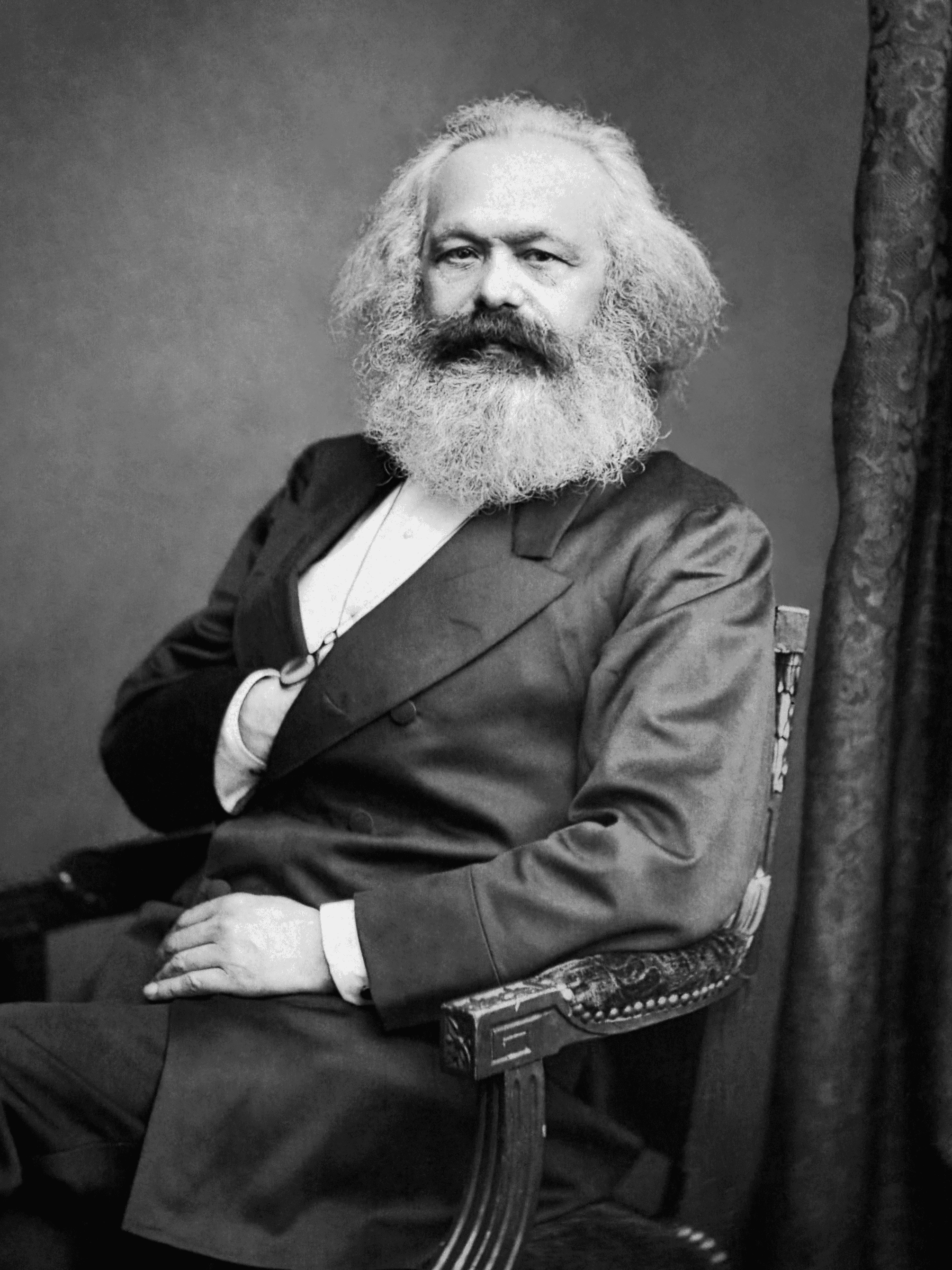
The Prussian authorities who expelled Karl Marx from his homeland could hardly have anticipated that the young philosopher from Trier would spend his final decades as a stateless exile in London, quietly dismantling the intellectual scaffolding of the Western world.
In the autumn of 1836, a young law student named Karl Marx arrived in Berlin, carrying with him a reputation for late-night brawling, romantic poetry, and a "weak chest" that had permanently excused him from Prussian military service. He had just spent a year at the University of Bonn, where he served as co-president of a drinking society called the Trier Tavern Club and fought a duel with a member of an aristocratic student corps. His father, Heinrich Marx—a prosperous, Enlightenment-educated lawyer who had converted his family from Judaism to Lutheranism to escape anti-Semitic Prussian professional restrictions—had forced the transfer to Berlin to rescue his son from a life of dissipation. In the intellectually charged atmosphere of the Prussian capital, however, the young Marx did not find quiet obedience. Instead, he found Georg Wilhelm Friedrich Hegel. Though Hegel had died five years prior, his grand, sweeping philosophy of history as a dialectical march of the human spirit dominated European intellectual life. Marx, soon abandoning his law books for philosophy, fell in with a circle of radical dissidents known as the Young Hegelians. They met in smoky taverns to debate how Hegel’s revolutionary method of analysis could be turned against the Prussian state’s own conservative institutions. It was the beginning of an intellectual journey that would dismantle the philosophical orthodoxy of Europe and reshape the modern world.
As a young man, Marx was a creature of fierce intensity and volatile temperament. In 1841, he secured his doctorate from the liberal University of Jena with a daring thesis comparing the natural philosophies of Democritus and Epicurus, aiming to demonstrate that theology had to yield to the superior wisdom of philosophy. Blocked from an academic career by a Prussian government increasingly hostile to radical thinkers, Marx turned to journalism. In Cologne, he became the editor of the Rheinische Zeitung, a radical newspaper where he began to hone his critiques of contemporary politics and develop a budding interest in economics. The work was a constant battle against state authority. Marx bitterly lamented that his newspaper had to be presented to the police "to be sniffed at," warning that if the official nose smelled anything "un-Christian or un-Prussian," the issue was suppressed. When the paper published a fierce denunciation of the Russian monarchy, Tsar Nicholas I personally requested its closure, and the Prussian government obligingly banned it in 1843.
Now a marked man and newly married to Jenny von Westphalen—a woman of the petty nobility who had broken off an aristocratic engagement to marry him—Marx chose exile. In Paris, and later in Brussels, his thought underwent a radical transformation. It was during this period of displacement that he met Friedrich Engels, a wealthy young German whose father owned textile mills in Manchester. Engels became Marx’s lifelong collaborator, financial savior, and intellectual alter ego. Together, they began to formulate a materialist conception of history. Where Hegel had argued that human history was driven by the clash of ideas, Marx and Engels asserted the opposite: that the material conditions of life—how humans produce and reproduce their existence—form the real foundation of society. Legal systems, political structures, religions, and philosophies were merely a superstructure built upon this economic base.
Connected to
12 links to entries not yet ingested in the Library.