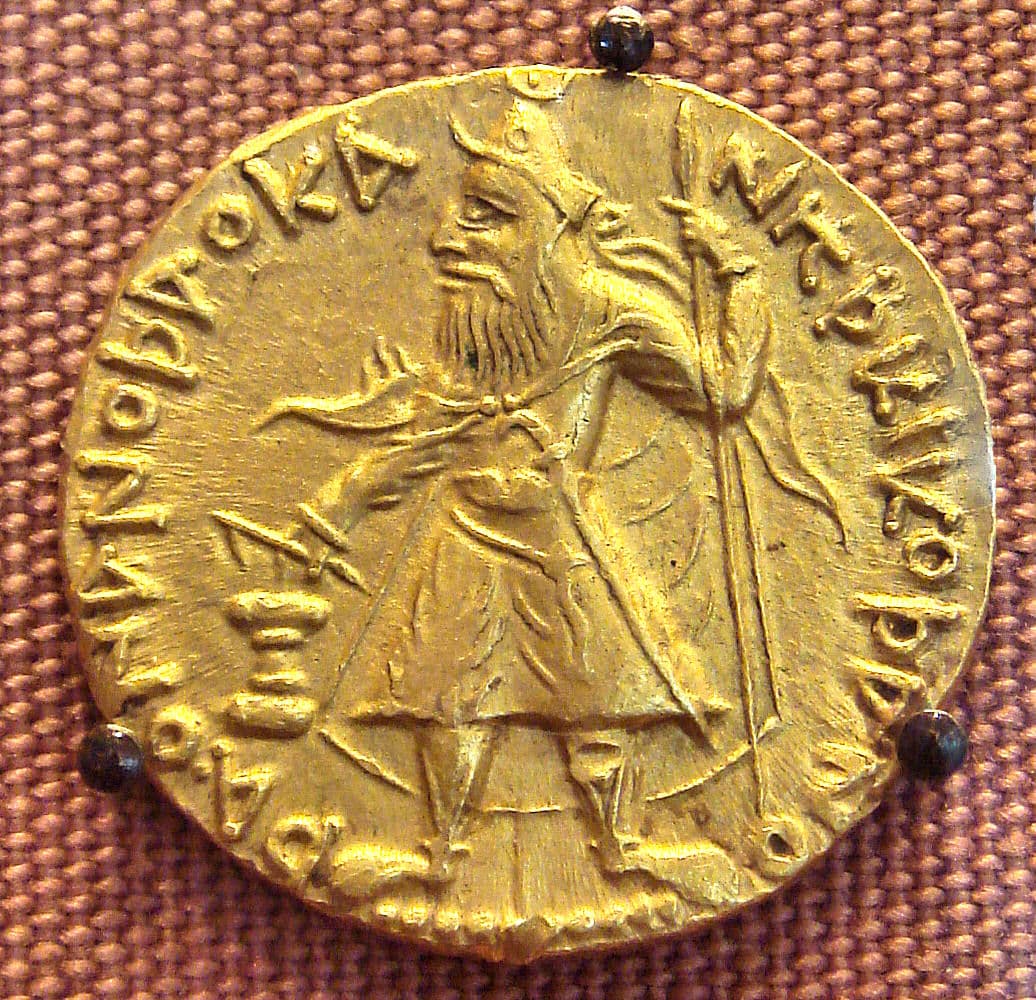
The Yuezhi emperor Kanishka I ruled an empire that stretched from the windswept tracks of Central Asia and Gandhara all the way to Pataliputra on the Gangetic plain, marking the absolute zenith of Kushan power.
On the face of a small gold coin, minted in the early second century of the Common Era, a bearded man stands in profile. He wears a heavy, stiff coat that falls to his knees, tucked into trousers gathered tightly at the ankles, and large, rounded boots suited for the freezing winds of the Central Asian steppes. From his shoulders, stylized flames flicker upward—a visual claim to divine right. He holds a long spear in one hand, a sword girt to his waist, and with his other hand, he reaches over a small altar, letting a sacrifice fall into the flames. To a Roman merchant trading along the maritime routes of the western coast, or to a Chinese envoy traveling the perilous oases of the Tarim Basin, this figure was instantly recognizable. He was Kanishka, the Great King, the King of Kings, under whose hand the Kushan Empire rose to its brilliant, syncretic zenith.
For centuries, the origin of Kanishka and his dynasty was shrouded in the shifting sands of imperial genealogies and disputed calendars. Early European scholars, attempting to pin his reign to the established coordinate points of Indian history, believed he ascended the throne in 78 CE, linking his coronation to the inception of the Saka calendar era. Modern consensus, however, corrected by the discovery of the Rabatak inscription, places his accession much later, around 127 CE. This inscription, a remarkable ancestral declaration, settled a long-standing debate over his lineage, mapping a direct line of succession: Kanishka’s great-grandfather was Kujula Kadphises, the founder of the Kushan state; his grandfather was Vima Taktu; and his father was Vima Kadphises. Kanishka belonged to the Yuezhi, a confederation of nomadic pastoralists who had been driven from the frontiers of China generations earlier. Their migration set off a domino effect across Central Asia, ultimately dismantling Hellenistic remnants in Bactria and pushing into the fertile plains of northern India.
From his capital at Purushapura, modern-day Peshawar, located near the eastern entrance of the Khyber Pass, Kanishka governed a geographical colossus. His empire linked worlds that had long been separated by formidable mountain barriers. It stretched from the fertile banks of the Oxus River in modern southern Uzbekistan and Tajikistan, across the rugged passes of the Karakoram and Hindu Kush, and down through Kashmir into the heart of the Gangetic plain, reaching as far as Mathura and Pataliputra. To administer this diverse realm, Kanishka made a momentous administrative pivot. Around 127 CE, he replaced Greek—which had persisted as the language of the bureaucracy since the conquests of Alexander the Great—with Bactrian, the eastern Iranian tongue spoken by the Kushan elite. Yet, even as he elevated his native administrative language, he retained the Greek script to write it, introducing a single modified character to represent the "sh" sound in his own name.
+ 10 further connections to entries not yet ingested
This linguistic transition is captured beautifully on Kanishka’s extensive coinage, which acts as a metal archive of a shifting imperial identity. The earliest coins of his reign utilize the Greek language and script, declaring him Basileus Basileon Kaneshkou—King of Kings, Kanishka—and featuring Hellenic deities such as Helios, Selene, and Hephaistos. These early inscriptions, however, are rife with spelling and syntactical errors, suggesting a bureaucracy operating in a language it was rapidly forgetting. Soon, the Greek pantheon vanished from the mints, replaced by an astonishing assembly of Iranian, Indic, and even Sumero-Elamite divinities. On the reverses of these coins, one finds the Zoroastrian fire-god Atar, the wind-god Vata, the lunar deity Mah, the victorious Verethragna, and Mithra in his various guises. Alongside them stood Nana, a pan-Asiatic goddess associated with Anahita, and Oesho, a multifaceted divinity representing the wind-god Vayu conflated with the Hindu god Shiva.
Though Kanishka’s personal faith remained deeply rooted in this ecumenical, largely Iranian-Indic pantheon, his historical legacy is inextricably bound to the destiny of Buddhism. According to Buddhist tradition, Kanishka was a patron of transcendent importance, comparable to the Maurya emperor Ashoka. While historians debate whether he ever formally converted to the faith, there is no doubt that his political patronage transformed it. He summoned the Fourth Buddhist Council in Kashmir, presided over by the venerable scholars Vasumitra and Ashwaghosha. At this assembly, three monumental commentaries on the Buddhist Canon were composed, one for each of the "three baskets" of the tradition. Kanishka reportedly had these treatises engraved on copper plates, secured them in stone boxes, and buried them beneath a memorial mound. Though the original plates are lost, the intellectual shift they represented survived through Chinese translations. The council marked a transition toward the use of Sanskrit as a major vehicle for Buddhist scholarship, a linguistic shift that altered the intellectual life of the subcontinent.
Under Kanishka’s stewardship, the visual language of Buddhism underwent a radical evolution. It was during his reign that the first anthropomorphic representations of the Buddha appeared, structured around the thirty-two physical marks of a great man. Kanishka patronized two distinct and brilliant schools of art: the Gandhara school, heavily influenced by Hellenistic naturalism, and the Mathura school, rooted in indigenous Indian artistic traditions. His coins offer some of the earliest dated depictions of the Buddha in human form. These rare issues—constituting less than one percent of his surviving coinage—depict the standing Buddha in a heavy monastic robe covering both shoulders, a hallmark of the Gandharan style. Other copper coins depict the historical Shakyamuni Buddha with his right hand in the fear-dispelling abhaya mudra, or the future Buddha, the Bodhisattva Maitreya, seated cross-legged upon a columned throne, holding a water pot.
Nowhere was Kanishka’s devotion to Buddhist architecture more visible than in his stupa at Purushapura. Rediscovered by archaeologists in the early twentieth century, the base of this colossal monument measured eighty-seven meters in diameter. According to the accounts of Chinese pilgrims who journeyed to the region centuries later, the stupa rose hundreds of feet into the air, clad in timber and iron, crowned with gilded umbrellas, and shimmering with jewels. It was a physical anchor for the faith, visible for miles across the Peshawar valley, demonstrating the wealth and piety of the Kushan state.
This patronage of Buddhism had geopolitical consequences that reverberated across the Eurasian landmass. By securing the trade routes of the Silk Road and pacifying the mountain corridors of the Pamirs and the Karakorams, Kanishka facilitated the safe passage of merchants, pilgrims, and monastics. It was along these secure arteries that Mahayana Buddhism traveled from the monasteries of Gandhara into the Tarim Basin and, eventually, into Han Dynasty China.
Yet, this vast, wealthy empire was constantly forced to defend its borders. To the west, Kanishka’s forces reportedly clashed with and repelled an invasion by the Parthian Empire. To the northeast, the Kushans confronted the westward expansion of China's Han Dynasty. Chinese records chronicle a massive military expedition of seventy thousand Kushan soldiers, led by a viceroy named Xie, who marched across the Pamir Mountains around 90 CE to confront the Han general Ban Chao near Khotan. Though that particular expedition ended in a Kushan retreat due to Ban Chao’s scorched-earth tactics, several of Kanishka's coins have been found within the Tarim Basin, testifying to the enduring commercial and political pressure the Kushans exerted on the region.
Kanishka’s reign ultimately acted as a grand crucible. By uniting the nomadic energy of the steppes with the administrative traditions of the Hellenistic world, the religious fervor of India, and the cosmological systems of Persia, his empire became the ultimate intermediary of the ancient world. When Kanishka's reign ended around 144 CE, he left behind an empire at its geopolitical and cultural zenith. The migrations of the Central Asian nomads had not merely disrupted old empires; under Kanishka, they had built a bridge between East and West, fostering a globalized ancient economy and permanently reshaping the spiritual landscape of Asia.