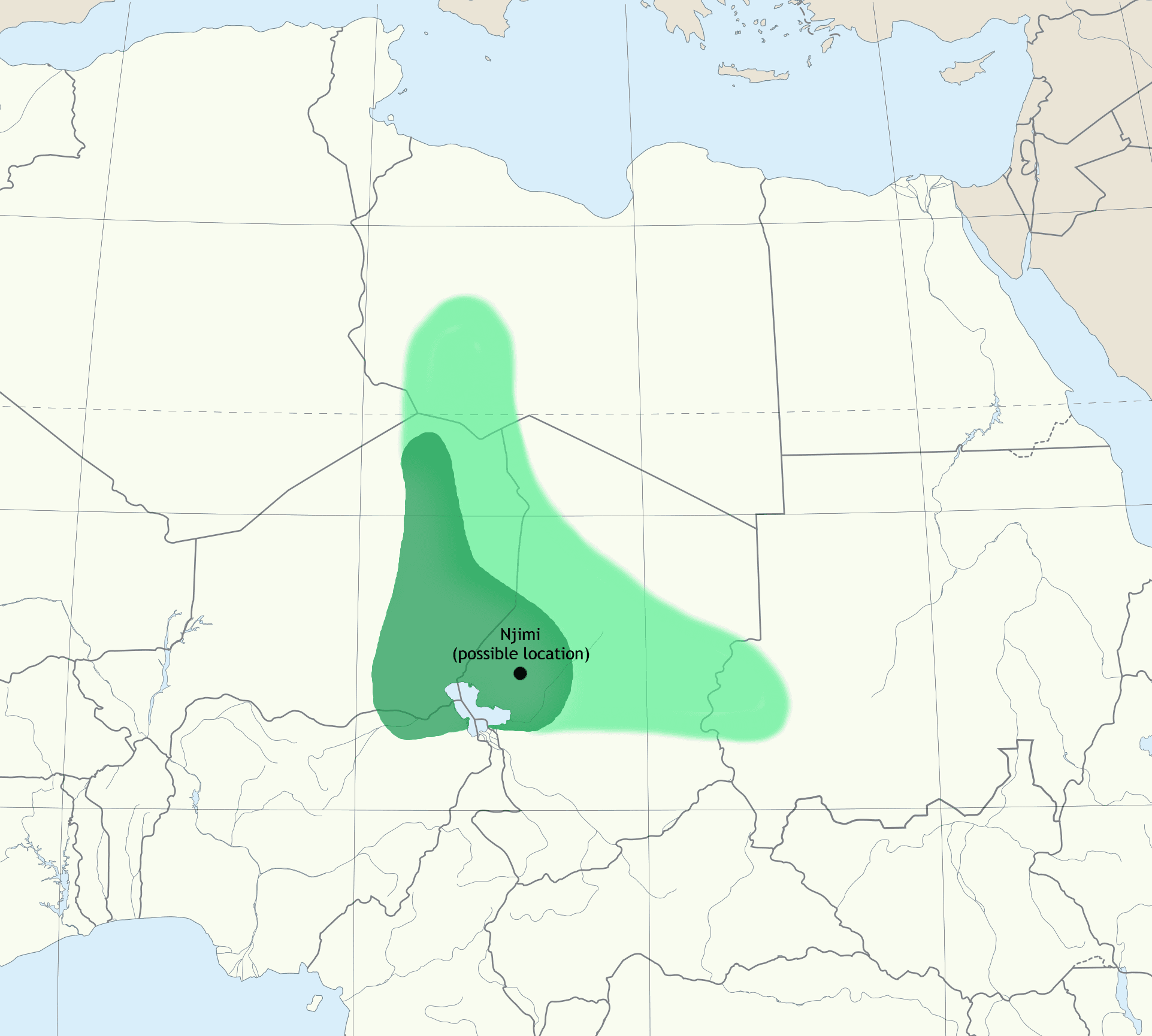
For eight centuries, the political and economic life of Central Africa revolved around the shifting waters of Lake Chad.
For more than a thousand years, a state existed in the fluctuating basin of Lake Chad that defied the classical lifespans of global empires. Known to modern history as Kanem-Bornu, it was not a single, static entity, but a resilient political chameleon that twice shifted its geographic heart, outlived the dynasties of Europe’s Middle Ages, and survived deep into the era of industrial colonialism. Its rulers, who bore the title of mai, governed a shifting mosaic of desert, savannah, and wetland that stretched at various times across parts of what are now Nigeria, Niger, Cameroon, Chad, Libya, Algeria, and Sudan. At the center of this immense domain sat Lake Chad—not merely a source of water, but a liquid crossroads where the ecological zones of Africa met, and where the wealth of the Mediterranean collided with the resources of the forest south.
The origins of this state lie in a period when the camel first became common in the inner Chad Basin, around the fifth century CE. Though human settlement and iron-smelting in the region date back to the first millennium BCE, the introduction of the camel from North Africa or the Nile Valley acted as a catalyst. It unlocked the vast, hostile expanse of the Sahara, transforming the desert from an impassable barrier into a network of commercial highways. By the eighth century, pastoralists from the Ennedi Plateau, primarily of the Zaghawa ethnic group, began coalescing with agriculturalists and ironworkers to form a stratified society northeast of Lake Chad. This early state, known as Kanem, was ruled by the Duguwa dynasty from a capital called Njimi. For centuries, European scholars searched in vain for the ruins of Njimi; it is highly probable that the city was constructed of impermanent materials, and early Arabic geographers described the capital as a "city of tents," reflecting the nomadic, pastoral heritage of its founders.
The early Duguwa rulers built their power on a simple, brutal economic engine: the raiding of neighboring stateless populations and the export of these captives northward in exchange for horses. This trade was managed through the girgam, the empire’s royal chronicle. Though preserved orally for centuries before being transcribed by European scholars in the mid-nineteenth century, the girgam outlines a remarkably consistent line of rulers, beginning with the semi-mythical first ruler, Susam, and the dynasty’s namesake, Duku.
This early aristocratic order was shattered in the eleventh century by the arrival of a new ideological force. Islam had lingered on the northern fringes of the Chad Basin since the Umayyad raids of the seventh and eighth centuries, likely carried southward by Toubou pastoralists and trans-Saharan merchants. Early Duguwa resisted the new faith, wary of its egalitarian doctrine that threatened the traditional, semi-divine authority of the ruler. However, by the eleventh century, conversion became politically and economically irresistible. After the reign of the first Muslim ruler, the eleventh-century Hu—who may have been a woman—a dynastic revolution occurred. Around 1085 CE, Hummay overthrew the old order and established the Sayfawa dynasty. To legitimize their rule within the wider Islamic world, the Sayfawa claimed descent from the legendary Yemeni hero Sayf ibn Dī Yazan, a genealogical fiction common among medieval African Islamic states seeking prestige.
2 links to entries not yet ingested in the Library.
Under the Sayfawa, Islam became the state apparatus. Yet, the conversion of the court did not lead to the total Islamization of the populace. The mais recognized a profound economic paradox: Islamic law forbade the enslavement of fellow Muslims. To force the conversion of all their subjects and neighbors would be to dry up the very wellspring of their wealth. Thus, the empire maintained a delicate balance, preserving a large pagan periphery that could be legally raided to feed the insatiable slave markets of North Africa and the Middle East, while the urban elites and merchant classes embraced the literacy, jurisprudence, and international connections of the Islamic world.
The empire reached its first great golden age in the thirteenth century under mai Dunama II Dibalemi. Dunama II projected Kanem's military might deep into the desert, seizing control of the vital trade routes northward to the Fezzan. Kanem was no longer just a middleman; it was an economic colossus. The empire exported ivory, animal products, and captives, but its most lucrative commodity was salt. Drawing from the rich saline deposits of the Sahara, the empire established a virtual monopoly, distributing salt across a vast, salt-starved West African interior.
This golden age, however, carried the seeds of its own collapse. The very wealth that enriched the center provoked bitter rivalries. By the fourteenth century, internal dynastic disputes coincided with a devastating conflict with the Bilala people from the east. Faced with military defeat and economic exhaustion, mai Umar I Idrismi made a radical decision: he abandoned the ancient homeland of Kanem.
In the late fourteenth century, the court packed up its administrative apparatus and migrated west of Lake Chad to the region of Bornu, in modern-day Nigeria. Previously a tributary state of the empire, Bornu now became its core. This migration initiated a century of profound political instability, characterized by civil war and nomadic incursions, as the displaced Sayfawa elite struggled to assert control over their new home. The stabilization of this new western empire was finally achieved by mai Ali I Gaji in the late fifteenth century. Ali I Gaji brought an end to the internal anarchy and established a magnificent, permanent brick capital at Ngazargamu. Under his leadership and that of his successor, mai Idris III Katagarmabe—who temporarily recaptured the old capital of Njimi—the state transformed. It was no longer the Empire of Kanem; it had become the Bornu Empire, a highly centralized, bureaucratic state.
The apogee of this second imperial incarnation arrived in the late sixteenth century with the reign of mai Idris IV Alooma. A brilliant military reformer and diplomat, Alooma imported Ottoman firearms and Turkish military advisers, training a highly disciplined musketeer corps that terrorized Bornu’s neighbors. He reformed the legal system, replacing traditional customary law with strict Islamic jurisprudence, and built brick mosques throughout his territories to cement the Islamic character of the state. Under Alooma, Bornu was not merely a regional power; it was a recognized peer of the Ottoman Empire and the Moroccan Sultanate.
Yet, the heights of the sixteenth century could not be sustained. By the seventeenth and eighteenth centuries, the global environment was shifting. The trans-Saharan trade routes, which had sustained the empire for nearly a millennium, began to lose their monopoly as European maritime trade on the West African coast offered alternative commercial outlets. Simultaneously, severe environmental fluctuations and prolonged droughts weakened the agricultural base of the Chad Basin.
By the early nineteenth century, the empire was on the verge of total collapse. The rise of the Fula jihads, led by Usman dan Fodio, swept across West Africa, culminating in the establishment of the rival Sokoto Caliphate to the west. Bornu's capital of Ngazargamu was sacked, and the ancient Sayfawa dynasty, weakened by centuries of rule, proved incapable of defending the realm. In their desperation, they turned to a charismatic Islamic scholar and military commander named Muhammad al-Amin al-Kanemi. Al-Kanemi successfully repelled the Fula forces, but in doing so, he became the de facto ruler of the state. For decades, the Sayfawa mais remained as mere figureheads until 1846, when the last Sayfawa ruler was executed, bringing an end to one of the longest-lived dynasties in human history.
Al-Kanemi's descendants, ruling with the title of shehu (sheikh), governed a diminished and fragile state. The end came swiftly and violently in 1893, when the Sudanese warlord Rabih az-Zubayr invaded the region, destroying the old institutions and establishing a brutal, short-lived military regime. The resulting chaos left the region vulnerable to European imperial expansion. Although the French and British restored the al-Kanemi dynasty to nominal power in 1900, it was a restoration in name only. By 1902, the ancient territories of Kanem-Bornu were partitioned and absorbed into the colonial empires of Britain, France, and Germany.
Today, the physical monuments of Kanem-Bornu are largely gone, reclaimed by the sands of the Sahel and the shifting marshes of Lake Chad. Yet, its legacy remains deeply woven into the modern fabric of Central and West Africa. The Kanuri language, which became the lingua franca of the empire, is still spoken by millions, and the traditional Dikwa and Borno emirates in northeastern Nigeria survive as non-sovereign cultural institutions, still led by descendants of the al-Kanemi line. For over a thousand years, Kanem-Bornu served as the vital connective tissue between the Mediterranean world and the African interior, proving that empires of immense longevity and sophistication could thrive in the challenging environments of the Sahel.