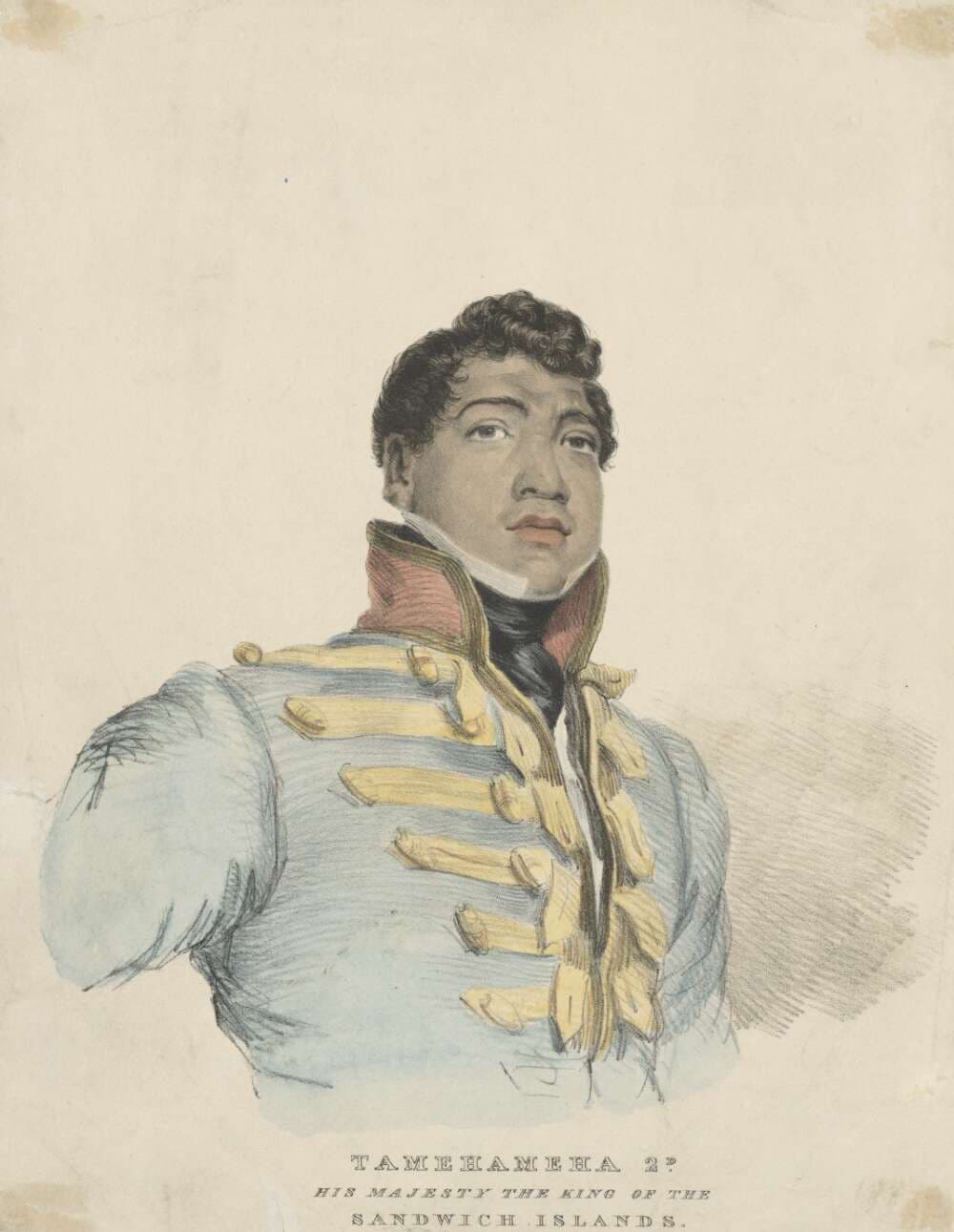
When the young prince Liholiho sailed into the Hawaiian capital of Kailua-Kona in May 1819 to claim his deceased father’s throne, he was met on the shore by his formidable stepmother, Queen Kaʻahumanu.
In May 1819, a young chief named Liholiho sailed toward the black volcanic sands of Kailua-Kona, prepared to claim the absolute, sacred authority of his late father, the great unifier Kamehameha I. Instead, he was met on the shore by his father’s most formidable widow, Queen Kaʻahumanu. She did not kneel. Draped in the late king’s royal red feather cape, she looked at the young heir and announced to the assembled crowd: "We two shall rule the land." Liholiho, twenty-one years old and untested, was forced to accept a compromise that stripped him of his absolute inheritance. While he took the title Kamehameha II, the administrative machinery of the kingdom passed to Kaʻahumanu, who established herself as the first Kuhina Nui, or co-regent. Though he preferred the name ʻIolani—the "royal hawk" whose high flight hovered above all earthly things—the young king would spend his brief, turbulent five-year reign caught between the ancient obligations of his ancestors and the swift, overwhelming currents of the modern world.
Six months after his awkward ascension, Liholiho shattered the cornerstone of the Hawaiian universe. In November 1819, during a public feast, he sat down with his mother, the sacred queen Keōpuolani, and the co-regent Kaʻahumanu, and ate a meal with them. This simple act of dining together was a revolutionary transgression. Under the ancient, highly structured kapu system of religious laws, men and women were strictly forbidden from eating together (ʻai kapu), a taboo whose violation was believed to invite the wrath of the gods. By deliberately initiating the ʻAi Noa (free eating), Liholiho signaled the formal dismantling of the traditional religious order. The social class of priests was disbanded, temples (heiau) were abandoned, and the wooden images of the ancient gods were cast down and burned.
This spiritual vacuum did not go uncontested. Kamehameha I had bequeathed his fearsome war god, Kūkaʻilimoku, and its temples to Liholiho’s cousin, Kekuaokalani. Rising in rebellion, Kekuaokalani demanded that the young king withdraw his edicts, restore the priesthood, and dismiss his reformist advisors. Liholiho refused. The two factions met at the Battle of Kuamoʻo on the island of Hawaiʻi, where the king’s forces—better armed with Western muskets and led by the prime minister Kalanimōkū—crushed the defenders of the old gods. The ancient Hawaiian religion was dead by royal decree, its temples in ashes, leaving the islands spiritually vacant just months before the first American Christian missionaries arrived on the shores of the archipelago. Liholiho himself, however, proved a reluctant convert to the new faith. Despite his destruction of the old gods, he refused to officially embrace Christianity, steadfastly rejecting the missionaries' demands that he give up his love of alcohol and four of his five wives. He remained the last Hawaiian monarch to practice polygamy, keeping his beloved sister, Kamāmalu, as his favorite queen.
+ 12 further connections to entries not yet ingested
Liholiho’s style of rule was defined by a restless, impulsive energy. In November 1820, captivated by Western luxury, he purchased the extravagant American yacht Cleopatra’s Barge for an astronomical sum: over a million pounds of valuable sandalwood, valued at roughly $80,000 at the time—a ship that had sold in Massachusetts just years prior for a fraction of that price. He renamed the opulent vessel Haʻaheo o Hawaiʻi ("Pride of Hawaii") and used it to host lavish, alcohol-fueled entertainments for foreign merchants and visiting captains. One merchant wryly noted that while all religious sects were tolerated on the islands, "the King worships the Barge." His impulsiveness could border on the reckless. In the summer of 1821, while aboard a small, open boat off Oʻahu with thirty men and a few high chiefs, he suddenly ordered the crew to cross the treacherous, wind-swept channel to the island of Kauaʻi. They possessed no compass, no charts, and no provisions. Against all odds, they survived the crossing. When they arrived, the local chief, Kaumualiʻi, chose hospitality over hostility, welcoming the unarmed king. Liholiho spent a month enjoying his vassal's hospitality, only to abruptly kidnap Kaumualiʻi one evening under cover of darkness, force him into an exile marriage with Kaʻahumanu, and hold him under house arrest in Honolulu until his death.
As foreign influence mounted, Liholiho sought to secure his kingdom’s sovereignty by forging a direct, personal alliance with the British Empire. In 1822, the British monarch George IV had gifted him a six-gun schooner, the Prince Regent. Determined to thank the British king in person and negotiate a formal protectorate, Liholiho resolved to sail for London, ignoring the frantic pleas of his advisors and his mother. Following her death in late 1823, he chartered the British whaling ship L'Aigle under Captain Valentine Starbuck. Accompanied by Queen Kamāmalu, several high chiefs, and a French translator named Jean Baptiste Rives, the royal delegation departed Honolulu.
Their journey was a grand, globetrotting odyssey that captured the imagination of the societies they encountered. During a stopover in Rio de Janeiro, the newly minted Emperor Pedro I of Brazil received the Hawaiian monarch with high state honors, presenting Liholiho with a diamond-encrusted sword in a golden sheath; in return, Liholiho presented the emperor with a priceless, sacred ʻahu ʻula (a traditional feather cloak of Hawaiian high royalty). When L'Aigle dropped anchor in Portsmouth in May 1824, the British public and press reacted with a mixture of intense curiosity and patronizing amusement. The papers struggled to spell the king's name, settled on "Rheo Rhio," and joked about the "Sandwich Islands." Yet the towering, elegant presence of Queen Kamāmalu—who stood over six feet tall—and the dignified bearing of the Hawaiian court quickly charmed London high society. Handled by Frederick Gerald Byng, a dandyish gentleman usher appointed by the Foreign Office, the royal party toured Westminster Abbey, attended the opera at Covent Garden, and had their portraits painted by the fashionable Hayter family.
But the grand tour ended in sudden tragedy. Having never been exposed to the pathogens of the wider world, the Hawaiian delegation possessed no immunity to common European childhood diseases. Following a visit to the Royal Military Asylum in early June, the entire court fell ill with measles. Queen Kamāmalu succumbed first, dying on July 8, 1824. Broken-hearted and burning with fever, Liholiho died six days later on July 14, at just twenty-six years of age, before he could ever meet King George IV.
The bodies of the young king and queen were placed in lead coffins and returned to their islands aboard the massive British frigate HMS Blonde, commanded by Captain George Anson Byron. When the ship arrived in Honolulu in May 1825, a grieving nation received their dead rulers with a hybrid ceremony that mirrored the fractured, changing identity of Hawaii itself: British marines marched in formal funeral procession, an Anglican chaplain read prayers, and an American missionary preached in the Hawaiian tongue. Liholiho was laid to rest in a coral-stone tomb on the grounds of what would become ʻIolani Palace, succeeded by his younger brother, Kauikeaouli. By breaking the ancient kapu and dismantling the old gods, Kamehameha II had cleared the path for a new, Westernized Hawaii, but in doing so, he had exposed his kingdom—and his own body—to the fatal embrace of the outside world.