Place · Indus Valley Civilization
Kalibangan
- Also known as
- Kalibanganas
- Калибанган
- Калібанган
- קליבנגאן
- كاليبانجان
- كاليبانغان
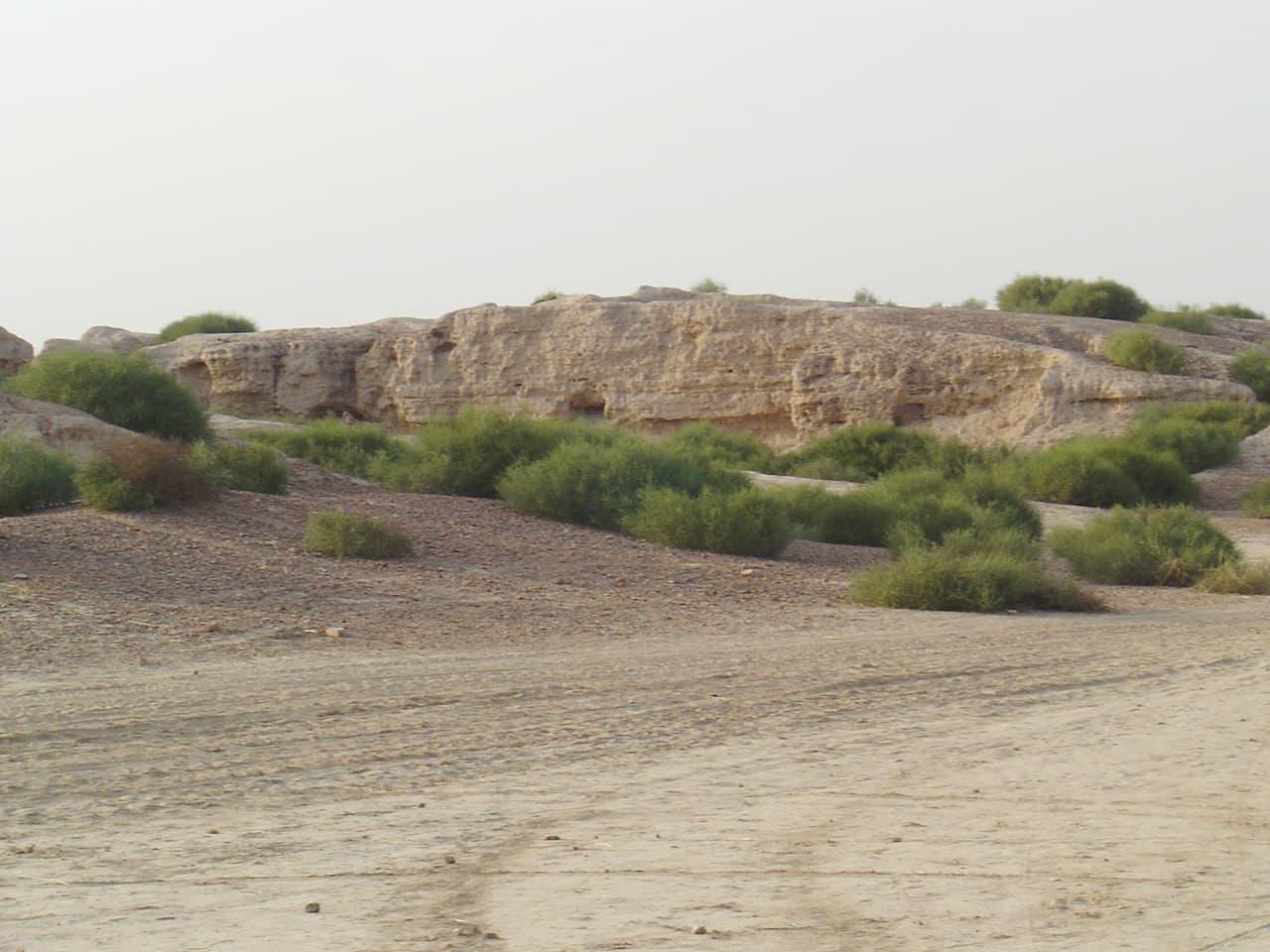
Long before the formal recognition of the Indus Valley Civilization, an Italian Indologist named Luigi Tessitori wandered the dry southern banks of the Ghaggar River in Rajasthan and realized he was standing on something ancient beyond measure.
For thousands of years, the dry, wind-swept plains of northern Rajasthan guarded a secret buried beneath two unremarkable clay mounds. Located on the southern bank of the seasonal Ghaggar River—in a triangle of land where the ancient, vanished waters of the Drishadvati and Sarasvati once met—the site known as Kalibangan looked to the casual observer like nothing more than a pair of barren hills rising from the desert. It was here, in the early twentieth century, that an Italian Indologist named Luigi Tessitori noticed something extraordinary. Tessitori was not an archaeologist; he was a scholar of ancient Indian texts, but the strange, weathered fragments of pottery and masonry scattering the earth caught his attention. He reached out to John Marshall, then Director of the Archaeological Survey of India, who was busy excavating a site called Harappa hundreds of miles away. Tessitori insisted these northern Rajasthani ruins were prehistoric and pre-Mauryan. He died in 1919, five years before the world formally recognized the existence of the Indus Valley Civilization, never knowing that his desert mounds were once a thriving, highly structured provincial capital of one of the ancient world’s greatest empires.
The true awakening of Kalibangan occurred after the partition of British India in 1947. With the major urban centers of Harappa and Mohenjodaro suddenly falling within the borders of Pakistan, Indian archaeologists felt a sudden, urgent pressure to locate and understand the remnants of the Indus Valley Civilization remaining on their side of the border. It was Amlānand Ghosh who first identified the Rajasthan mounds as Harappan, paving the way for a massive, nine-year excavation campaign beginning in 1960. Led by Braj Lal and a dedicated team including Bal Thapar, M.D. Khare, K.M. Shrivastava, and S.P. Jain, the diggers peeled back the earth over an area of a quarter-square kilometer. What they uncovered was not a single, static ruin, but a complex, two-tiered sequence of human history. The lower level, labeled Kalibangan I, belonged to an older, proto-Harappan culture, while the upper layer, Kalibangan II, represented the classic, highly planned metropolis of the mature Indus Valley Civilization.
Beneath the orderly grid of the later Harappan city lay the evidence of a pioneering agricultural community dating back to approximately 2900 BCE. Outside the walls of this early settlement, archaeologists made an astonishing discovery: the earliest ploughed agricultural field ever revealed anywhere in the world. Preserved beneath layers of sediment, the field bore a distinct grid pattern of furrows. One set of shallow grooves ran east-to-west, spaced about thirty centimeters apart, while another set ran north-to-south, spaced much wider at one hundred and ninety centimeters. This layout was not merely an ancient curiosity; it was a highly sophisticated agricultural strategy. Even today, modern farmers in this very region of Rajasthan use an identical grid to plant two crops simultaneously in the same field, typically sowing mustard in the wide furrows and gram in the narrow ones. To safeguard this fragile monument of human ingenuity, the team refilled the excavated field after documenting it, marking its boundaries with concrete pillar posts.
The early inhabitants of Kalibangan were also remarkable potters, creating a ceramic tradition so distinct that archaeologists used it to establish a definitive datum line for pottery styles across the Indian subcontinent, known as the "six fabrics of Kalibangan." These vessels, cataloged from Fabric A to F, ranged from coarse, wheel-thrown redwares decorated with delicate black and white painted lines of trees, flowers, and insects, to the highly polished, violet-tinged vessels of Fabric C, which represent the pinnacle of early Harappan ceramic art. These people lived in a fortified town built of small, uniform mud bricks. They used wheeled toy carts—suggesting a reliance on wheeled transport for trade—and manufactured delicate tools from chalcedony and agate, alongside copper axes and ornaments of steatite, carnelian, and shell.
This early era of Kalibangan came to a sudden, violent end. Around 2600 BCE, a powerful earthquake tore through the region, leaving behind dramatic structural fissures in the archaeological record—the earliest recorded earthquake in human history. The shockwaves devastated the settlement, forcing the inhabitants to temporarily abandon the site. Yet, the strategic value of the river confluence was too great to ignore. Within a short period, a new population reclaimed the ruins, clearing away the debris to build a grand, planned metropolis that would serve as a major provincial capital of the mature Harappan culture.
This new city was a masterpiece of civil engineering. Like its sister cities of Mohenjodaro and Harappa, Kalibangan was divided into two distinct fortified zones: a smaller, elevated "citadel" on the west and a sprawling "lower town" to the east. The lower town was laid out in a rigorous, grid-iron pattern governed by streets oriented precisely to the cardinal directions. The mathematical precision of this urban planning was unmatched in contemporary West Asia. The streets were built in strict proportion to one another; if a minor lane measured a single unit of width, the main roads were twice or thrice as wide, ranging from 1.8 meters for alleys to 7.2 meters for major thoroughfares. At street corners, the Harappans installed fender posts to protect the corners of mud-brick buildings from the wooden axles of passing carts. Underneath these streets lay a coordinated sanitation system where household drains emptied directly into deep soakage jars.
The social and spiritual life of mature Kalibangan, however, departed from the patterns seen in other major Harappan hubs. Most notably, excavations yielded no evidence of the mother goddess figurines that are so ubiquitous elsewhere in the Indus Valley. Instead, the spiritual life of Kalibangan centered on fire. Across the site, archaeologists discovered unique, clay-lined fire altars. In the southern half of the citadel, atop massive mud-brick platforms accessed by brick staircases, stood rows of oval fire-pits. At the center of each pit was a cylindrical clay or brick sacrificial post, surrounded by charcoal and flat, triangular terracotta pieces known as "sacrificial cakes."
These fire altars were not restricted to a priestly elite. They were discovered in three distinct contexts: as public altars on the high platforms of the citadel, as household shrines within the private courtyards of the lower town, and in a separate, isolated third complex located about eighty meters east of the city, which seemed to serve exclusively as a communal ritual site. Near these altars lay wells and the remains of bathing areas, suggesting that ritual purification and ceremonial washing were central to the community's worship. In several of these pits, archaeologists found the charred remains of animal bones, pointing to the practice of animal sacrifice.
For centuries, Kalibangan flourished as a vital hub of trade, administration, and agriculture, bridging the gap between the fertile plains of the Indus and the resource-rich lands of Rajasthan. When its excavation report was finally published in its entirety by the Archaeological Survey of India in 2003—three decades after the last trenches were filled—it confirmed the site's status as a cornerstone of South Asian prehistory. Long after the rivers that fed its fields dried up and the desert sands reclaimed its streets, Kalibangan remains a testament to the resilient, deeply organized beginnings of urban civilization on the subcontinent, where humanity first carved a living out of the dry earth with a wooden plough, and looked to the hearth-fire to understand the cosmos.
Connected to
4 links to entries not yet ingested in the Library.