Person · Mesoamerican Civilizations
K'inich Yax K'uk' Mo'
- Also known as
- Kinich Kukmo
- Kinich Kukmó
- Kʼinich Yax Kʼukʼ Moʼ
- Radiante Primeiro Quetzal-Tartaruga
- Yax Kuk Mo
- К'ініч-Яш-К'ук'-Мо
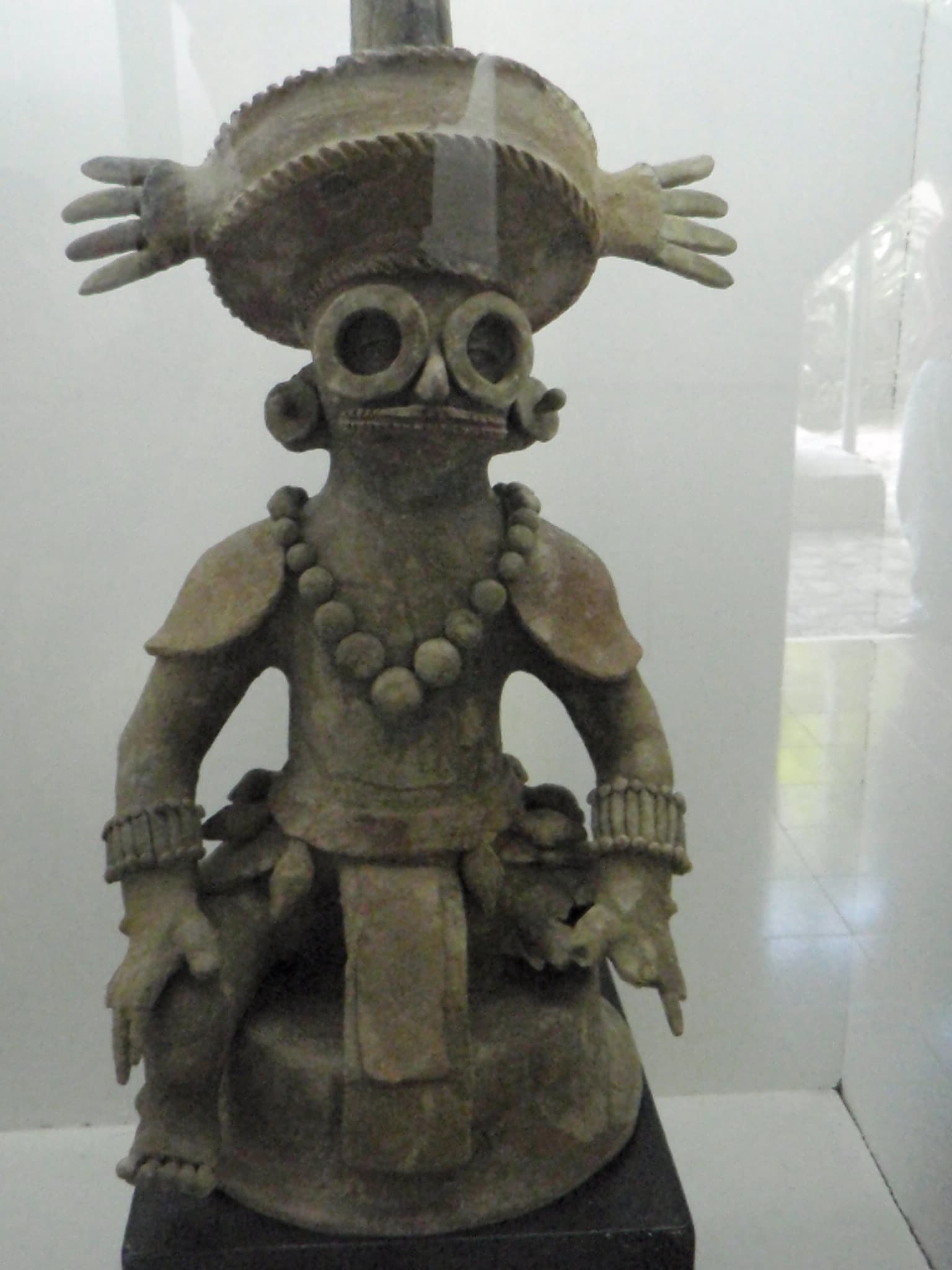
The battered skeleton resting in the Hunal tomb beneath the Copán acropolis tells a story of physical violence and political mythmaking.
Under the soaring stone canopy of Temple 16, deep within the humid Acropolis of Copán, lies a skeleton that tells two entirely different stories of the ancient Maya world. Physically, the bones are those of a battered veteran. The sternum is fractured, the shoulder heavily damaged, and the arm bears the unmistakable, healed breaks of a life spent in violent collision—injuries most likely sustained in the brutal, high-stakes ritual ball games that defined Mesoamerican elite life. But iconographically, this same man was rendered by his descendants as something akin to a god-emperor from a distant metropolis. In the stone reliefs of Copán, a city nestled in the southeastern lowlands of modern Honduras, he wears the strange, goggle-eyed headdress of Tlaloc, the central Mexican rain deity associated with Teotihuacan, a colossal city located over a thousand kilometers to the northwest. This is K’inich Yax K’uk’ Mo’, whose name translates to "Great Sun, Quetzal Macaw the First." He was the k’ul ajaw—the holy lord—who founded a dynasty in 426 CE that would rule Copán for nearly four centuries, serving as the bridge between local southern dynasties and the overwhelming, prestigious cultural shadow of central Mexico.
For decades, the prevailing narrative of Copán’s origins was one of imperial conquest from afar. The sheer weight of Teotihuacano imagery surrounding K’inich Yax K’uk’ Mo’ suggested that he was a foreign conqueror, an elite emissary, or a military commander sent directly from the colossal avenues of Teotihuacan to establish an outpost on the Maya frontier. His classic depictions on Copán's monuments, most famously on the sides of the four-sided stone block known as Altar Q, show him handing the scepter of office directly to his sixteenth successor, his eyes shielded by the foreign central Mexican goggles. This narrative of a northern invader fit cleanly into the broader geopolitics of the late fourth and early fifth centuries, a period when Teotihuacan’s influence rippled across the Maya lowlands, installing puppet rulers and new dynasties from Tikal to the highlands. Yet, when archaeologists finally breached the Hunal tomb beneath Temple 16 in 2000 and subjected the founder’s teeth to strontium isotope analysis, the chemistry of his enamel told a far more localized, nuanced story.
The isotopic signature of a person's teeth acts as a geological diary of their childhood, capturing the unique chemical makeup of the water and soil from where they grew up. The teeth of the man buried in the Hunal tomb did not contain the isotopic signature of the volcanic central Mexican valley. Instead, they revealed that K’inich Yax K’uk’ Mo’ spent his formative years much closer to home, in the Petén Basin region near the great Maya metropolis of Tikal, before moving to an area between Tikal and Copán. Epigraphic research published in 2022 added another layer to this regional journey, demonstrating that his lineage was actually an offshoot of the Maya dynasty at Caracol, located in modern Belize. He was not a central Mexican stranger in a strange land, but a product of the Maya heartland.
This revelation shifts our understanding of how power and legitimacy operated in the Classic Maya world. Rather than a literal conqueror from the north, K’inich Yax K’uk’ Mo’ represents a profound act of political theater and cultural synthesis. To rule Copán, a vital geopolitical node on the Motagua River trade route, he needed more than local pedigree; he needed the supreme prestige of Teotihuacan, the grandest metropolis of the era. His adoption of the goggle-eyed Tlaloc headdress, his central Mexican war regalia, and the foreign artistic motifs were deliberate choices, designed to align his new dynasty with the most powerful ideological brand of his day. Whether he spent time at Tikal learning these northern ways—Tikal itself was heavily influenced by Teotihuacan under the rule of Yax Nuun Ayiin I, the son of a Teotihuacan lord—or simply adopted the style to legitimize his rise, the result was a masterful fusion of local authority and cosmopolitan prestige.
Once established at Copán, K’inich Yax K’uk’ Mo’ lost no time in projecting his power across the surrounding landscape. His rule, which lasted from 426 to roughly 437 CE, was marked by rapid geopolitical expansion. He did not merely govern Copán; he functioned as a regional kingmaker, installing his own subordinates to secure trade and territory. Among his most significant acts was the installation of a ruler named Tok Casper upon the throne of neighboring Quiriguá, a site that would remain intimately, and sometimes violently, bound to Copán's destiny for centuries. By placing allies in key positions along the river valleys, the founder secured a wealthy, stable kingdom that would dominate the southeastern Maya frontier long after his death.
The physical legacy of this founding father became the literal and figurative bedrock of Copán. As the centuries progressed, subsequent kings did not bury the memory of K’inich Yax K’uk’ Mo’; instead, they physically built over him, encasing his original tomb in ever-larger layers of monumental architecture, culminating in Temple 16. In the eighth century, long after Teotihuacan itself had collapsed into ruin, late Copán rulers like K’ak’ Yipyaj Chan K’awiil and Yax Pasaj Chan Yopaat continued to carve the image of the goggle-eyed founder onto their altars and temples. For these later kings, facing the gathering pressures of the Classic Maya collapse, the retrospective invocation of their founder's Teotihuacano heritage was the ultimate shield of legitimacy. They kept him alive in stone, a perpetual guardian of the dynasty, even as the world he helped build began to fracture around them. When the dynasty finally fell silent around 822 CE, the scarred bones in the Hunal tomb remained, draped in jade and shell jewelry, still wearing the foreign headdress that had transformed a local warrior into the immortal Sun of Copán.
Connected to
- born inTikal
+ 3 further connections to entries not yet ingested