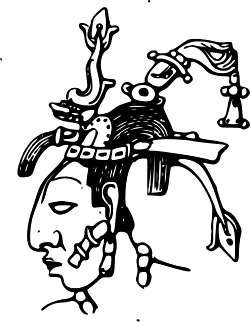
A twelve-year-old boy inheriting a fractured kingdom rarely portends a golden age, yet the accession of Kʼinich Janaab Pakal I in July 615 CE initiated one of the most remarkable reigns in human history.
In the early decades of the seventh century, the Maya city-state of Palenque was a broken place. Sacked by the formidable military machine of Calakmul in 599 CE, and then ravaged again in 611 CE by the armies of the Calakmul king Scroll Serpent, the city’s political order collapsed. The reigning lord, Ajen Yohl Mat, died shortly after the second catastrophe. His heir, Janahb Pakal, followed him to the grave within months. Without a clear male successor to take up the offices of the state, the city’s lineage was thrown into a profound crisis. Power devolved to Lady Sak Kʼukʼ, a noblewoman of the ruling dynasty. In July of 615 CE, in an act of dynastic desperation and hope, she placed the crown upon her twelve-year-old son. His name was Kʼinich Janaab Pakal, meaning "Radiant Corn-Flower Shield," and he would go on to rule for sixty-eight years and thirty-three days—the fifth-longest verified reign in human history, and an era that would transform his battered capital into one of the crown jewels of Mesoamerican civilization.
The young king who inherited this ruin was physically shaped for the role he was to perform. In keeping with the aesthetic and aristocratic ideals of the Classic Maya, Pakal’s skull had been subjected to severe artificial cranial elongation during his infancy. Through a process of tight wrapping and splinting, his head was coaxed into a tabular oblique shape, forcing his forehead to recline and his face to grow forward and outward in a dramatic, outthrusting profile. His central upper incisors were deliberately filed and notched at their lateral edges to form a T-shape, mimicking the Ik’ glyph—the sacred symbol for wind, breath, and the vital life force. He grew to a height of roughly 163 centimeters, standing slightly taller than the average Palenque male. Yet, despite these striking physical alterations, his early years on the throne were defined not by independent military might, but by the quiet custody of his mother. Lady Sak Kʼukʼ served as regent, steering the city-state through its convalescence and slowly, systematically ceding actual authority to her son until her death in September 640 CE.
Once free of the regency, Pakal set about reshaping the geopolitical landscape of the western Maya lowlands. In 626 CE, he had married Ix Tzʼakbu Ajaw, a princess from the nearby satellite settlement of Uxteʼkʼuh and a descendant of the ancient Toktahn dynasty, a union that yielded at least three sons and solidified his domestic legitimacy. Two years later, the geopolitical chess match began in earnest. Though one of Pakal’s high-ranking officials was captured by the rival city of Piedras Negras in 628 CE, Pakal responded six days later by capturing Nuun Ujol Chaak, the lord of Santa Elena. Santa Elena was promptly reduced to a tributary state. Decades later, Pakal’s military campaigns reached further west. In 659 CE, he captured six high-value prisoners, including a lord from Pipaʼ, a region associated with Pomona. When Pipaʼ resisted, Pakal slew another of its lords in 663 CE, while simultaneously sweeping back through Santa Elena to seize six more captives. These triumphs were not merely political; they were theatrical. The east court of Palenque’s great palace was specifically remodeled as a grand ceremonial arena designed to display these broken captives to the public, their humiliations carved forever into the stone and painted in vibrant, narrative frescoes.
+ 8 further connections to entries not yet ingested
It was through architecture, however, that Pakal truly secured his immortality. In 647 CE, at the age of forty-four, he launched his first major building project: a solitary temple on the city’s periphery known today as El Olvidado, or "The Forgotten." From there, his ambitions turned inward to the heart of Lakamhaʼ, the urban core of Palenque. He dramatically expanded the Palace of Palenque, adding monumental rooms over older levels and constructing Building E, which the Maya called Sak Nuk Naah, the "White Skin House." Unlike the deep, blood-red plaster that coated the rest of the palace, Building E was painted a brilliant, gleaming white. Over the next decade, Pakal’s builders erected Houses B and C in 661 CE, and House A in 668 CE, transforming the palace into a sprawling labyrinth of courtyards, subterranean galleries, and administrative halls. The stone surfaces of these structures were covered in complex hieroglyphic texts, dynastic stairways, and tablets that traced Pakal’s lineage back through the mists of deep time, cementing his place in the cosmos.
Yet the ultimate architectural statement of Pakal’s reign was designed to be his tomb: the Bʼolon Yej Teʼ Naah, or "House of the Nine Sharpened Spears," known today as the Temple of the Inscriptions. Pakal died on August 29, 683 CE, at the advanced age of eighty. He was buried deep within the belly of this colossal stepped pyramid, sealed beneath a massive, intricately carved limestone sarcophagus lid that remains one of the supreme masterpieces of pre-Columbian art. The iconographic program of the lid depicts the king at the moment of his death and transfiguration. Framed by the terrifying, open skeletal jaws of a funerary serpent representing the portal to the underworld, Pakal is depicted wearing the attributes of the Tonsured Maize God, complete with a sacred turtle-shell ornament on his chest. He is suspended in a delicate, almost fetal posture of rebirth, reclining against the trunk of a great cruciform world tree that ascends into the heavens. Around the borders of the lid, bands of cosmological symbols—the sun, the moon, the stars—frame the heads of the city’s ancestral nobility, presenting the dead king’s demise not as a tragic end, but as a cosmic necessity, a descent down the Milky Way into the southern horizon from which he would inevitably rise again like the morning corn.
For centuries, this subterranean chamber remained lost to the jungle, guarded by stone plugs and a staircase choked with deliberate rubble. When the Mexican archaeologist Alberto Ruz Lhuillier finally cleared the debris and raised the limestone slab in 1952, he uncovered Pakal’s skeleton intact. The king lay wrapped in a spectacular mosaic mask of jadeite, surrounded by rich necklaces of jade beads and stucco reliefs depicting his transition to divinity. Almost immediately, however, a fierce scientific controversy erupted. Initial physical examinations of the skeleton’s teeth revealed surprisingly little wear, suggesting the individual was a man of about forty years of age—a stark contradiction to the epigraphic texts, which insisted Pakal had died at eighty. Ruz Lhuillier and other early researchers argued that the inscriptions must have been exaggerated, or that they referred to two separate rulers with the same name. But epigraphers stood their ground, asserting that the Maya calendar was far too precise to tolerate such a discrepancy. Modern morphometric analysis of the skeleton eventually resolved the debate, proving that the bones did indeed belong to an elderly man who died in his eighth or ninth decade. The lack of dental wear was a telling testament to Pakal’s extreme aristocratic privilege; unlike his subjects, whose teeth were ground down by stone-milled maize, the king enjoyed a soft, highly refined diet that left his teeth intact, though coated in unusually large deposits of calculus.
Long after the physical remains of Kʼinich Janaab Pakal were sealed away in the dark, his presence continued to haunt the political life of Palenque. To the Maya, the boundaries of biological death were porous. Decades after his passing, his descendants continued to depict Pakal as an active political agent. On the Tablet of the 96 Glyphs, a late sculptor claimed that his design had been directly commissioned by the "revered ancestor" himself. On a carved panel in Temple XXI, carved half a century after Pakal’s biological death, the old king—his skin realistically rendered with the soft folds and hard lines of extreme age—is shown handing the sacred instruments of state to his grandson, Ahkal Moʼ Nahb. In these ancient Maya bodyscapes, Pakal’s spirit was understood to move freely across the barriers of time, merging with mythical rulers of the deep past and continuing to guide the dynasty he had rescued from the brink of oblivion. Through these enduring stone portraits, Pakal’s physical body and the hieroglyphic texts of his achievements became one, a permanent medium through which the "Radiant Shield" of Palenque could protect his city for eternity.