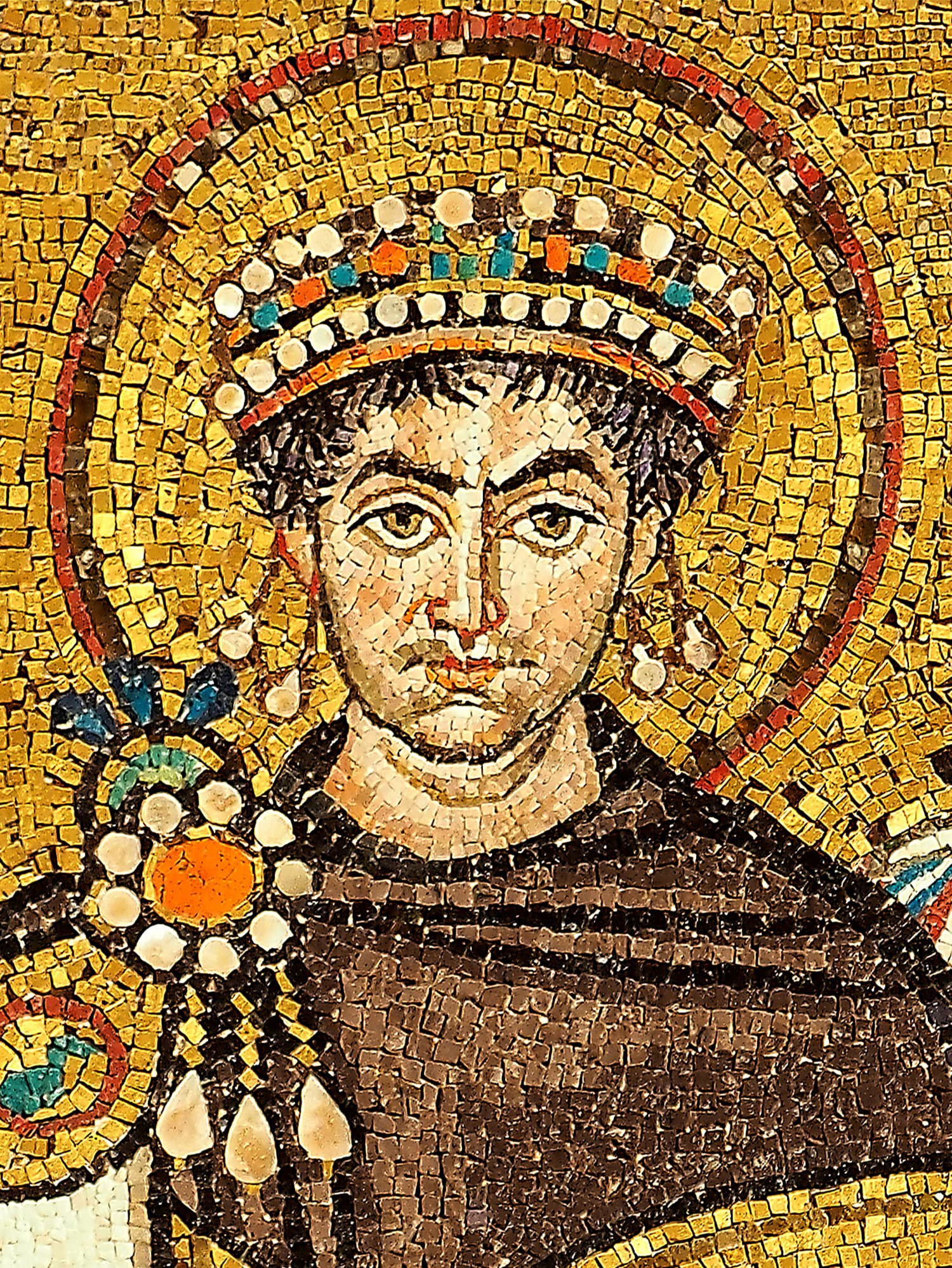
The dream of a restored Roman Empire found its ultimate champion in a Latin-speaking peasant from Tauresium.
In the early decades of the sixth century, a visitor to the Great Palace of Constantinople might have encountered a short, fair-skinned man pacing the corridors deep into the night. He was curly-haired, round-faced, and handsome, with a receding hairline and a greying beard that made him look, to the eyes of the contemporary historian Procopius, remarkably like the ancient tyrant Domitian. This was Justinian I, a ruler of such relentless, exhausting industry that his subjects came to call him "the emperor who never sleeps." Yet this tireless master of the Roman world, who would spend his life attempting to resurrect the grand, unified empire of Augustus and Trajan, was not born to the purple. He was, by birth, a peasant from the rugged hills of Tauresium in Dardania, a native Latin speaker from the Balkan interior who, it was whispered, always spoke Greek with the thick, unpolished accent of a barbarian.
His rise was a triumph of dynastic adoption and sheer administrative talent. Born around 482 or 483 CE—originally named Uprauda—he was rescued from obscurity by his uncle Justin, an illiterate but highly decorated soldier who rose from the ranks to command the imperial guard. When Emperor Anastasius died in 518, Justin was proclaimed emperor, propelled to the throne with the significant help of his ambitious nephew. Justinian, who took his new name in honor of his uncle, immediately became the power behind the throne, navigating the complex theological and administrative waters of the court while his aging uncle grew increasingly senile. By the time Justin died in August 527, Justinian had already been crowned co-emperor, having married his mistress, Theodora, two years prior. The marriage was a scandal of the highest order: Theodora was an actress, a profession equated with the lowest ranks of society, and Justin had been forced to rewrite the imperial marriage laws to allow the union. Yet she would prove to be his most formidable partner, possessing a steel will that would soon preserve his crown.
The fragility of Justinian’s authority became terrifyingly clear in January 532 during the Nika riots. What began as a violent clash between the Blues and the Greens—the rival chariot-racing factions of the Hippodrome—quickly metastasized into a full-scale insurrection against the emperor’s heavy-handed administration and his highly efficient, rapacious tax collectors, John the Cappadocian and Peter Barsymes. The rioters set fire to the city, destroying government buildings, state archives, hospices, and hospitals. They demanded the dismissal of the brilliant legal adviser Tribonian and attempted to crown Hypatius, a nephew of the former emperor Anastasius, as their own ruler. As the flames reached the grand Baths of Zeuxippus and the patients of the Hospice of Samson perished in the inferno, Justinian barricaded himself in the palace, preparing to flee by sea. It was Theodora who shamed him into staying, famously declaring that the purple made a fine burial shroud. Steeled by her resolve, Justinian ordered his generals, Belisarius and Mundus, to trap the rioters inside the Hippodrome. The resulting slaughter was absolute; some 30,000 unarmed civilians were cut down in the arena, and Hypatius was promptly executed.
+ 12 further connections to entries not yet ingested
Out of the ashes of this near-ruin, Justinian initiated a breathtaking reconstruction of his capital, a physical manifestation of his grand vision for a restored Christian Roman Empire. The crown jewel of this program was the Hagia Sophia, a church of such unprecedented architectural daring that its massive dome seemed, to contemporaries, to be suspended by a golden chain from heaven itself. But his grandest monument was not made of stone; it was built of words. Upon his accession, Justinian inherited a Roman legal system that had degenerated into a chaotic, self-contradictory wilderness of ancient statutes, senatorial decrees, and centuries of juristic commentary. To find the law was nearly impossible; to apply it consistently was hopeless.
In 528, Justinian appointed a commission of ten legal experts, led by the brilliant quaestor Tribonian, to tackle the jus novum—the imperial constitutions issued since the second century. Working with astonishing speed, they purged redundancies, resolved contradictions, and published the Codex Justinianeus in 529. But the far more daunting task lay in the jus vetus, the vast ocean of opinions written by authorized Roman jurists over the centuries. To prepare for this, Justinian first issued his "Fifty Decisions" (Quinquaginta decisiones), resolving the most contentious disputes that had split legal minds for generations. Then, in 530, a new commission of sixteen lawyers perused and condensed millions of lines of ancient text, extracting the most permanent legal principles into a fifty-volume work called the Digesta, or Pandectae, published in 533. Accompanied by the Institutiones, a textbook for law students, and later supplemented by his own new laws, the Novellae (written in Greek, the language of his eastern subjects), this monumental synthesis became the Corpus Juris Civilis.
This legal masterpiece did more than just preserve Roman law; it reshaped the moral landscape of the empire. Justinian’s legislation sought to protect the vulnerable, reflecting a distinct domestic focus. He outlawed the exploitation of prostitutes, treated rapists with severe penalties, and decreed that women charged with major crimes must be guarded by other women to prevent sexual abuse. Under his laws, a widowed woman was guaranteed the return of her dowry, and a husband could not take on major debt without his wife’s explicit consent, given twice. He protected children born out of wedlock, penalized child neglect, and guarded the rights of abandoned children forced to beg. Though he maintained the legal reality of slavery, he improved the rights of slaves to plead for their own freedom, declared that a master who killed a slave committed murder, and famously acknowledged that slavery was an unnatural state of human existence, contrary to natural law. Simultaneously, however, his orthodoxy had a darker edge: he barred "heretics", pagans, Jews, and Samaritans from holding public office, restricted their property rights, and destroyed their places of worship.
With his domestic authority secured by blood and his laws codified in ink, Justinian turned his gaze outward, launching his renovatio imperii—the restoration of the western provinces lost to barbarian kingdoms in the previous century. Though Justinian himself never set foot on a battlefield, his generals orchestrated brilliant campaigns. The legendary Belisarius swiftly annihilated the Vandal Kingdom of North Africa, returning the region to Roman rule. Next, Belisarius and the eunuch general Narses turned their attention to Italy, embarking on a grueling, multi-decade campaign against the Ostrogothic Kingdom. Rome, Sicily, Dalmatia, and the Italian peninsula were slowly, painfully recaptured. In the westernmost reaches of the Mediterranean, the praetorian prefect Liberius reclaimed the southern coast of the Iberian Peninsula from the Visigoths, establishing the province of Spania. Even on the distant Black Sea, the emperor subdued the Tzani, a people who had never before bowed to Roman authority.
These conquests re-established Roman dominance over the western Mediterranean basin, pouring more than a million solidi of new annual revenue into the imperial treasury. Yet this glory was bought at an agonizing price. The wars in Italy dragged on for decades, devastating the landscape and draining the empire's resources. To fund these western ambitions, Justinian was forced to neglect the eastern frontier, sparking renewed, punishing conflicts with the Sasanian Empire under Kavad I and Khosrow I.
The later years of his long reign were shadowed by loss and a quiet, monastic retreat. In the early 540s, a devastating pandemic of bubonic plague swept through the empire; Justinian himself contracted the disease but miraculously recovered. Theodora was less fortunate; she died in 548, likely of cancer, leaving him to rule alone for nearly two decades. Without her, the aging emperor became increasingly consumed by theology, immersing himself in complex dogmatic debates. He discontinued the ancient office of the Consul in 541, severing one of the last living links to the old Roman Republic.
When Justinian finally died on November 14, 565, childless and exhausted, he left behind an empire that stretched from the sands of Mesopotamia to the pillars of Spain. He was buried in the Church of the Holy Apostles, though his bones would not rest forever; they were desecrated and scattered centuries later during the sack of Constantinople by Western Crusaders in 1204. But his true monument survived the collapse of his physical empire. Though many of his western conquests slipped away shortly after his death, the Corpus Juris Civilis endured. Transmitted through Italy, it became the foundation of continental European law, eventually traveling via the age of global exploration to the Americas and beyond. The peasant boy from the Balkans, who sought to restore the world of the Caesars by force of arms, ultimately conquered the modern world through the quiet, enduring majesty of his laws.