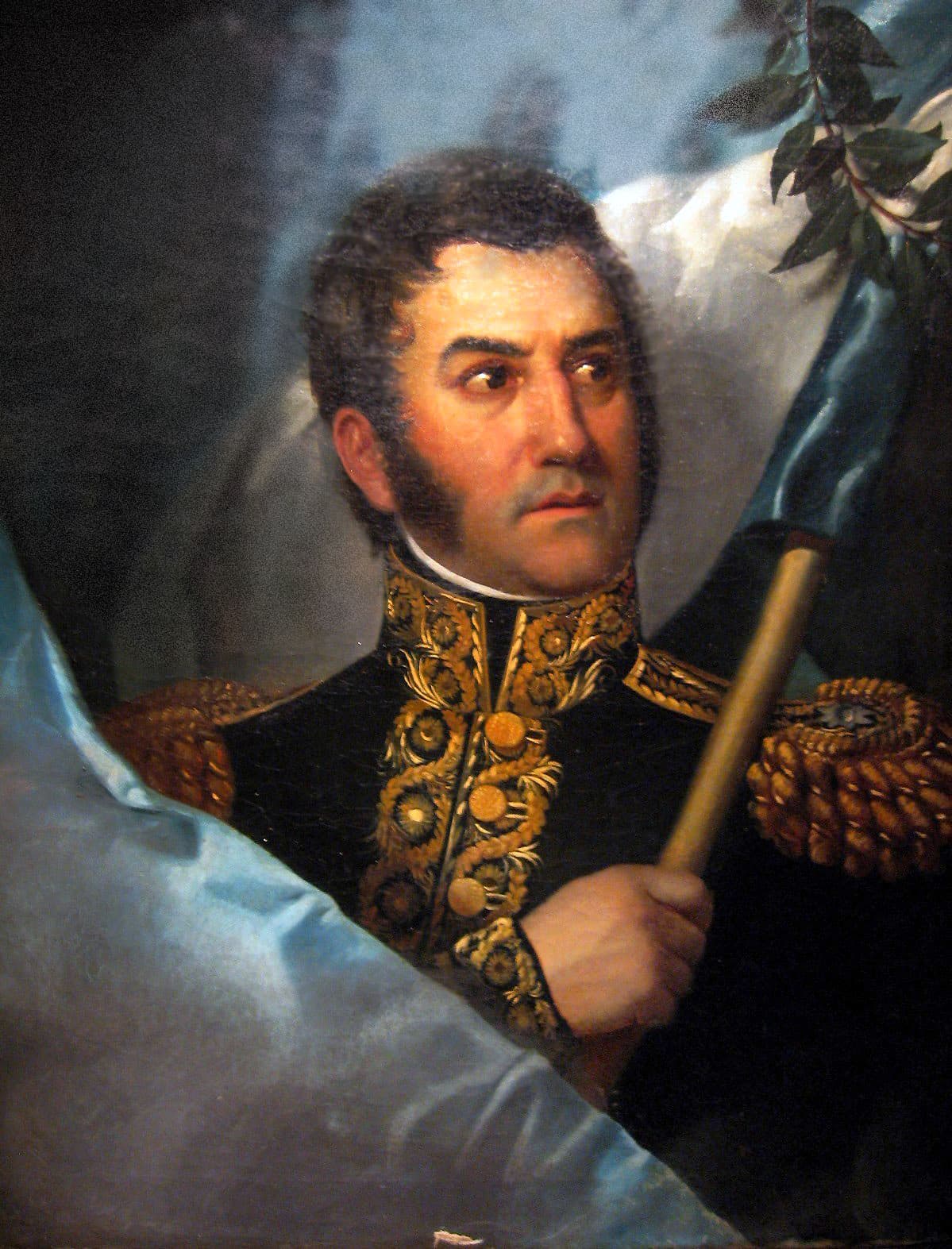
Before he became the architect of South American liberation, José Francisco de San Martín y Matorras spent decades serving the very empire he would eventually dismantle.
In the dark early hours of February 3, 1813, a Spanish-trained officer named José de San Martín stood atop the tower of the San Carlos Convent in San Lorenzo, peerless and watching. Below him, the dark waters of the Paraná River lapped at the Argentine shore. For months, royalist ships from Montevideo had been raiding these riverbanks, pillaging villages with impunity while the embryonic revolutionary government in Buenos Aires struggled to defend its vast, untamed hinterland. San Martín had arrived from Europe only a year prior, a veteran of Spain’s Peninsular War who had spent his youth fighting Napoleon, only to abandon his commission and return to the land of his birth to offer his sword to the cause of South American self-determination. Now, with a newly raised regiment of mounted grenadiers hidden in the convent courtyard below, he waited for dawn. As the Spanish royalists disembarked to pillage, San Martín executed a textbook pincer movement, charging directly into the fray. The skirmish was brief but nearly fatal. San Martín’s horse was shot out from under him, pinning his leg to the earth. A royalist soldier lunged to bayonet him, slashing his face and wounding his arm before two of his own men, Juan Bautista Baigorria and Juan Bautista Cabral, threw themselves into the melee to save their commander. Cabral died of his wounds, but the charge succeeded. The Battle of San Lorenzo was a minor military engagement, but it marked the violent, romantic baptism of a man who would systematically dismantle Spanish imperial rule across the southern half of the continent.
To understand San Martín is to understand the strange, bifurcated world of the late eighteenth-century Spanish Empire. Born in 1778 in Yapeyú—a former Jesuit mission among the Guaraní people in modern-day Argentina—San Martín was the son of a Spanish lieutenant governor. He left the Americas at the age of seven when his family returned to Spain, settling eventually in Málaga. By the age of eleven, he was a cadet in the Murcian Infantry Unit. His youth was spent in the crucible of late-eighteenth-century European warfare: fighting North African Moors in Melilla and Oran, suffering captivity as a prisoner of war under the British Royal Navy, and marching against Portugal in the War of the Oranges. It was during these years of service that he absorbed the intellectual currents of the Spanish Enlightenment, which clashed sharply with the absolute monarchy he served. When Napoleon invaded Spain in 1808, San Martín fought alongside the Spanish patriots, winning a gold medal and a promotion to lieutenant colonel at the spectacular Spanish victory of Bailén. Yet, as the French armies gradually swallowed the Iberian Peninsula, leaving only the besieged city of Cádiz free, San Martín made a choice that still puzzles historians. In 1811, he resigned from the Spanish military. Whether driven by a latent love for his native soil, the quiet recruitment efforts of British agents who stood to profit from free trade in South America, or a belief that the struggle against royal absolutism had simply migrated to the New World, he joined the secret Lodge of Rational Knights in Cádiz and sailed for London. There, at the home of the Venezuelan revolutionary Francisco de Miranda, he met fellow exiles and plotted a return to a continent he had not seen since childhood.
12 links to entries not yet ingested in the Library.
When San Martín arrived in Buenos Aires in March 1812 aboard the British ship George Canning, he was viewed with a mixture of hope and deep suspicion. He was, after all, a man who had spent his entire adult life in the uniform of the Spanish Crown. To prove his loyalty and utility, he set about organizing the Regiment of Mounted Grenadiers, introducing rigorous European cavalry tactics, iron discipline, and a professional code of honor to a revolutionary army that had previously relied on enthusiastic but untrained militias. He married María de los Remedios de Escalada, a fourteen-year-old girl from a prominent patrician family, cementing his ties to the local elite. He also co-founded a local branch of the Lodge of Rational Knights with Carlos María de Alvear. This secret society quickly became the shadow engine of Argentine politics, orchestrating the overthrow of the First Triumvirate in October 1812 to install a government more dedicated to total independence. Yet, as Alvear and other Buenos Aires politicians became bogged down in provincial rivalries and internal civil wars against regional caudillos, San Martín grew disillusioned. He realized that the revolution was doomed if it remained provincial. The primary threat to South American liberty lay not in the local skirmishes of the Río de la Plata, but in the towering royalist stronghold of Peru, protected by the formidable geography of the Andes and the Pacific Ocean.
Taking command of the battered Army of the North in 1814, San Martín recognized that the traditional invasion route to Peru through the high, oxygen-depleted valleys of Upper Peru—modern-day Bolivia—was a graveyard for revolutionary armies. He formulated a radical, alternative strategy: he would withdraw, organize a new army in the western province of Cuyo, cross the treacherous, snow-choked passes of the Andes into Chile, liberate that territory, and then launch a maritime invasion northward to strike at the heart of Spanish power in Lima. For three years, as governor of Cuyo, San Martín lived in Mendoza, meticulously assembling the Army of the Andes. He built foundries to cast cannon, organized hospitals, mapped the mountain passes, and recruited a diverse force of Argentine gauchos, Chilean exiles, and liberated slaves. In January 1817, he began the crossing. Operating at altitudes of over twelve thousand feet, where the air was thin and the cold lethal, his columns moved in synchronized precision across multiple passes, completely baffling the Spanish defenders. The army descended into the central valley of Chile and shattered the royalist forces at the Battle of Chacabuco. Despite a subsequent setback, San Martín secured Chilean independence once and for all at the decisive Battle of Maipú in 1818.
The final phase of his grand strategy required a navy to transport his victorious army to Peru. Sailing north, San Martín landed on the Peruvian coast and gradually tightened a blockade around Lima. Rather than engaging in a bloody, head-on assault that might alienate the local population, he utilized psychological warfare, political negotiation, and minor skirmishes to pressure the Spanish Viceroy into evacuating the capital. On July 12, 1821, San Martín’s forces entered Lima, and on July 28, he officially declared the independence of Peru, accepting the title of "Protector." Yet, his position was precarious. Royalist armies still controlled the vast Peruvian highlands, his treasury was empty, and his troops were plagued by disease. It was at this critical juncture, in July 1822, that San Martín traveled to Guayaquil, Ecuador, for a private, closed-door meeting with Simón Bolívar, the charismatic liberator of the north. What passed between the two titans of South American independence remains one of the great mysteries of history. No witnesses were present, and no minutes were kept. When the doors opened, San Martín made a decision that astonished his contemporaries: he quietly returned to Lima, resigned his protectorate and his military command, and left the final liberation of Peru to Bolívar.
By 1824, San Martín had exiled himself to France, withdrawing entirely from the political and military arenas of the continent he had helped free. He lived out his remaining years in quiet obscurity, dying in Boulogne-sur-Mer in 1850. In the decades that followed, the nations he forged began to look back on his self-imposed exile not as a defeat, but as an act of supreme civic virtue—a refusal to participate in the fratricidal civil wars that tore post-colonial South America apart. Today, the Order of the Liberator General San Martín stands as Argentina’s highest national honor. He remains enshrined in the pantheon of the Americas as the stoic planner, the quiet strategist who looked at the impassable wall of the Andes, saw a highway to liberation, and then had the rare grace to walk away from the power he had won.