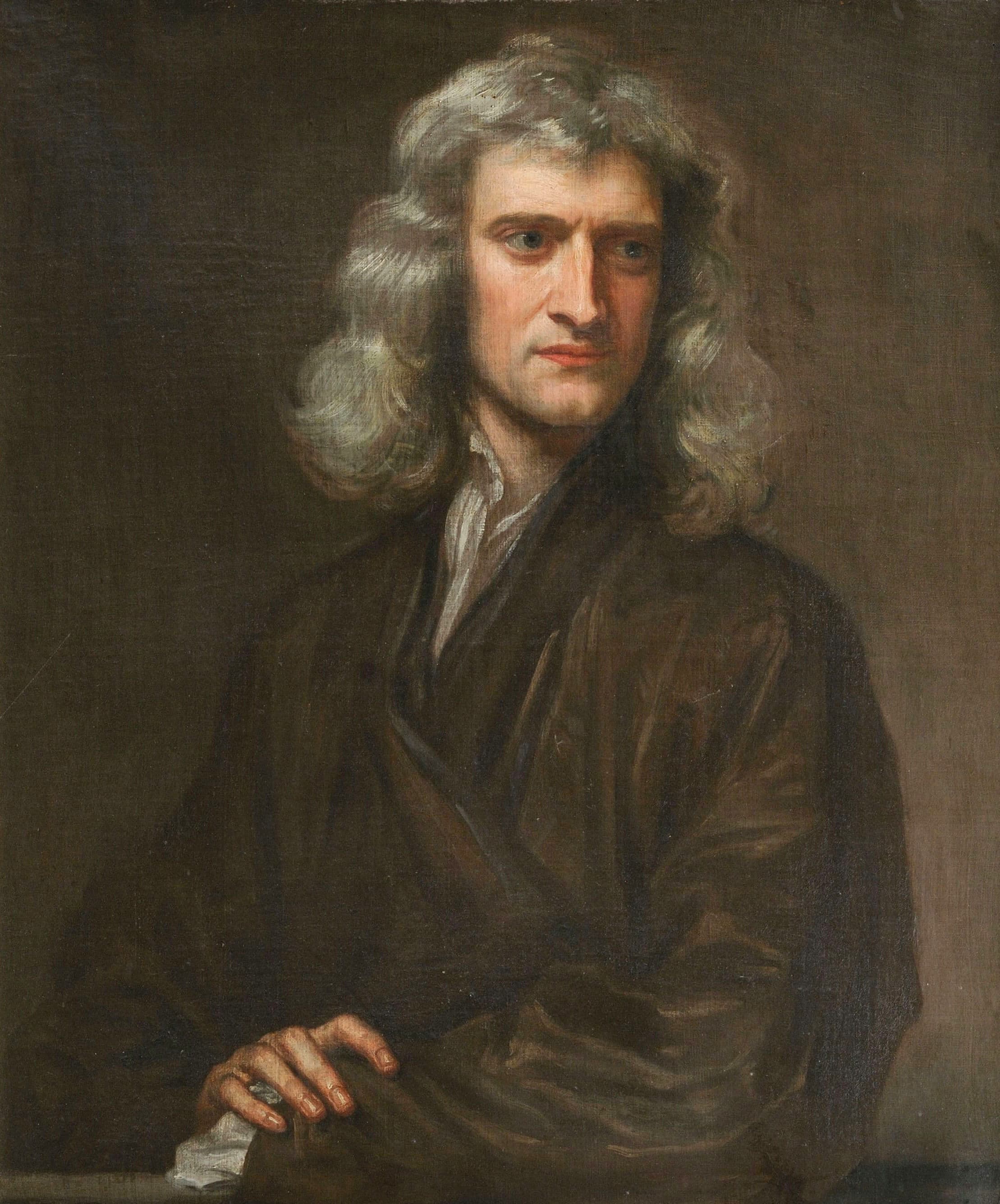
The intellectual landscape of Europe was forever altered by a man who looked at the fall of an apple and the orbit of the moon and saw the exact same physical law at work.
On a winter day in 1659, a seventeen-year-old boy stood in the mud of a Lincolnshire farm, neglecting his chores to construct miniature windmills and carve sundials into the wooden beams of his family’s manor. His mother, twice widowed and desperate for a practical manager of her estate, had pulled him from school to make him a farmer—an occupation the boy loathed with a quiet, burning intensity. Isaac Newton had already proven himself poorly suited to the rhythms of rural life; his mind was elsewhere, consumed by a restless need to quantify the physical world. Realizing the boy’s agrarian career was a disaster, his uncle and the schoolmaster of Grantham intervened, persuading his mother to return him to his books. It was a rescue that rescued modern science. Re-enrolled, driven by a fierce desire to humiliate a schoolyard bully who had mocked him, Newton rose to become the top-ranked student in his school, leaving behind walls covered in drawings of birds, beasts, ships, and mathematical schemes.
When Newton arrived at Trinity College, Cambridge, in June 1661, he did so as a subsizar—a student of modest means who paid his way by performing menial valet duties for wealthier classmates and faculty. Cambridge was still intellectually bound to the medieval scholasticism of Aristotle, but Newton’s notebooks from the era reveal a mind rapidly breaking free of its tutors. Under the heading "Quaestiones," he began listing his own inquiries into the "mechanical philosophy" of René Descartes, Galileo Galilei, and Thomas Street. He was an exceptionally organized thinker, dog-earring pages with precision and constructing alphabetical indexes that mirrored modern reference systems. By 1664, a scholarship secured his place for four more years, and the following year he discovered the generalized binomial theorem. But just as his intellectual engines were warming, the world outside intervened. In August 1665, the shadow of the Great Plague fell over England, and Cambridge shut its doors as a precaution against the contagion.
Newton retreated to his birthplace at Woolsthorpe Manor. There, during two quiet, isolated years of exile from the university, the young graduate underwent what has been described as the most productive period of intellectual discovery ever experienced by a single human being. In the solitude of the countryside, Newton developed the foundations of infinitesimal calculus, formulated his theories of optics, and conceived the law of universal gravitation. Working entirely in private, he synthesized seemingly disparate fields to stimulate creative breakthroughs, acting as a Janusian thinker who stood between the ancient world’s qualitative descriptions of nature and a new, quantitative future. He was the first to calculate the age of the Earth through physical experiment, designed a precursor to the modern wind tunnel, and provided the first quantitative estimate of the solar mass. When he returned to Cambridge in 1667, he was quickly elected a fellow of Trinity. Two years later, at the age of twenty-six, he succeeded his mentor Isaac Barrow as the Lucasian Professor of Mathematics.
12 links to entries not yet ingested in the Library.
Yet for all his internal brilliance, Newton was a spectacularly ineffective teacher. His lectures were almost always empty; he did not enjoy teaching, nor did he care for students. His assistant, Humphrey Newton, observed that the professor would arrive punctually in his lecture hall, and upon finding the room empty, would simply talk to the bare walls for fifteen minutes before retreating to his laboratory. Over his entire academic career, he was assigned only three students to tutor, none of whom left any mark on history. Newton’s true communication was written, and it was combative. In 1672, the same year he was elected a Fellow of the Royal Society, he published a corrected and amended edition of Bernhardus Varenius’s Geographia Generalis, bridging classical geography with pure mathematics to quantify the Earth's physical features. That same year, he presented his work on optics. Having built the first reflecting telescope, Newton demonstrated that a prism did not color light, as had been believed since antiquity, but rather separated white light into the constituent colors of the visible spectrum. He originated the use of prisms as beam expanders, a concept that would centuries later become integral to tunable lasers, and formulated the first empirical law of cooling, which established the formal basis of convective heat transfer.
The peak of Newton’s scientific achievement arrived in 1687 with the publication of the Philosophiæ Naturalis Principia Mathematica. In this monumental text, Newton achieved the first great unification in physics, establishing the laws of motion and universal gravitation that would dominate the scientific worldview for centuries. By applying his mathematical description of gravity, he solved the two-body problem, introduced the three-body problem, and derived Johannes Kepler’s laws of planetary motion. He accounted for the ocean tides, calculated the trajectories of comets, and explained the precession of the equinoxes, effectively erasing any lingering scientific doubt about the heliocentric nature of the Solar System. To prove that the same physical laws governed both the terrestrial and the celestial, Newton inferred that the rotation of the Earth must make it an oblate spheroid rather than a perfect sphere—a hypothesis later confirmed by the geodetic measurements of French astronomers Alexis Clairaut and Charles Marie de La Condamine, which finally converted the remaining skeptics of continental Europe to Newtonian mechanics.
Behind this towering monument of rationalism, however, lay a deeply complex, secretive, and unorthodox inner life. Newton was a man of intense religious conviction, yet his theology was radically at odds with the Church of England. He privately rejected the doctrine of the Trinity, viewing it as a historical corruption of early Christian scripture. Because Trinity College required its fellows to take holy orders and be ordained as Anglican priests within seven years, Newton faced a crisis that threatened his academic survival. He resolved to resign rather than conform, but his mentor Isaac Barrow helped secure a royal dispensation from King Charles II, exempting the Lucasian Professor from the ordination requirement. Free from the scrutiny of the Church, Newton spent a vast portion of his life immersed in subjects that remained hidden from the public: intensive biblical chronology and the secretive, symbolic world of alchemy. Most of these writings remained unpublished, locked away in personal chests until long after his death.
In his later decades, Newton transitioned from the quiet cloisters of Cambridge to the corridors of British state power. Politically aligned with the Whigs, he served two brief, unremarkable terms as a Member of Parliament for the University of Cambridge. In 1696, he moved to London to become Warden, and later Master, of the Royal Mint, a position he held until his death in 1727. He brought the same obsessive precision to the nation’s currency that he had applied to the stars, significantly increasing the accuracy and security of British coinage to combat counterfeiters. He was knighted by Queen Anne in 1705 and ruled over the English scientific establishment as the formidable president of the Royal Society from 1703 until his passing. By the time Newton died, his laws of motion and gravitation had become the bedrock of the Enlightenment, defining a mechanical universe that functioned like a grand, predictable clock. Though his classical mechanics would eventually be superseded in the twentieth century by the theory of relativity, they remain the elegant, highly accurate approximations that humanity still uses to navigate the local universe, secure in the mathematical bridges he built between the earth and the heavens.