Person · 501 CE – 544 CE · Pre Islamic Arabia
Imru' al-Qais
- Also known as
- 'Imru'-l-Qays
- Amriolkais
- Amrolkais
- Amrolkaïs
- Amru al-Kais
- Amru al-Qais
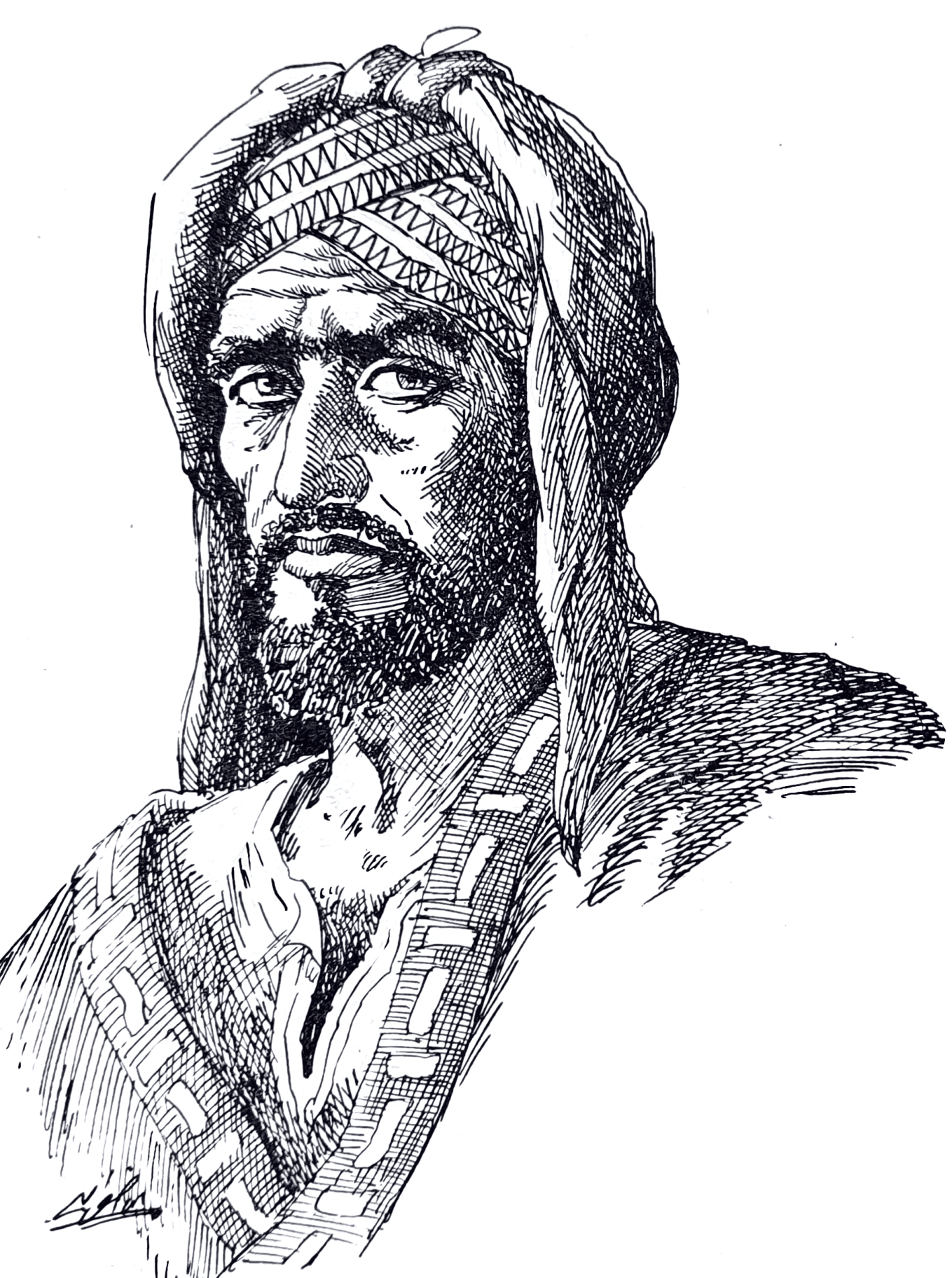
The father of Arabic poetry began his life as a banished prince, exiled by a king who detested his son’s devotion to verse, wine, and women.
In the early sixth century, long before the sands of the Arabian Peninsula were united by the message of Islam, a young prince of the royal house of Kinda sat drinking in the Najd desert, surrounded by a court of outcasts, singers, and rebels. His name was Imru’ al-Qais. To his father, Hujr, the stern regent over the restive northern tribes of Asad and Ghatafan, the boy was an embarrassment. In the aristocratic code of the Kindite dynasty—which had migrated from South Arabia centuries prior to establish a fragile hegemony over the nomadic interior—a prince was meant to wield the sword, negotiate tribal alliances, and command respect. Imru’ al-Qais preferred to chase women, organize lavish, scandalous drinking parties, and, worst of all, compose poetry. In the pre-Islamic Jahiliyyah, the "Age of Ignorance," each tribe had its chief and its poet, and the two were almost never the same. To the ruling elite, verse was a trade for vassals, not kings. Yet the young prince could not stop. He was a man possessed by the cadence of the Arabic tongue, a linguistic pioneer who would shape the literary consciousness of an entire civilization, even as he lost everything else.
The friction between father and son eventually curdled into exile. Stories offer various catalysts for the final rupture: perhaps it was the disaster that ensued when Hujr tried to instill discipline by putting his son in charge of the family camel herds; perhaps it was the public scandal when the young poet openly courted his cousin ‘Unayzah and, after being denied her hand, supposedly enjoyed her affections in secret; or perhaps it was the lewd verses the prince penned about his father’s own wives and concubines. Cast out of the Kindan court, Imru’ al-Qais became a wanderer, drifting from oasis to oasis. He spent his days in a haze of wine, female companionship, and verse, living a life that seemed destined to end in comfortable, sybaritic obscurity.
Then, around the year 525 CE, the world that sustained his family collapsed. The Christian Kingdom of Axum, based in modern-day Ethiopia, invaded and occupied Yemen, destroying the southern patrons who had long guaranteed Kindite power in the north. Sensing weakness, the subject tribes rose in rebellion. The Asad assassinated King Hujr. According to the ninth-century historian Ibn al-Kalbi, the news of the murder reached Imru’ al-Qais while he was in the middle of a drinking game with his companions. The prince did not weep. He paused, stared at his friends, and uttered words that would echo through Arabic literature for centuries: "May God be merciful to my father. He let me stray when I was small, and now that I am grown he has burdened me with his blood. There will be no alertness today, and no drunkenness tomorrow. Today is for drink, and tomorrow for serious matters."
With that vow, the dissolute poet transformed into an instrument of vengeance. Renouncing the wine and women that had defined his youth, he set out to claim his blood-debt. Though his brothers shirked the task, Imru’ al-Qais rallied the powerful tribes of Bakr and Taghlib to his banner, launching a brutal campaign against the Asad. When the rebels sent an emissary offering thousands of camels and sheep as blood-money to settle the feud, the prince refused. He demanded war. The ensuing conflict was devastating; so many Asad tribesmen were slaughtered that the Bakr and Taghlib eventually withdrew their support, declaring that the requirements of honor had been fully satisfied. But for Imru’ al-Qais, vengeance was merely the first step. He did not simply want Asad blood; he wanted his father's lost kingdom.
Without the backing of the northern tribes, the prince became "the Lost King" (al-Malik aḍ-Ḍalīl), a tragic, migrating figure seeking patrons across the Levant and the Arabian Peninsula. He was running not only from his enemies but from the encroaching irrelevance of his dynasty. His desperate quest eventually led him to the gates of Constantinople, the glittering capital of the Byzantine Empire. Sponsored by the Ghassanid prince Al-Harith ibn Jabalah—Justinian I’s Christian Arab vassal—Imru’ al-Qais appealed directly to the Roman Emperor. Justinian, always eager to secure his southern desert frontier against the Sasanians and their Lakhmid vassals, received the poet-king warmly and promised him military support, even attempting to pressure the Axumites into backing his claim.
But the grand alliance was not to be. After leaving Constantinople to return to Arabia, Imru’ al-Qais fell gravely ill near Ankara in modern-day Turkey. A persistent legend arose that Justinian, discovering the poet had seduced a woman of the imperial court, sent a messenger after him with a gift: a magnificent tunic laced with deadly poison. When the prince put it on, the toxin seared his flesh, killing him. Modern historians discount this romantic conspiracy, pointing instead to the chronic, agonizing skin disease that Imru’ al-Qais himself lamented in his final poems. He died in Anatolia somewhere between 561 and 565 CE, far from the red sands of the Najd, and was buried in Hıdırlık. Centuries later, in 1262 CE, travelers still reported seeing a Greek statue erected over the tomb of the Arab king who died in exile.
While Imru’ al-Qais failed to resurrect the Kingdom of Kinda, he succeeded in establishing an empire of words. His Mu'allaqa—"Let us stop and weep"—is widely considered the crown jewel of pre-Islamic literature, one of the seven masterworks supposedly written in gold leaf and hung on the walls of the Kaaba in Mecca. It begins with the nasib, the elegiac remembrance of a ruined campsite where a lover once lived, a trope he popularized and which became the mandatory opening for classical Arabic poetry:
Halte, weep for the memory of a beloved and a homestead, At the edge of the sandy desert between Al-Dakhul and Hawmal...
Through his verse, the desert landscape comes alive not as a barren void, but as a theater of intense human emotion, filled with detailed descriptions of horses, night-storms, and the fleeting warmth of lost love. He learned his craft from the masters of his father’s generation—the veteran Zuhayr bin Janab, the poet Abu Du’ah al-Iyadi, and the loyal retainer ‘Amr bin Qami’ah, who accompanied him to his death—but he synthesized their styles into something entirely his own.
Whether he died a pagan, as most medieval biographers assumed, or had adopted the Christianity of his northern patrons, as later Jesuit scholars argued from the biblical imagery in his late poems, Imru’ al-Qais remained a transitional figure standing at the threshold of history. He lived in the twilight of the old tribal kingdoms and died just decades before the rise of Islam would fundamentally reshape the language he helped perfect. He bequeathed to the Arab world its poetic vocabulary, its meters, and its tragic, brooding romanticism. In the end, the "Lost King" never regained his earthly throne, but in the vast realm of Arabic literature, his sovereignty remains absolute.
Connected to
8 links to entries not yet ingested in the Library.