Place · West African Empires
Ile Ife
- Also known as
- Ife
- Ife
- Ife
- Ife
- Ife
- Ife
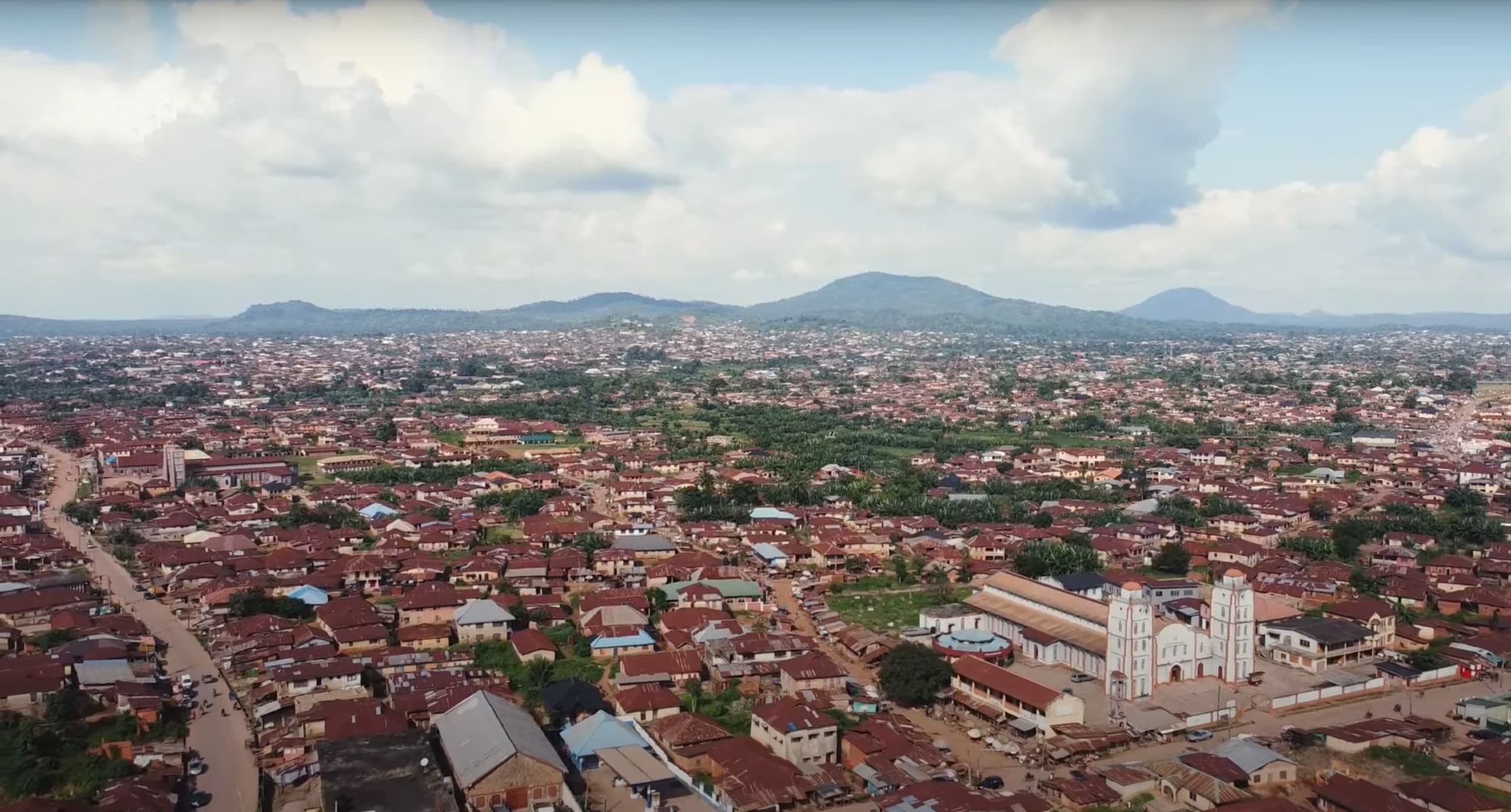
Before the dry land of the world existed, Yoruba cosmological tradition holds that there was only a primordial ocean.
According to the sacred geography of the Yoruba, the world did not begin with a void, but with a vast primordial ocean and a golden chain dangling from the heavens. Down this chain climbed Obatala, tasked by the supreme deity Olodumare with creating dry land. But the journey was long, and Obatala grew thirsty, stopping to drink so deeply of palm wine that he fell into a stupor. It was his brother, Oduduwa, who seized the materials of creation—a handful of earth and a five-toed cockerel—and cast them onto the water. The earth formed a mound called Oke Ora, and the cockerel began to scratch, scattering the dirt across the waters to create the land. Where the earth spread and expanded, they built a city: Ilé-Ifẹ̀, "The Home of Expansion." To cement this new world, Oduduwa planted a single palm nut that grew into a massive tree with sixteen branches, symbolizing the sixteen original clans of the early confederation.
This cosmological drama is not buried in antiquity; it is a living civic reality. The everlasting rivalry between Obatala, who went on to fashion the first humans from clay, and Oduduwa, the progenitor of the Yoruba kings, is still re-enacted today by dedicated votaries in the dust of the city’s streets during the annual Itapa New Year festival. For more than two millennia, this city in the forested hills of modern south-western Nigeria has stood as the spiritual axis of a civilization. Founded as early as 1000 BCE to 500 BCE, Ifẹ̀ grew by 900 CE into a dazzling West African emporium, a place where the human form was captured in bronze and terracotta with a breathtaking, serene naturalism that rivaled, and in many ways anticipated, the masters of the European Renaissance.
At the center of this universe sits the Oòni, the divine king of Ifẹ̀. To the Yoruba, the Oòni is not merely a political executive; he is the 401st spirit, the only Orisha who speaks. He is the custodian of a city that lives by a sacred calendar of 401 distinct deities. Every single day of the year, save for brief interludes, a festival is celebrated for one of these spirits, transforming the city’s neighborhoods and palace courtyards into open-air theaters of ritual, music, and divine possession. The current ruler, Oba Adeyeye Enitan Ogunwusi Ojaja II, an accountant who ascended the throne in 2015 as the 51st Oòni, occupies a lineage that spiritually traces its roots back more than ten thousand years. When the Oòni speaks, he carries the weight of a dynasty whose sons, daughters, and grandchildren dispersed from the holy city centuries ago to found the great regional sister-states of Yorubaland—from Ila Orangun and Ketu to the mighty military empire of Oyo. Even the neighboring kingdom of Benin traces its imperial second dynasty to Oranmiyan, the youngest son of Oduduwa, who left his son Eweka to rule Benin before marching north to establish Oyo.
The physical reality of ancient Ifẹ̀ was as sophisticated as its theology. Between the twelfth and fourteenth centuries, the city was a thriving metropolis of paved streets, where citizens walked on intricate pavements made of systematically laid potsherds. In the damp earth beneath these streets, archaeologists have unearthed evidence of a highly advanced iron-smelting industry. Using local ore and charcoal, Ifẹ̀’s metallurgists achieved an astonishingly high efficiency, producing slags with remarkably low iron loss—a testament to a mastery of pyrotechnology that flourished long before European contact.
Nowhere was this mastery of fire and earth more brilliantly realized than in the sacred grove of Igbo Olokun. Hidden within the forest, this shrine to the goddess of the sea was actually one of the earliest and most innovative glass-production workshops in West Africa. Between the eleventh and fifteenth centuries, Ifẹ̀’s glassmakers developed unique, highly specialized recipes using local raw materials, producing distinct high-lime, high-alumina and low-lime, high-alumina glass. From these furnaces came millions of brilliant blue and green glass beads. These beads were not mere ornaments; they were "the currency for negotiating political power, economic relations, and cultural and spiritual values" across the continent. Archaeologists have traced these distinct Ifẹ̀ beads along ancient trade routes as far away as Mali, Mauritania, Burkina Faso, and Ghana, proving that the holy city was a vital heartbeat in the vast trans-Saharan trade networks.
The pinnacle of Ifẹ̀’s material culture, however, remains its sculptural art. During the reign of the legendary King Obalufon II around 1300 CE—who is today deified as the patron god of brass casting, weaving, and royal regalia—Ifẹ̀’s artists achieved a level of refined, lifelike portraiture that stunned the modern world when it was first excavated. Working in terracotta, stone, and copper alloys of brass and bronze, they sculpted heads of kings, queens, and gods with a quiet, classical dignity. These faces, often marked with delicate vertical scarification lines, feature beautifully proportioned features, though the heads are often rendered slightly larger than life-size. To the artists of Ifẹ̀, this was not a mistake of anatomy but a profound philosophical statement: the head was the vessel of Ase, the inner spiritual power and vital energy of a person. Among these masterpieces is the life-size copper mask of Obalufon II himself, a seamless testament to the lost-wax casting technique he is credited with inventing.
By the fifteenth century, the artistic and economic center of gravity began to shift away from Ifẹ̀ toward the rising military empires of Benin and Oyo. Yet, as political power waned, Ifẹ̀’s spiritual authority only deepened. It remained, and remains, the cradle, the Jerusalem of the Yoruba world.
Today, the modern city of over half a million people is divided into the local governments of Ife East and Ife Central, bustling with the commerce of Osun State. But beneath the asphalt of the modern roads and the walls of contemporary buildings lies the sacred earth of Oke Ora. In the quiet shade of the Oduduwa Grove, initiates still gather to seek the blessings of the ancestor of their civilization. At the Agbonniregun Temple, the priests of Ọrunmila, the deity of wisdom and divination, still consult the ancient system of Ifá to bring order to human lives. Through these enduring rites, the naturalistic bronze faces in the museums, and the unbroken line of the Oòni, Ilé-Ifẹ̀ continues to expand, holding the spiritual memory of tens of millions of people across West Africa and the global diaspora.
Connected to
4 links to entries not yet ingested in the Library.