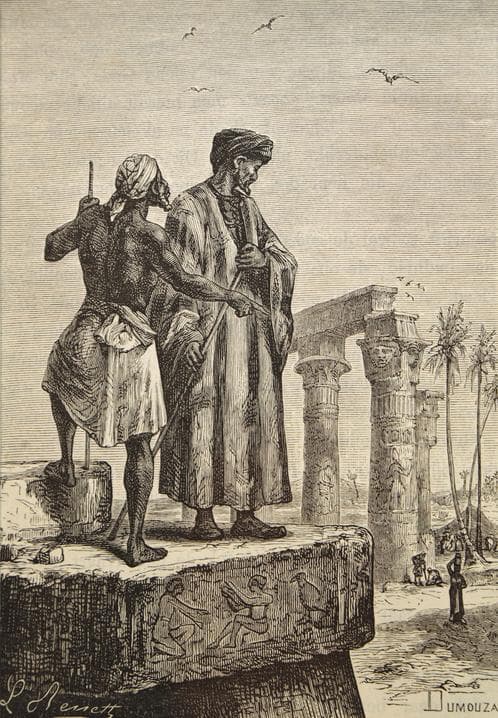
In the summer of 1325, a twenty-one-year-old law student named Abu Abdullah Muhammad ibn Battuta walked out of his family home in Tangier, driven by what he called an overmastering impulse to see the sacred sanctuaries of Mecca.
On the fourteenth of June in the year 1325, a twenty-one-year-old law student named Abu Abdullah Muhammad ibn Battuta walked out of the coastal city of Tangier and headed east. He was alone, possessed by what he would later call an "overmastering impulse" and a long-cherished desire to visit the sacred sanctuaries of Islam. Behind him, he left a comfortable life among the legal elite of Morocco’s Marinid dynasty, where his family of Arabized Berber descent had long served as qadis, or religious judges. Ahead of him lay the overland route across North Africa—a grueling, sixteen-month trek to Mecca. He wept as he parted from his living parents, leaving home "as birds forsake their nests," entirely unaware that this initial journey would stretch into a twenty-four-year exile. He would go on to log some 117,000 kilometers, a distance that dwarf the recorded travels of his contemporary Marco Polo and the later maritime voyages of Zheng He, making him the most traveled man of the pre-modern world.
What began as a standard act of devotion—the hajj—rapidly transformed into an open-ended, multi-decade investigation of the fourteenth-century world. Ibn Battuta was not merely an adventurer; he was a trained scholar of the Sunni Maliki school of jurisprudence. In the medieval Islamic world, this legal training was a universal passport. Wherever a Muslim ruler held sway, there was a need for judges, notary publics, and legal scholars who could navigate the complexities of Sharia. Traveling along the Mediterranean coast through the Hafsid and Abd al-Wadid sultanates, Ibn Battuta quickly learned the practical mechanics of travel. To survive the bandit-ridden tracks, he joined commercial and pilgrim caravans. He also began a lifelong pattern of serial domesticity, marrying a bride in the Tunisian town of Sfax, only to divorce her shortly thereafter following a dispute with her father—the first of many marriages, concubines, and alliances he would contract and dissolve along his route.
By the spring of 1326, Ibn Battuta reached the Mamluk port of Alexandria, where two holy men set the template for his future. The first, an ascetic named Sheikh Burhanuddin, allegedly looked at the young Moroccan and saw a destiny written in the dust of distant roads, instructing him to seek out holy men in India, Sind, and China. Another pious mystic, Sheikh Murshidi, interpreted a dream of Ibn Battuta’s to mean he was destined to wander the earth. Thus encouraged, Ibn Battuta plunged into the heart of the Mamluk Sultanate. He explored Cairo, then tried to reach Mecca via a minor route through the Nile Valley to the Red Sea port of ʿAydhab. When a local rebellion blocked his path, he turned back to Cairo and diverted to Damascus. In Syria, under the secure umbrella of Mamluk patrols, he visited Hebron, Jerusalem, and Bethlehem before joining a massive, disciplined pilgrim caravan heading south to Medina. By November 1326, he had arrived in Mecca, completed his rites, and claimed the prestigious title of .
+ 11 further connections to entries not yet ingested
Yet the completion of his religious duty only sharpened his curiosity. Rather than turning west toward Tangier, Ibn Battuta turned northeast toward the Ilkhanate, the Mongol state that ruled Iraq and Iran. Traveling with a returning Persian caravan, he crossed the Najd plateau to Najaf to pray at the mausoleum of Ali, the fourth caliph. Then, abandoning the direct route to Baghdad, he embarked on a six-month loop through the Zagros Mountains to Isfahan and Shiraz—cities that had miraculously escaped the worst of the Mongol conquests. When he finally reached Baghdad in the summer of 1327, he found a metropolis still scarred and hollowed out by the catastrophic sack led by Hulagu Khan some seventy years earlier. He briefly joined the royal entourage of Abu Sa'id, the last unified Mongol Ilkhan, traveling north to the thriving commercial hub of Tabriz before returning through Mosul and Mardin. By the time he completed his second hajj in late 1327, he was racked with chronic diarrhea but rich in geographical experience.
The years that followed transformed Ibn Battuta from a regional pilgrim into an ocean-going explorer. Based in Mecca until perhaps 1330, he eventually made his way to the Red Sea port of Jeddah and boarded a jalbah—a fragile vessel of wooden planks stitched together with coconut fiber. Hugging the coast, he sailed south to Yemen, visiting the highland capital of Ta'izz under the patronage of the Rasulid king Mujahid Nur al-Din Ali, before reaching the bustling port of Aden. From Aden, he rode the monsoon winds south to the Horn of Africa, landing at Zeila and then moving down to Mogadishu. In 1332, Mogadishu was at the zenith of its medieval wealth. Ibn Battuta marveled at its immense size, its lucrative export trade in high-quality fabrics, and its ruler, Sultan Abu Bakr ibn Shaikh 'Umar. Though the Sultan spoke his native Somali, he was fluent in Arabic and sat at the center of a sophisticated court of ministers, legal experts, and military commanders.
Continuing south along the Swahili coast, Ibn Battuta entered the Bilad al-Zanj, the "Land of the Zanj." He stopped briefly at Mombasa before arriving at Kilwa, an island city-state in modern-day Tanzania that controlled the East African gold trade. Here, the traveler found an urban paradise. Kilwa was a beautifully planned city built of coral stone, featuring the grand Palace of Husuni Kubwa and a massive extension of the Great Mosque. Its ruler, Sultan al-Hasan ibn Sulaiman, impressed Ibn Battuta with his humility and religious devotion. When the monsoon winds shifted, blowing back toward the north, Ibn Battuta sailed to Oman and the Strait of Hormuz, eventually completing yet another hajj to Mecca.
By the early 1330s, however, Ibn Battuta had set his sights on a grander prize: the wealthy, unpredictable court of Muhammad bin Tughluq, the Sultan of Delhi, who was actively recruiting foreign Muslim scholars. To reach India, Ibn Battuta decided on an arduous overland route through Anatolia and Central Asia. He crossed the Sinai once more, sailed from the Syrian port of Latakia aboard a Genoese vessel, and landed at Alanya on the southern coast of modern-day Turkey. In Anatolia, Ibn Battuta encountered the fityan, semi-religious brotherhoods of young artisans led by leaders known as Akhils. These associations operated a network of hospices dedicated to welcoming travelers. Overwhelmed by their hospitality, Ibn Battuta moved from one fityan lodge to another through more than twenty-five Anatolian towns, spending the holy month of Ramadan in the Hamidid capital of Eğirdir.
It was this vast, interconnected web of Islamic institutions—hospices, courts, mosques, and pilgrim routes—that allowed Ibn Battuta to cross continents without ever truly leaving home. In his later years, retired in Morocco, he would dictate these memories to a scribe named Ibn Juzayy, producing the monumental travelogue known as the Rihla (A Gift to Those Who Contemplate the Wonders of Cities and the Marvels of Travelling). Though modern historians occasionally wrestle with his shaky chronology and debated itineraries, the Rihla remains an unparalleled portrait of the medieval world. It reveals a fourteenth-century globe that was remarkably fluid, connected by trade, faith, and the universal language of law, where a young jurist from Tangier could find familiar food, familiar prayers, and a prestigious job thousands of miles from the coast of North Africa.