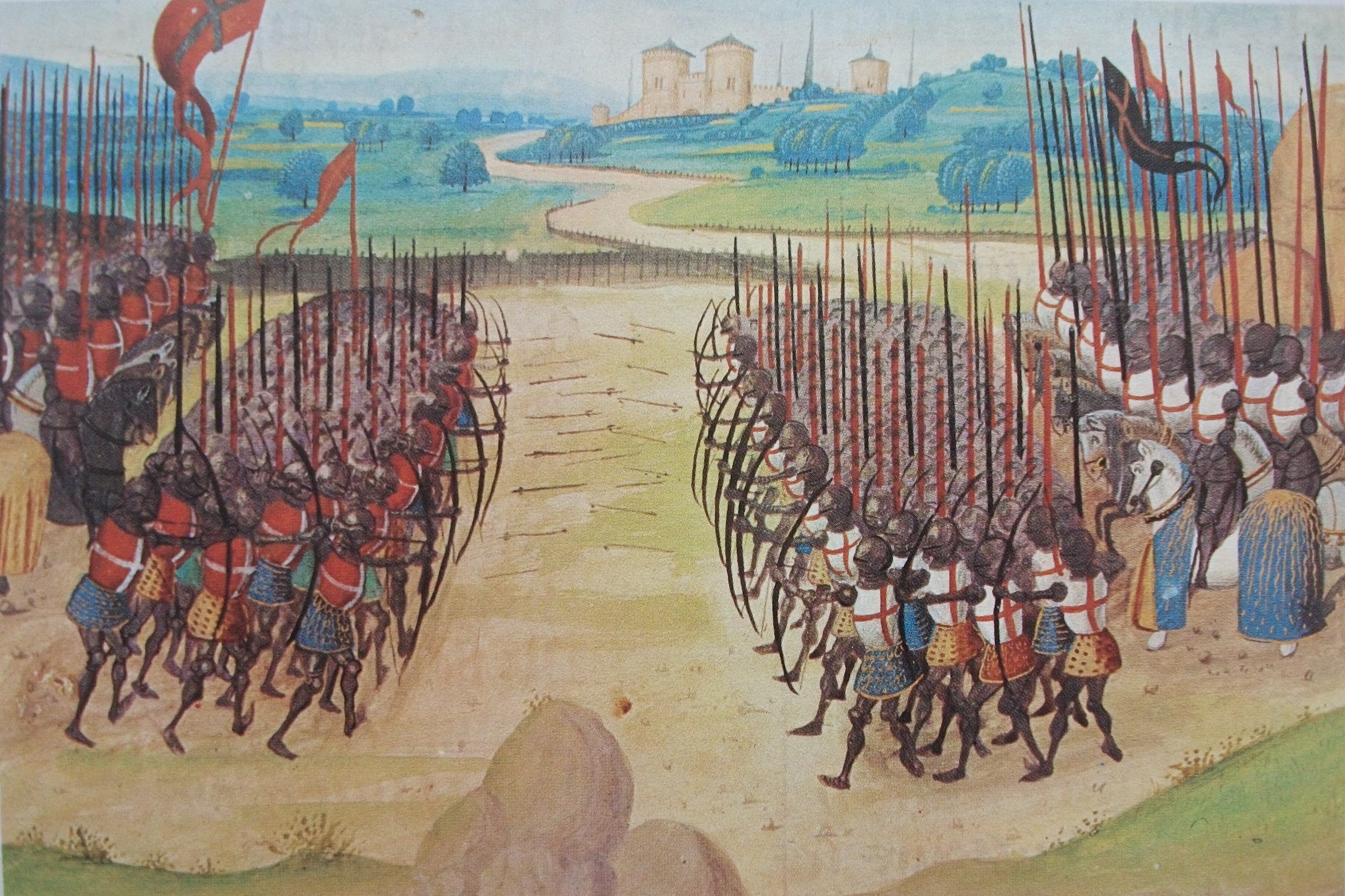
Five generations of kings and two rival dynasties fought for 116 years over the wealthiest and most populous kingdom in Western Europe, producing a conflict that reshaped the nature of medieval power.
In May 1337, King Philip VI of France met with his Great Council in Paris to settle a matter of geography and pride. The French crown had long chafed at the anomaly of Gascony—a fertile, wine-rich duchy in the southwest of France held by the kings of England. By feudal law, the English king was a vassal of the French monarch for these continental lands, an arrangement of mutual humiliation that had bred friction since the Norman Conquest of 1066. When Philip’s council agreed to confiscate Gascony and take it back into French hands, they believed they were merely exercising a sovereign's right over a troublesome duke. They did not anticipate that the duke in question, the young and aggressive Edward III of England, would respond by tearing up his oath of fealty. Instead of pleading for his fiefdom, Edward revived a dormant, audacious claim: that he was not merely the Duke of Gascony, but by right of blood, the true King of France.
This dynastic challenge was born of a succession crisis that had haunted the French court for two decades. When Charles IV died in 1328 without a male heir, the direct line of the ancient Capetian dynasty withered. Edward III was Charles’s closest male relative, born to the dead king’s sister, Isabella. But the French nobility, repulsed by the prospect of an English sovereign—particularly one whose mother was widely suspected of murdering her husband, the late Edward II—invoked a convenient precedent. They ruled that women could neither inherit the crown of France nor transmit the right to inherit it. This logic bypassed Edward and delivered the throne to Charles’s cousin, Philip of Valois. Edward had initially submitted, even traveling to France to perform reluctant homage for his continental lands. But the confiscation of Gascony shattered this uneasy peace. What began as a standard medieval property dispute instantly mutated into a titanic, multi-generational struggle for the wealthiest and most populous crown in Western Europe. It was a war that would outlive both kings, lasting one hundred and sixteen years, and fundamentally transforming the nature of European society.
The conflict, which historians would later divide into three great phases, began with a series of staggering English triumphs that shattered the military conventions of the age. Led by Edward III and his charismatic heir, Edward the Black Prince, the English forces abandoned the traditional, slow-moving siege warfare of the high Middle Ages in favor of devastating chevauchées—fast, brutal cavalry raids designed to ruin the French countryside and break the authority of the Valois crown. When the French knightly hosts rode out to defend their lands, they were systematically decimated by English tactical innovation. At Sluys in 1340, the French fleet was destroyed, securing English control of the Channel. On land, the devastating power of professional archers and coordinated infantry brought the English miraculous victories over the pride of French chivalry: first at Crécy in 1346, followed by the capture of the crucial port of Calais in 1347, and finally at Poitiers in 1356, where the Black Prince captured Philip VI’s successor, King John II of France.
+ 12 further connections to entries not yet ingested
But the sheer physical devastation of the war was soon eclipsed by an even greater catastrophe. Between 1347 and 1351, the Black Death swept across Western Europe, arresting the march of armies and emptying kingdoms. In France, the plague claimed between six and twelve million lives—thirty to sixty percent of the population—inducing economic collapse, massive labor shortages, and widespread social dislocation. England fared only slightly better, losing two to three million people. The compounding miseries of war, taxation, and pestilence triggered violent domestic upheavals. In France, the capture of their king at Poitiers ignited the Jacquerie, a desperate peasant uprising, and fierce political conflicts in Paris between the Dauphin and the merchant leader Stephen Marcel. Though the Treaty of Brétigny in 1360 briefly paused the war by granting Edward III vast territories in exchange for renouncing his claim to the throne, the peace was a fragile illusion. By 1369, the energetic Charles V the Wise of France declared the treaty void and renewed the struggle. Guided by his brilliant Constable, Bertrand du Guesclin, the French avoided disastrous set-piece battles, opting instead for a grinding war of attrition that gradually wore the English down, reducing their continental holdings to a few coastal enclaves by the time Charles and du Guesclin died in 1380.
The war’s final, most dramatic acts were set in motion by the internal collapse of France in the early fifteenth century. As King Charles VI descended into severe mental illness, the French court fractured into a bloody civil war between two rival factions, the Armagnacs and the Burgundians. Sensing an opportunity to revive his dynasty’s claims, the ambitious Henry V of England invaded France in 1415. At Agincourt, his heavily outnumbered army achieved a legendary victory, paving the way for the conquest of Normandy. Allied with the powerful Duke of Burgundy, Henry forced the French to sign the Treaty of Troyes in 1420, which disinherited the Dauphin and named Henry regent and heir to the French throne. Yet, at the very zenith of English power, the momentum vanished. In 1422, Henry V died unexpectedly, leaving his infant son, Henry VI, to inherit two crowns under the regency of the Duke of Bedford.
The tide turned not through the calculations of princes, but through the sudden, mystifying appearance of a peasant girl from Domrémy. In 1429, Joan of Arc arrived at the court of the embattled Dauphin, claiming divine voices had sent her to lift the siege of Orléans and see him crowned. Her presence galvanized a demoralized French nation. Orléans was saved in May 1429; the English were routed at Patay in June; and the Dauphin was crowned as Charles VII at Reims in July. Though Joan was captured by the Burgundians in 1430 and burned at the stake by the English in Rouen the following year, the spiritual and political revival she ignited was irreversible. In 1435, the Treaty of Arras reconciled Charles VII with Philip the Good, Duke of Burgundy, stripping England of its key ally. From that moment, the English slide was relentless. Paris fell to the French in 1436; Normandy was systematically reclaimed in the late 1440s; and the defeat of the veteran English captain Sir Thomas Kyriel at Formigny in 1450 signaled the end of English dominance in the north.
The final act of this century-long drama unfolded in the far south, in the very duchy where the war had begun. Guienne, having spent centuries under English rule, revolted against its new French masters, prompting the veteran English commander John Talbot to land with an army of five thousand men. But on July 17, 1453, at the Battle of Castillon, Talbot’s forces were destroyed by the superior, modernized artillery of the French army. Talbot was killed, and when Bordeaux capitulated on October 9, the war was effectively over. Of all the vast continental domains once held by the Plantagenets, only the pale of Calais remained under English control.
The world left behind in 1453 bore little resemblance to the one that had entered the war in 1337. The conflict had served as a crucible for the modern state. The old feudal levies, dominated by aristocratic heavy cavalry and bound by codes of chivalry, had been rendered obsolete by professional, paid infantry and the thunder of gunpowder artillery. To sustain such a prolonged struggle, both crowns had been forced to centralize their administrations, establish permanent taxation, and birth the first standing armies in Western Europe since the fall of Rome. But the deepest transformation was psychological. The shared elite culture of the Anglo-Norman world was dead; in its place stood a fierce, nascent nationalism. The English nobility, stripped of their ancestral lands in France and harboring deep resentment toward a bankrupt crown, turned their violent energies inward, plunging England into the decades of civil strife known as the Wars of the Roses. France, though scarred by decades of famine, banditry, and plague, emerged unified, powerful, and centralist—no longer a collection of warring fiefdoms, but a cohesive kingdom ready to assert itself as a dominant power on the European stage.