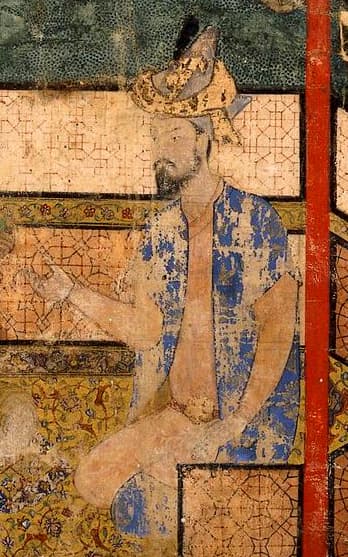
To inherit the throne of Delhi in 1530 was to step into a lethal inheritance of rivalries, where fraternal peace was a rarity and the state was always at risk of tearing itself apart.
In the early summer of 1542, a small, exhausted convoy struggled through the searing, white-hot expanse of the Thar Desert. The heat was at its most punishing, the water skins were dry, and the rations had dwindled to nothing. Among the travelers was Hamida Bano, the young wife of the deposed Mughal emperor, eight months pregnant and riding a horse that was rapidly failing. When her mount finally collapsed into the sand, none of the fleeing courtiers or soldiers offered the queen another. It was a moment of profound degradation for the house of Babur. The emperor himself dismounted and placed his wife on his own horse, resigned to riding a camel through the suffocating heat for several miles before a follower named Khaled Beg finally offered him a mount. Nasir al-Din Muhammad, known to history as Humayun—a name meaning "the fortunate" or "the auspicious"—would later describe this grueling trek as the absolute nadir of his life. Only twelve years earlier, he had inherited the throne of Delhi, the master of a young and glittering empire. Now, he was a landless fugitive, chased into the desert by an Afghan rival, betrayed by his own brothers, and reduced to begging for horses in the wilderness.
Humayun’s rise and fall, and his eventual, improbable resurrection, embodies the precarious nature of sovereignty in sixteenth-century Hindustan. He was born in Kabul in 1508, the eldest son of Babur, the brilliant Timurid conqueror who had swept down from Central Asia to dismantle the Lodi dynasty. Humayun’s mother, Māham Begum, was a woman of high pedigree, related to the Timurid ruler of Herat and descended from the Persian mystic poet Sheikh Ahmad-e Jami. Yet high birth was no guarantee of security. When Babur died in December 1530, the twenty-two-year-old Humayun inherited an empire that was barely a decade old, its roots shallow and its borders fiercely contested. Furthermore, the Timurids did not practice primogeniture. Instead, following the older Central Asian customs of Genghis Khan, they viewed the empire as collective family property. Any male of the ruling line possessed a claim to sovereignty. Babur had attempted to divide his territories, leaving the northernmost Afghan domains of Kabul and Kandahar to Humayun’s half-brother, Kamran Mirza, while Humayun received the core Indian conquests. It was an arrangement designed to prevent fratricide, but it achieved the opposite, transforming Humayun’s brothers—Kamran, Hindal, and Askari—into bitter, opportunistic rivals who watched his every misstep with predatory interest.
From the outset of his reign, Humayun’s temperament worked against the demands of his fragile empire. He was a man of high culture, deeply interested in astronomy, astrology, and literature, but he lacked his father’s relentless, predatory focus. He was also a frequent consumer of opium, a habit that often induced periods of lethargy and complacency at the worst possible strategic moments. His reign was immediately squeezed by two powerful rivals: to the southwest lay Sultan Bahadur, the wealthy and ambitious ruler of Gujarat, and to the east, along the Ganges in Bihar, was the brilliant Afghan commander Sher Shah Suri, then known as Sher Khan. In 1535, learning that Bahadur was plotting an assault on Mughal territories with Portuguese assistance, Humayun mobilized his forces and captured the formidable forts of Mandu and Champaner within a month. Yet, rather than pressing his advantage to destroy his rival, Humayun halted his campaign to organize his new conquests. While the emperor lingered, Bahadur escaped to Portuguese protection, and a popular revolt soon restored Gujarat to the Sultan.
+ 12 further connections to entries not yet ingested
This pattern of sudden brilliance followed by fatal hesitation repeated itself with catastrophic consequences in the east. While Humayun was occupied in Gujarat, Sher Shah Suri invaded Bengal and laid siege to its capital, Gaur. Humayun marched east to relieve the city, but allowed himself to be delayed by the lengthy siege of Chunar, a fortress held by Sher Shah’s son. By the time Humayun finally reached Gaur, he found a ghost city. Sher Shah had already captured the city, emptied its vast grain stores, and stripped Bengal of its immense wealth, transporting the plunder eastward to fund his war chest. The roads of Gaur were littered with corpses. Confronted by this grim scene, Humayun did not pursue his enemy; instead, he withdrew into his harem, shutting himself away for months to indulge in luxury.
This paralysis triggered a chain reaction of betrayals. In Agra, Humayun’s nineteen-year-old brother, Hindal, who had been tasked with securing the army's rear, abandoned his post, declared himself acting emperor, and murdered the grand Mufti, Sheikh Buhlul, whom Humayun had sent to reason with him. Meanwhile, Kamran Mirza marched down from the Punjab, ostensibly to assist the emperor but actually planning to carve up the crumbling empire with Hindal. By June 1539, when Humayun finally marched back to confront Sher Shah, his forces were divided and demoralized. The two armies met at the Battle of Chausa on the banks of the Ganges. During a tense, prolonged standoff, Humayun attempted diplomacy, agreeing to recognize Sher Shah’s rule over Bihar and Bengal under nominal Mughal suzerainty. To save face, the two leaders staged a mock battle: the Mughals would charge, and the Afghan forces would retreat in feigned terror. But once the theatrical charge was complete and the Mughal troops returned to their tents, they let down their guard. Seeing the imperial camp asleep and unprepared, Sher Shah broke the treaty. His forces launched a surprise night attack, slaughtering the sleeping Mughal soldiers. Humayun only survived by plunging into the Ganges, swimming across the river with the aid of an inflated water skin provided by a water-carrier named Shams al-Din Muhammad.
Returning to Agra, Humayun showed a remarkable, perhaps fatal, capacity for forgiveness. He pardoned Hindal’s treason and attempted to form a united front with his brothers. But Kamran, refusing to serve under Humayun, withdrew his forces to Lahore. On May 17, 1540, Humayun’s remaining army met Sher Shah’s forces at the Battle of Kannauj, two hundred kilometers east of Agra. The Mughal defeat was total. Humayun fled first to Delhi and then to Lahore, where the four brothers reunited, only to bicker as Sher Shah’s army drew closer. When Humayun tried to negotiate, offering to leave the entire Ganges Valley to Sher Shah if he could keep Lahore, the Afghan commander replied dryly, "I have left you Kabul. You should go there." Kabul, however, belonged to Kamran, who privately offered to ally with Sher Shah against Humayun in exchange for the Punjab. Though Humayun’s advisors urged him to execute his treacherous brother, the emperor refused, remembering the dying words of his father, Babur: "Do nothing against your brothers, even though they may deserve it."
It was during this desperate flight from Lahore that Humayun sought out spiritual solace, visiting Guru Angad Sahib, the second Sikh Guru, at Khadur Sahib. According to Sikh accounts, when the emperor arrived, the Guru was sitting and teaching children, and did not immediately rise to greet him. Offended, the fugitive emperor began to lash out, but the Guru calmly reminded him that when he actually needed to fight for his throne, he had fled, yet now he wished to attack a man at prayer. Rebuked, Humayun received the Guru's blessing and a prophecy that he would one day regain his empire.
Humayun’s long exile had begun. Wandering through the Thar Desert, he and his pregnant wife suffered the deepest deprivations before finding temporary refuge in the small fort of Umarkot, where Hamida Bano gave birth to their son, Akbar, in the autumn of 1542. Driven further west by hostile local rulers, Humayun finally crossed the borders of India and sought asylum in Persia at the court of the Safavid ruler, Shah Tahmasp I. His fifteen years in exile would permanently reshape the cultural landscape of the Indian subcontinent. In the Safavid court, Humayun was exposed to the heights of Persian art, literature, and administrative sophistication. When he finally returned to India, he was accompanied by a large retinue of Persian noblemen, artists, and calligraphers. This influx of Safavid influence largely overshadowed the Central Asian, Chagatai-Turkic origins of the early Mughal court, inaugurating a golden age of Persianate architecture, language, and miniature painting in India.
Humayun's opportunity to reclaim his empire arrived when Sher Shah Suri was killed by an accidental gunpowder explosion during the siege of Kalinjar in 1545. The Sur Empire, which had briefly replaced the Mughals, fractured under Sher Shah’s successors. In 1555, supported by Safavid military aid and accompanied by his now thirteen-year-old son Akbar, Humayun marched back across the Indus. He defeated the Indo-Afghan armies, entered Delhi in triumph, and reoccupied the throne he had lost fifteen years prior. The restoration, however, was tragically brief. In January 1556, only six months after his return to power, Humayun was in his library at the Sher Mandal in Delhi. As he descended the steep stone steps of the pavilion, he heard the adhan, the Muslim call to prayer. Attempting to kneel in reverence, his foot caught in his robe, and he fell headlong over the parapet. He died of his injuries three days later on January 27, 1556, at the age of forty-seven, leaving his newly restored, one-million-square-kilometer empire to his teenage son.
The legacy of the second Mughal emperor is written in stone and manuscript. Though his reign was defined by instability, his return from Persia cemented the cultural synthesis that would define the Mughal Empire at its zenith. After his death, his widow commissioned the magnificent Humayun’s Tomb in Delhi, a colossal red sandstone and white marble precursor to the Taj Mahal, which stood as a monument to the dynasty’s rebirth. It was a fitting resting place for a monarch who, as one historian famously observed, stumbled through life and tumbled out of it, yet managed to preserve the seed of an empire that would soon dominate the subcontinent.