Person · Pre Columbian North American
Hiawatha
- Also known as
- [colui che] fa i fiumi
- Aiionwatha
- Aiionwatha
- Aiionwatha
- Aiionwatha
- Ayenwatha
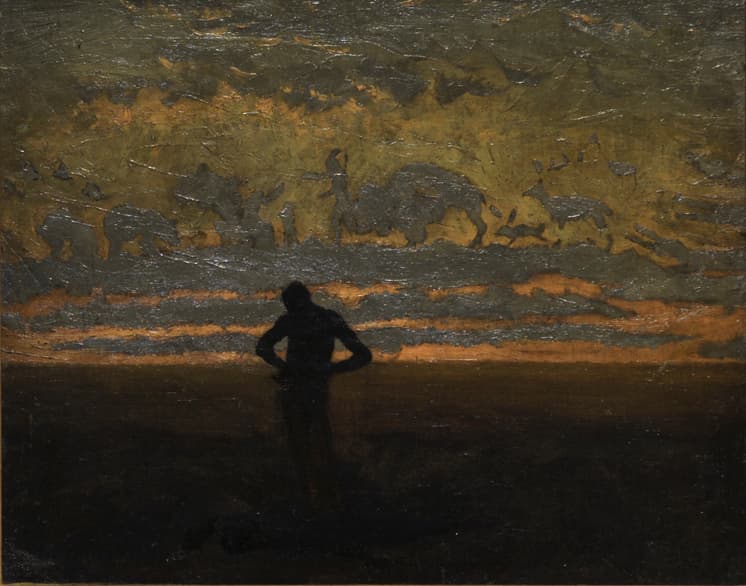
Long before European contact, in a forest cleared by the smoke of a cooking fire, a man looked into a kettle of water and saw a face that was not his own.
A man bent over a kettle of boiling water, preparing to consume the flesh of a fellow human being, looks down and sees a reflection that is not his own. In the water’s mirror appears a face of unexpected beauty, wisdom, and strength. The cannibal, astonished and suddenly struck with shame, realizes that this image cannot belong to one who kills and eats his kin. He looks up to find a stranger peering down through the smoke hole of his cabin roof. This stranger, a Huron prophet named Dekanawidah—the Great Peacemaker—does not strike or condemn him. Instead, he climbs down, sits across from the hearth, and speaks of a Great Law of Peace. The cannibal, whose name would become Hiawatha, listens, accepts the message, and vows to transform his life. In this moment, preserved in the oral histories of the Haudenosaunee, the bloody cycle of intertribal warfare in the Eastern Woodlands begins to break, replaced by a political vision that would reshape the northeast of North America.
To reconstruct the life of Hiawatha is to navigate the delicate boundary where history and sacred legend converge. While modern scholars and Native traditions place his life in the mid-twelfth century—a date supported by the memory of a solar eclipse that coincided with his work—he is fundamentally known through the epic narrative of his people. He was a leader of the Onondaga, the Mohawk, or perhaps both, born into the Onondaga but later adopted by the Mohawk. At the time of his meeting with the Great Peacemaker, the region was consumed by endless, blood-soaked feuds among five distinct Iroquois-speaking nations: the Mohawk, Oneida, Onondaga, Cayuga, and Seneca. The Peacemaker possessed the spiritual vision to unite these fractured peoples, but he suffered from a severe speech impediment that prevented him from effectively preaching his message. Hiawatha, possessed of a rare, persuasive eloquence, became his voice. He was the orator who could translate a divine vision of peace into the practical, political vocabulary of the council fire.
Yet, before Hiawatha could heal the divisions of the five nations, he had to survive the devastating grief of his own household. His chief political rival among the Onondaga was Tadodaho, a tyrant of unparalleled cruelty. Traditional accounts describe Tadodaho as a monster twisted in both mind and body: his head was a mass of living, writhing snakes, and snakes’ eyes glared from his very fingertips. Tadodaho fiercely opposed the message of unification, disrupting every council Hiawatha attempted to call. Through dark magic, the tyrant brought about the deaths of Hiawatha’s wife and his three daughters. Shattered by grief, Hiawatha fled his home and wandered the forests, a solitary figure stringing together purple and white beads of wampum. He sought anyone who could understand his sorrow and perform the thirteen-string ceremony of condolence, hoping to find a spell within the shells to quiet his mourning.
His wandering ended in the territory of the Mohawk, who had already embraced the Great Peacemaker’s message. There, the Peacemaker met him once more, offering Hiawatha strings of whelk shells to place over his eyes, ears, and throat as symbols of purity and healing. Chanting words that would forever define the Requickening Ceremony of the Iroquois, the Peacemaker comforted him: "I wipe away tears from thy face, using the white fawn-skin of pity... I make it daylight for thee... I beautify the sky. Now shall thou do thy thinking in peace." Healed of his paralyzing sorrow, Hiawatha joined the Peacemaker in composing the laws of the Great Peace and the sacred Peace Hymn. Armed with these new rituals of consolation, they set out together to win over the remaining nations.
The task required immense political patience. Hiawatha, now given a name meaning "he who combs"—a reference to the mission of combing the snakes out of Tadodaho’s hair—traveled with the Peacemaker and the Mohawk chiefs to negotiate. The Oneidas and Cayugas joined quickly, but the Seneca remained deeply divided until a solar eclipse darkened the skies, convincing them of the message's urgency. The final, greatest obstacle remained the Onondaga and their terrifying chief. Rather than destroying Tadodaho, the coalition offered him a place of honor, proposing that he become the principal chief of the new confederacy. Under the combined moral and political pressure of the other four nations, Tadodaho’s mind was made straight, the physical distortions of his body vanished, and Hiawatha stepped forward to comb the snakes from his hair.
Out of this reconciliation, the Haudenosaunee, or the People of the Longhouse, was born. The structure of this new confederacy was encoded in the Hiawatha Belt, a sacred object made of black and white beads fashioned from quahog clam and whelk shells. In this belt, the five nations are arranged in geographic order from west to east. On the far left are the Seneca, the Keepers of the Western Door; next are the Cayuga; in the center stands the Onondaga, symbolized by a great tree, serving as the Keepers of the Central Fire; to their right are the Oneida; and on the far right are the Mohawk, the Keepers of the Eastern Door. A single white line of wampum runs through each symbol, linking them in an unbreakable bond of unity and law. Centuries later, in 1722, the Tuscarora would join as the sixth nation, but the foundational architecture of the league remained that which Hiawatha and the Peacemaker designed.
For generations, the memory of Hiawatha remained preserved in the oral traditions and wampum records of the Haudenosaunee. However, in the nineteenth century, his name was detached from his actual history and thrust into the global literary consciousness through a profound misunderstanding. In 1855, Henry Wadsworth Longfellow published his epic poem, The Song of Hiawatha, intending to foster pride and remembrance for Native Americans. Yet, drawing on the papers of ethnologist Henry Rowe Schoolcraft, Longfellow mistakenly took the name of the Haudenosaunee statesman and applied it to the legends of Manabozho, an Ojibway demigod. Longfellow’s fictional hero, who battles monsters and ascends to the clouds, has no connection to the historical diplomat who walked the forests of upstate New York.
The real legacy of Hiawatha lies not in romanticized nineteenth-century American poetry, but in the enduring political structure he helped build. The Haudenosaunee Confederacy established a sophisticated system of representative democracy and conflict resolution that maintained peace across a vast territory for hundreds of years. By replacing the blood feud with the condolence ceremony, Hiawatha and the Great Peacemaker demonstrated that even the deepest grief and the most entrenched tyranny could be resolved through council, compromise, and the law of peace. Today, the design of the Hiawatha Belt flies on the flag of the Iroquois Confederacy, a living testament to a statesman who looked into a cooking pot, saw his own humanity reflected back, and spent the rest of his days combing the snakes of discord from the hair of his nation.
Connected to
- foundedIroquois
+ 5 further connections to entries not yet ingested