Person · 484 BCE – 425 BCE · Classical Greece
Herodotus
- Also known as
- Erodoto
- Erodoto
- Erodoto
- Erodoto
- Erodoto
- Erodoto d'Alicarnaso
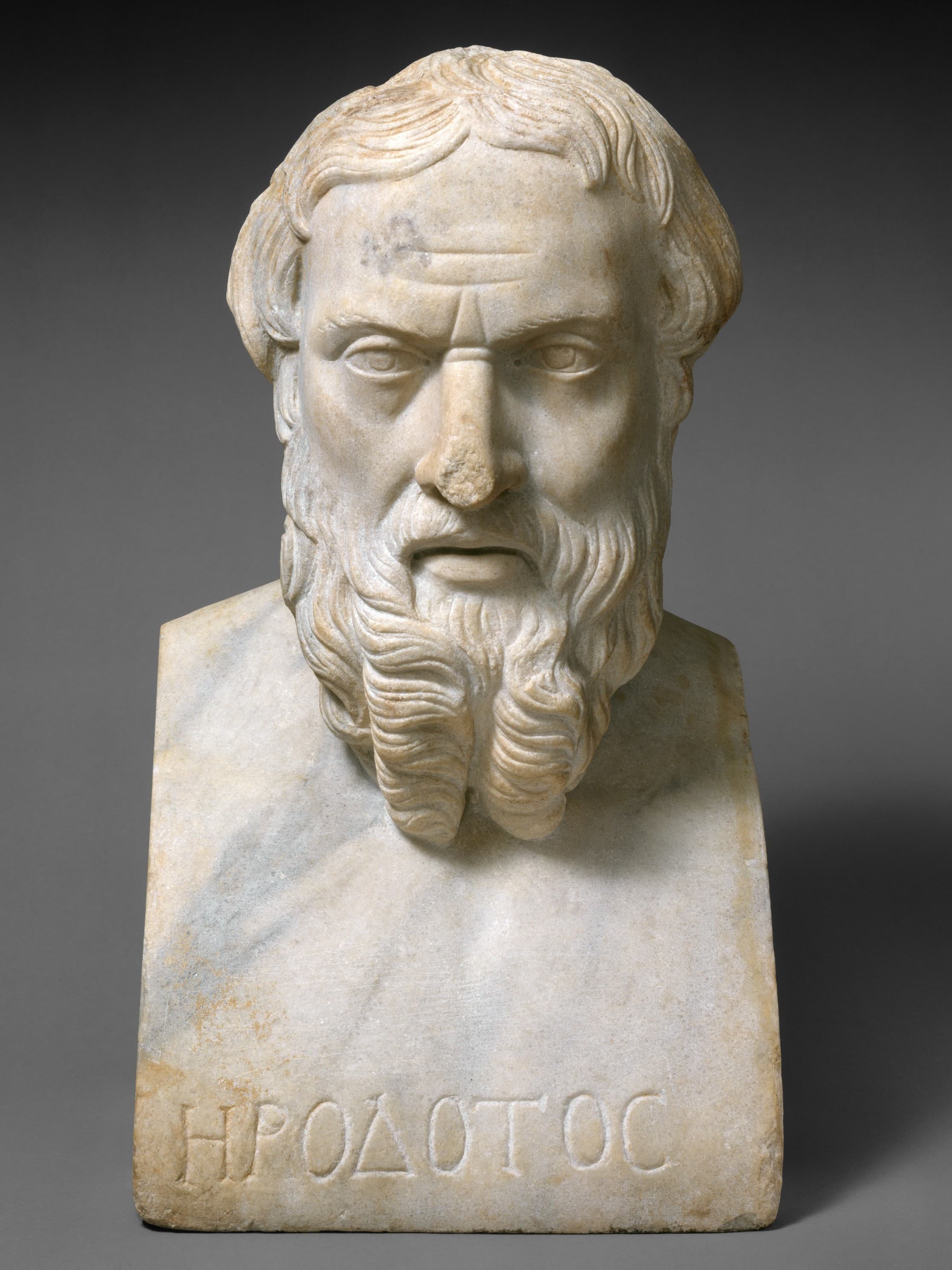
To write the history of a world-shaping clash, one must first learn to listen to the world itself.
In the middle of the fifth century BCE, a Greek-speaking traveler from the eastern edges of the Mediterranean walked the battlefields of Egypt, examining the weathered skulls left behind after the rebellion against Persian rule. He noticed a physical peculiarity: the Persian skulls were so fragile they could be shattered with a pebble, while those of the Egyptians were thick and robust. To satisfy his curiosity, he did not consult a oracle or spin a myth; he asked the locals, who explained that Egyptians shaved their heads from childhood, hardening the bone in the sun, while Persians wore soft felt tiaras. This small, empirical observation belongs to Herodotus of Halicarnassus, a man who stood at the threshold of a mental revolution. Before him, the past was preserved in the rhythmic, divinely inspired hexameters of epic poetry, where human actions were the playthings of Olympian gods. By seeking out physical evidence, interviewing eyewitnesses, and comparing customs, Herodotus invented a new way of organizing human memory. He called his method historie—a word that did not yet mean "history," but simply "inquiry."
Herodotus was born around 484 BCE in Halicarnassus, a bustling, outward-looking port city on the southwestern coast of Anatolia. It was a place where worlds collided. Though Greek in culture, Halicarnassus was a subject city of the vast Persian Achaemenid Empire, ruled during Herodotus’s youth by a queen named Artemisia, and later by her grandson, the tyrant Lygdamis. Herodotus himself was a product of this cultural hybridity; his father, Lyxes, and his relative, the epic poet Panyassis, bore names of Carian origin, suggesting he was at least partially Hellenized Carian. He grew up speaking the Ionic dialect of Greek and breathing the cosmopolitan air of a port that had helped pioneer Greek trade with Egypt. The proximity of the Persian colossus was not a distant political abstraction but a daily reality. This liminal existence between the Greek and non-Greek worlds shaped his intellectual horizon. Unlike the insular citizens of mainland Greece, Herodotus understood that the "barbarians"—the Greek term for foreign-tongued peoples—possessed their own ancient civilizations, complex laws, and venerable traditions worthy of respect.
When political turmoil gripped Halicarnassus, Herodotus’s family found itself on the losing side. Lygdamis executed Panyassis for suspected treason, prompting Herodotus to flee, possibly to the nearby island of Samos, an important member of the Athenian confederacy. The Byzantine encyclopedic dictionary, the Suda, preserves a romantic account of Herodotus later returning to lead the democratic uprising that overthrew the tyrant, though other ancient sources are silent on this heroic role. What is certain is that the loss of his civic home turned Herodotus outward. Between his twentieth and thirty-seventh years, roughly from 464 to 447 BCE, he embarked on an astonishing series of travels that covered thirty-one degrees of longitude and twenty-four degrees of latitude—an area spanning some 1,700 miles in each direction. He journeyed along the royal road from Sardis to the Persian capital of Susa; he descended the Euphrates to the towering walls of Babylon; he sailed north to Colchis and the windswept western shores of the Black Sea, venturing into the vast steppes of Scythia. He explored the ancient Phoenician temples of Tyre, coasted past Gaza, and spent months in Egypt, traveling as far south as the first cataract of the Nile.
Wherever he went, Herodotus operated as an intellectual gatherer. He measured monuments, interviewed priests, cataloged burial customs, and noted the peculiarities of local flora and fauna. He was a pioneer of cultural geography and ethnography, working under the conviction that to understand a people’s actions, one must understand their landscape and their nomoi—their customs and sacred laws. In Egypt, he observed how the annual flooding of the Nile dictated the rhythm of life, and he argued that the country was "the gift of the river." In Scythia, he marveled at the nomadic lifestyle of horse-riding archers who carried their homes on wagons. Rather than judging these foreign customs against an absolute Greek standard, Herodotus maintained a striking cultural relativism. He famously quoted the poet Pindar, asserting that "custom is king of all," illustrating this with an anecdote of the Persian king Darius, who asked some Greeks what price would induce them to eat the bodies of their deceased fathers. They cried out in horror at the suggestion. Darius then asked a tribe of Indians who did eat their dead what would entice them to burn the bodies, as the Greeks did, and they responded with equal dread.
Around 447 BCE, Herodotus migrated to Athens, the pulsing intellectual and democratic heart of the Greek world. There, in the brilliant circle of Pericles, Sophocles, and the philosopher Protagoras, his gathered materials took their final, monumental shape. He wove his geographical and ethnographic inquiries into a single, grand narrative: the rise of the Persian Empire and its ultimate, dramatic clash with the allied Greek city-states in the Greco-Persian Wars. To share his work, Herodotus adopted the practice of the day, delivering oral recitations to public audiences at civic festivals. Ancient accounts celebrate these performances; the writer Lucian claimed Herodotus read his entire work to the assembled crowds at the Olympic Games, while another tradition tells of a young Thucydides bursting into tears of inspiration upon hearing Herodotus recite. The Athenian assembly was so moved by his accounts of their ancestors' heroism at Marathon and Salamis that, upon the proposal of a citizen named Anytus, they voted to award him the massive sum of ten talents.
Yet Herodotus’s expansive, digressive style—which regularly abandoned the main military narrative to describe baboons in Libya, the building of the pyramids, or the sexual habits of distant tribes—drew sharp criticism from more austere minds. His contemporary Thucydides, writing a clinical, highly focused history of the Peloponnesian War, dismissed Herodotus’s work as a collection of prize-essays designed to please an audience for a moment, rather than a lasting possession for all time. To Thucydides and later critics, who labeled Herodotus the "Father of Lies," his inclusion of local legends, dreams, and divine retribution seemed unscientific. The comic playwright Aristophanes parodied him in The Acharnians, mocking Herodotus’s habit of tracing immense geopolitical conflicts back to mythical abductions of women. Herodotus defended his methodology with a simple, honest baseline: "My business is to record what people say, but I am by no means bound to believe it." He was not a credulous collector of myths, but a compiler of testimonies, offering his readers the raw material of human memory and allowing them to judge its validity.
In his later years, Herodotus joined the Athenian-sponsored colony of Thurii in southern Italy, a progressive pan-Hellenic project planned by the philosopher Protagoras. It was here, in Magna Graecia, that he likely spent his final years refining his Histories, though some scholars suggest he returned to Athens and perished in the devastating plague of 430 BCE. He died childless, leaving his writings as his sole heirs. He left behind a world forever altered by his vision. By lifting human deeds out of the realm of myth and placing them within a framework of geography, culture, and human causation, Herodotus gave humanity its past. His Histories showed that the clash of civilizations was not a decree of the gods, but a consequence of human choices, hubris, and the unpredictable turns of fortune. He captured the fragile, fleeting nature of human achievements, ensuring that the courage of the few who stood at Thermopylae and the grandeur of the empires they resisted would not be erased by the quiet, eroding march of time.
Connected to
10 links to entries not yet ingested in the Library.