Person · 1485 CE – 1547 CE · Mesoamerican Civilizations
Hernán Cortés
- Also known as
- Ay-al-nan.ke-al-te-s
- Cortez
- Cortés
- Cortési Hernán
- Ernan Kortes
- Ernan Kortes
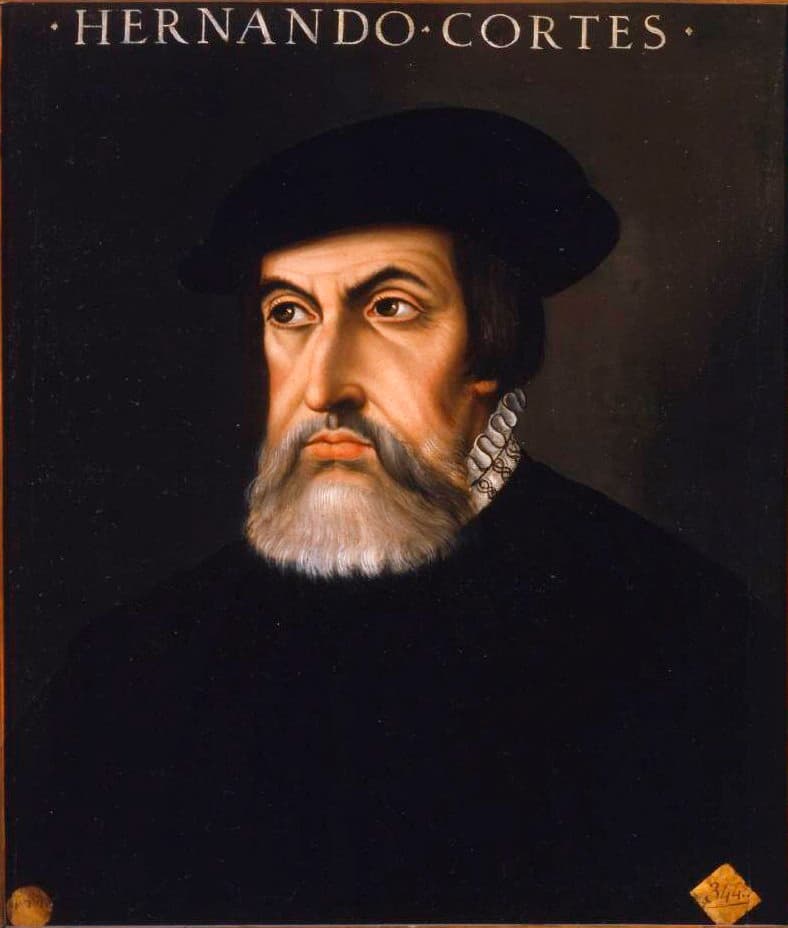
Before he was a marquis, Hernando Cortés was a mutineer.
In the early spring of 1519, eleven ships rode the swells off the coast of the Yucatán Peninsula, carrying a force that was, by any reasonable measure of military logistics, absurdly inadequate for the conquest of an empire. There were roughly five hundred men, thirteen horses, a handful of brass cannons, and a leader whose formal military experience was virtually nonexistent. Hernán Cortés was thirty-four years old, a man of medium, stocky build with a graying, melancholy face and eyes that shifted unpredictably between warmth and severe gravity. He was not a celebrated general but a provincial notary and municipal magistrate from Cuba who had spent his youth studying Latin under an uncle in Salamanca and drafting legal contracts in the Caribbean. Yet he possessed a dangerous, highly sophisticated understanding of Castilian jurisprudence, a quality that would prove far more lethal to the Aztec Empire than his meager artillery.
Cortés was a creature of the desolate, impoverished plains of Extremadura, born to a family of lesser nobility with distinguished lineage but slender means. He had missed the first great waves of transatlantic exploration due to a youth spent wandering the southern ports of Spain, marked by what his contemporaries described as a ruthless, haughty, and mischievous temperament. When he finally arrived in the New World in 1504, it was not as a soldier but as a bureaucrat. For fifteen years, he operated within the administrative machinery of Hispaniola and Cuba, securing land, extracting the labor of indigenous Taíno slaves, and serving as a secretary to the governor of Cuba, Diego Velázquez de Cuéllar. It was a life of comfortable, minor tyranny. But when Velázquez commissioned him to lead an exploratory expedition to the Mexican mainland in late 1518, only to revoke the charter at the last moment out of sudden jealousy, Cortés chose the path of open mutiny. He gathered his men, ignored the governor’s recall, and sailed into treason.
To survive his own rebellion against Spanish authority, Cortés knew he had to deliver a prize so vast that King Charles I of Castile would have no choice but to pardon the illegality of its acquisition. Upon landing on the coast of the mainland, he executed his first masterstroke of legalistic theater. In July 1519, his men founded the settlement of Veracruz. By establishing a formal municipality, Cortés resigned his commission under the hostile governor of Cuba and had the newly formed town council appoint him directly as captain-general, placing him theoretically under the sole authority of the King of Spain. To ensure his men shared his desperation, he then ordered his ships scuttled. There was no retreat to Cuba, no legal harbor to return to; their only path to survival lay inland, through the high mountain passes of the Sierra Madre, toward the valley of Mexico.
The conquest that followed was not a simple clash of European steel against indigenous stone, but a complex, brutal exercise in political manipulation. Cortés understood almost immediately that the Aztec Empire was not a monolithic state but a fragile confederation of tribute-paying city-states held together by fear and military coercion. To navigate this fractured landscape, he relied on two crucial interpreters: Gerónimo de Aguilar, a shipwrecked Spanish Franciscan priest who had learned Chontal Maya during years of captivity, and La Malinche, a young indigenous woman given to Cortés as a peace offering after a victory in Tabasco. Malinche spoke both Mayan and Nahuatl, the language of the Aztec court. Through this linguistic chain—Cortés to Aguilar in Spanish, Aguilar to Malinche in Mayan, and Malinche to the local lords in Nahuatl—Cortés could negotiate, flatter, threaten, and construct a vast network of indigenous allies who saw the Spaniards as a weapon to dismantle Aztec hegemony.
The most critical of these alliances was forged with the Tlaxcalans. After a series of fierce battles in September 1519, in which the Spaniards were nearly overwhelmed, the Tlaxcalan leadership decided that the newcomers represented a unique opportunity to destroy their ancestral enemies in Tenochtitlán. Strengthened by thousands of Tlaxcalan warriors, Cortés marched toward the holy city of Cholula in October. There, claiming he feared native treachery and wished to make a terrifying example to the Aztec emissaries watching his progress, Cortés ordered a pre-meditated massacre. Within hours, thousands of unarmed Cholulans were slaughtered in the city’s central plaza. It was a calculated display of terror designed to echo across the valley of Mexico, ensuring that when the Spanish column finally descended into the lake basin of Tenochtitlán, the Aztec emperor, Moctezuma II, would receive them not with immediate steel, but with a deeply apprehensive diplomacy.
The world Cortés eventually conquered was unlike anything the Spanish imagination had prepared for: a metropolitan marvel built upon a salt lake, connected to the mainland by massive causeways, populated by hundreds of thousands of people, and dominated by towering pyramids. Yet the fall of this empire was ultimately engineered by a man who used the very institutions of Spanish law to legitimize an unsanctioned invasion. Years later, when the smoke of the collapsed capital had cleared and the ruins of Tenochtitlán were rebuilt as Mexico City, the crown rewarded Cortés with the title of Marquis of the Valley of Oaxaca, acknowledging his immense conquests while pointedly denying him the viceroyalty of the newly won territory, which was handed to a high-ranking nobleman. He died in Spain in 1547, a wealthy but restless man of natural causes, having spent his final years writing letters to the King, defending his legacy, and petitioning for the recognition he felt he was owed. He left behind a transformed continent, bound to the Castilian crown by the ruins of an empire and the complex, violent foundations of modern Mexico.
Connected to
12 links to entries not yet ingested in the Library.