Place · 824 CE · Islamic Caliphates
Heraklion
- Also known as
- Candia
- Candia
- Candia
- Candia
- Candia
- Candia
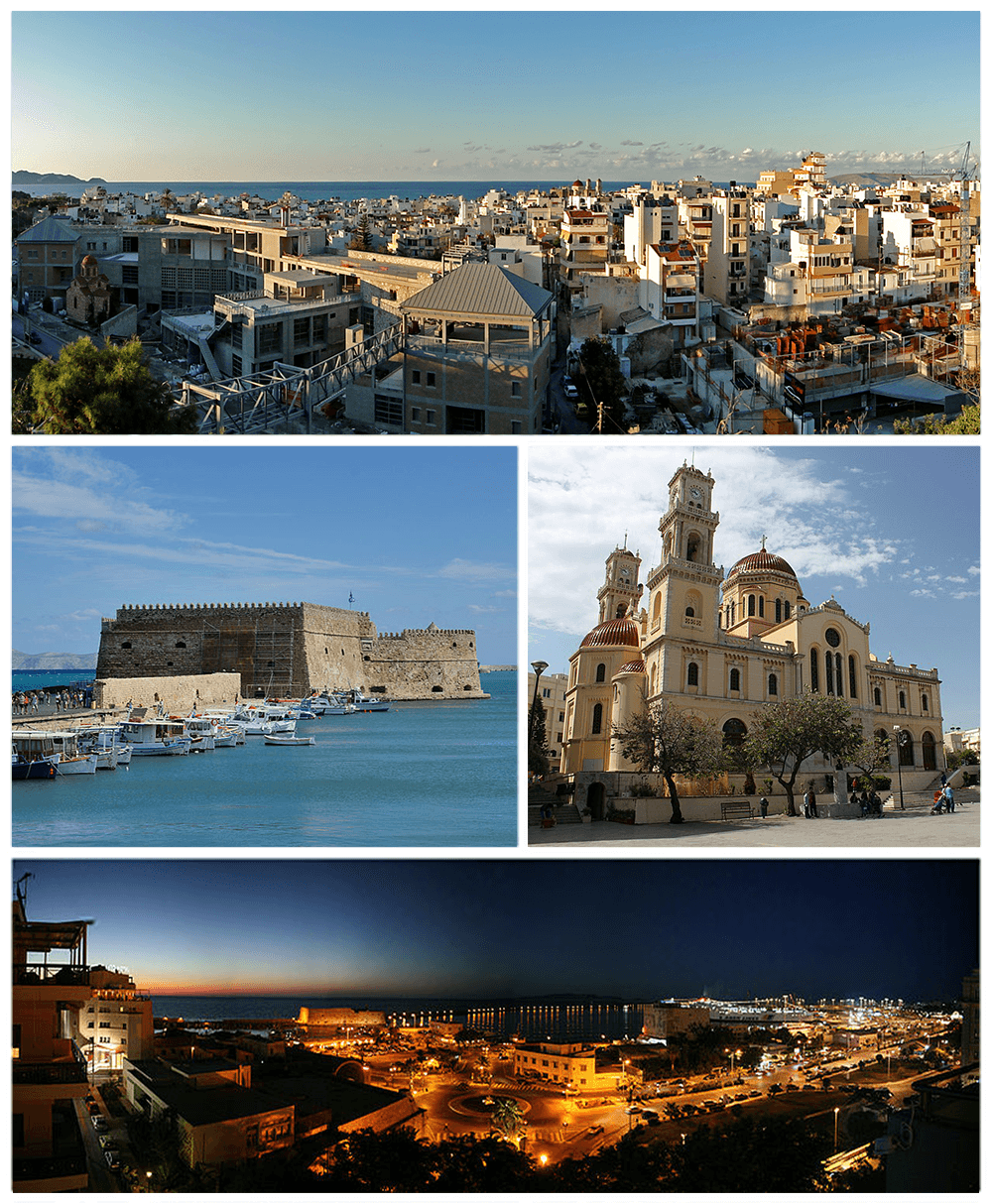
Before it became the modern administrative capital of Crete, the ground beneath Heraklion was already ancient.
Near the southern edge of the Aegean Sea, where the ancient world’s maritime trade routes converged, a modern city sits atop layers of vanished civilizations. To the casual traveler walking through its bustling modern squares, the city is Heraklion, the administrative capital of Crete. Yet, to peel back its topsoil is to encounter a dizzying succession of names and identities, each left by a different master of the Mediterranean. It has been a Minoan harbor, an Andalusian pirate nest known as rabḍ al-ḫandaq, a Byzantine stronghold called Chándax, a Renaissance Venetian capital named Candia, and an Ottoman garrison known as Kandiye. This singular geographic node has been continuously inhabited since at least 7000 BCE, making the surrounding area one of the oldest inhabited regions in Europe, a place where the physical remnants of the Bronze Age lie just miles from medieval ramparts designed to withstand gunpowder.
For millennia, the site’s destiny was tethered to Knossos, the legendary center of the Minoan civilization located just under four kilometers inland. From the early Bronze Age, around 3500 BCE, this stretch of Cretan coast served as the primary port for the massive Minoan palace. Through this harbor flowed the tin, copper, pottery, and oil that sustained Europe’s oldest urban center. The name "Heraklion" itself derives from this ancient harbor town, Heracleium, named in honor of the hero Heracles. When the Minoan civilization collapsed, the region entered a long twilight. Under Roman and early Byzantine rule, the port remained quiet, a provincial backwater plagued by Aegean pirates and bandits, its ancient connection to the ruined palace of Knossos preserved only in the accounts of geographers like Strabo.
The modern city’s true urban birth occurred not in antiquity, but in the year 824 CE, born from an act of displacement and conquest. A band of Arab exiles from al-Andalus, having been expelled from Iberia by the Emir Al-Hakam I, swept across the Mediterranean and seized Crete from the Eastern Roman Empire. Led by Abu Hafs Umar, they abandoned the traditional inland capital of Gortyna and established their headquarters at the old northern port. Here, they dug a massive defensive ditch around their new settlement, naming the fortress rabḍ al-ḫandaq—the "Castle of the Moat." Hellenized by the local Greek population as Chándax, this fortified settlement became the capital of the Emirate of Crete. For over a century, the city operated as a notorious and highly successful corsair state. The Saracens transformed the harbor into a protected haven for pirates who preyed upon Byzantine shipping, launching devastating raids across the Aegean islands and coastal Greece.
This thorn in the side of Constantinople was finally extracted in 960 CE, when the Byzantine general Nikephoros Phokas, the future emperor, landed a massive expeditionary force on the island. Following a brutal, prolonged winter siege, the defenses of Chandax were breached in March 961 CE. The Byzantine forces slaughtered the Saracen inhabitants, looted its accumulated wealth, and burned the Castle of the Moat to the ground. Rebuilt under imperial orders, the city remained under Byzantine control for nearly two and a half centuries, serving as a vital strategic outpost safeguarding the southern approaches to Constantinople.
The global convulsions of the Fourth Crusade reshaped the city once more. In 1204 CE, during the complex political bargaining that saw Western crusaders sack Constantinople and partition the Byzantine Empire, the Republic of Venice purchased the island of Crete. Recognizing the harbor's immense value, the Venetians renamed the city Candia and made it the seat of the Duke of Candia, transforming the entire island into the maritime kingdom of Regno di Candia. To secure their grip on this rebellious island, Venice began settling Venetian families there in 1212 CE. This forced coexistence of Latin and Greek cultures, catalyzed by the artistic currents of the Italian Renaissance, sparked a brilliant intellectual epoch known as the Cretan Renaissance. Candia became a center of letters, painting, and humanism, where Byzantine iconographic traditions fused with Venetian perspective.
To protect this jewel of their commercial empire, the Venetians constructed monumental fortifications that still dominate the city’s waterfront today. They reinforced the old Arab moat and built a colossal ring of defensive walls—in some places up to forty meters thick—punctuated by seven massive bastions. At the mouth of the harbor, they erected the formidable Koules Fortress, or Castello a Mare, alongside massive vaulted arsenals for their galleys. These defenses were put to the ultimate test during the Cretan War (1645–1669) when the forces of the Ottoman Empire laid siege to the city. The Siege of Candia lasted for twenty-one years, the longest recorded siege in human history up to that point. In its grueling final twenty-two months alone, the conflict claimed the lives of seventy thousand Ottoman soldiers and nearly sixty thousand Christian defenders, Cretans, and enslaved laborers. The city finally capitulated in 1669 CE to the Ottoman Grand Vizier Köprülü Fazıl Ahmed Pasha.
Under Ottoman rule, the city, renamed Kandiye, remained the island's capital until 1849, though its commercial fortunes waned as its harbor gradually silted up, forcing international shipping to migrate westward to Chania. Locally, Greek residents referred to the formidable walled city as Megalo Kastro—the "Big Castle." The nineteenth century brought upheaval, beginning with a devastating earthquake on October 12, 1856, which destroyed over three thousand homes in the city, leaving a mere eighteen intact and claiming 538 lives. Following decades of Cretan rebellions, the Great Powers intervened, establishing an autonomous Cretan State in 1898 under international supervision. It was during this British-administered transitional period that locals officially revived the ancient, classical name of Heraklion.
The twentieth century integrated Heraklion into the modern Greek state in 1913, but peace was short-lived. During the Second World War, the city was severely damaged by Luftwaffe bombing during the intense German invasion of Crete in May 1941, remaining under occupation until 1945. In 1971, Heraklion regained its title as the administrative capital of Crete, embarking on a period of rapid modernization and urban expansion.
Today, Heraklion is the fourth-largest city in Greece, its streets a crowded palimpsest of its tumultuous history. Pedestrians in the historic center pass the elegant Renaissance Loggia and the Morosini Fountain, with its carved stone lions, before walking past the Byzantine-era Cathedral of Saint Titus—which served for centuries as an Ottoman mosque—and the immense Venetian ramparts that still shield the old town from the sea. Its international airport, named after the famed Heraklion-born writer and philosopher Nikos Kazantzakis, welcomes millions of travelers each year, many of whom come to walk the restored corridors of Knossos or view the Minoan frescoes housed in the city's archaeological museum. Though the moat that gave the Arab city its name has long been dry, the walls of Heraklion remain, preserving the memory of an island outpost that was, for centuries, the heavily fortified hinge upon which the empires of the Mediterranean turned.
Connected to
- in countryByzantine Empire395 CE
- in countryOttoman Empire1299 CE
+ 6 further connections to entries not yet ingested