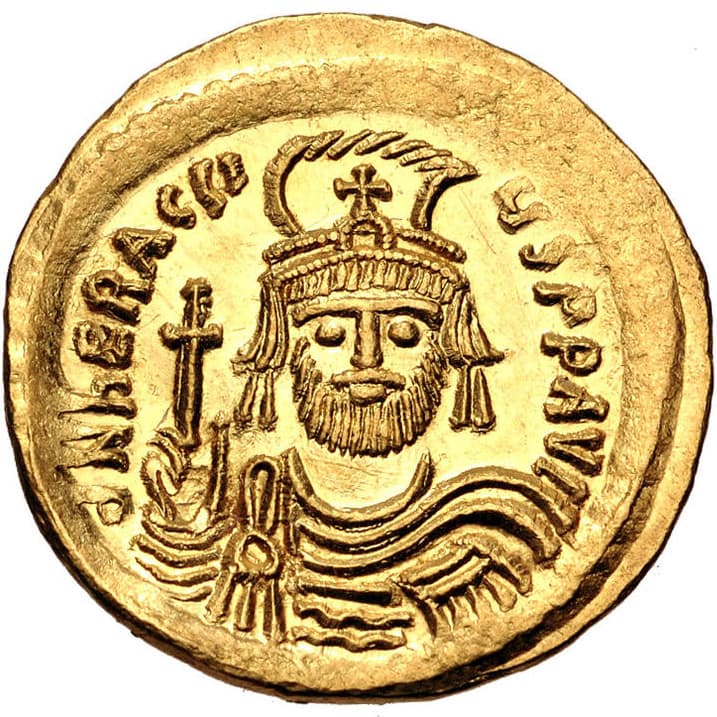
The throne that Heraclius seized in 610 CE, after leading a rebellion from North Africa with his father against the emperor Phocas, was already sliding toward ruin.
In the autumn of 610 CE, a young commander named Heraclius arrived by sea at the harbor of Constantinople, his ships bearing the standards of a rebellion that had begun on the distant coast of North Africa. The city he came to claim was in ruins, paralyzed by the reign of Phocas, an army officer who had usurped the throne eight years prior through the murder of the Emperor Maurice and his family. Phocas had ruled by terror, leaving the empire’s borders exposed to a devastating invasion by the Sasanian Persians. When Heraclius confronted the deposed tyrant, he reportedly asked him, "Is this how you have ruled, wretch?" Phocas’s dying reply—"And will you rule better?"—lingered over the scene as Heraclius personally decapitated his predecessor. The dead emperor’s body was further mutilated to avenge his assault on the wife of a powerful local politician, and on October 5, Heraclius was crowned in the Chapel of Saint Stephen within the Great Palace. He inherited an empire on the verge of extinction, beginning a thirty-year reign that would witness one of the most dramatic military resurrections in human history, followed immediately by an equally spectacular collapse.
The new emperor’s origins lay in Cappadocia, though his parentage linked him closely to the rugged frontier of Armenia. He was the eldest son of Heraclius the Elder, a distinguished general who had served under the late Emperor Maurice in the wars against the Persian usurper Bahram Chobin. Appointed Exarch of Africa, the elder Heraclius had established a powerful, semi-independent power base in Carthage. In 608 CE, father and son openly renounced their allegiance to Phocas. While the younger Heraclius prepared his naval expedition, his cousin Nicetas launched an overland invasion of Egypt, successfully securing the empire’s vital grain supply. When Heraclius finally steered his fleet into the Bosporus, the elite imperial guard known as the Excubitors—led by Phocas’s own son-in-law, Priscus—deserted to the rebel cause. Heraclius entered the capital almost without resistance. Yet the crown he assumed was a heavy one. He was bilingual, probably fluent in both Armenian and Greek, and possessed a deep, practical understanding of military logistics inherited from his father's campaigns. He would need every shred of this inheritance, for the Persian King of Kings, Khosrow II, was already marching through the Roman East.
Khosrow II had been restored to his own throne years earlier with the help of the murdered Emperor Maurice, and he used his benefactor’s death as a pretext to launch a war of total conquest. The Persian armies tore through the Levant and Egypt, exploiting the chaos of the Roman succession crisis. In 613 CE, Heraclius personally took command of the imperial forces, only to suffer a catastrophic defeat near Antioch at the hands of the Persian generals Shahrbaraz and Shahin. The consequences of this loss were swift and devastating. Damascus fell in 613 CE, followed by Jerusalem in 614 CE. The capture of Jerusalem was a spiritual trauma for the Christian world; the Persians damaged the Church of the Holy Sepulchre and carried off the True Cross, the empire's most sacred relic, to their capital at Ctesiphon. By 621 CE, Egypt—the economic engine of the Mediterranean—was entirely in Persian hands, cutting off the imperial grain dole to Constantinople. Simultaneously, the Avars and Slavs swept down from the north, overrunning the Balkans and advancing to the very walls of the capital.
+ 12 further connections to entries not yet ingested
By 618 CE, the situation had grown so desperate that Heraclius seriously contemplated abandoning Constantinople altogether, planning to relocate the seat of Roman power to the safety of Carthage. He was stopped only by the intervention of Patriarch Sergius and the citizens of Constantinople, who implored him to remain. To finance a counter-offensive, Heraclius took extraordinary measures, possibly threatening to leave for Africa to force the clergy’s hand. He secured a massive loan from the Church, melting down ecclesiastical gold and silver treasures to mint coins, while drastically slashing non-military expenditures. On April 4, 622 CE, Heraclius left Constantinople to launch his counter-offensive, leaving his young son under the regency of Patriarch Sergius and the general Bonus. To steel the resolve of his battered army, Heraclius transformed the conflict into a holy war. He distributed the acheiropoietos—an image of Christ believed not to have been made by human hands—as a military standard, and delivered impassioned speeches framing their struggle as a righteous defense of the Christian faith against the fire-worshiping Persians who had plundered their holy cities.
For the next several years, Heraclius lived on campaign, accompanied by his second wife, Martina—his niece, whom he had married in 622 or 623 CE despite widespread public and ecclesiastical outrage over their incestuous union. Operating out of Anatolia and the Caucasus, Heraclius proved himself a brilliant tactician. He drilled his troops into a disciplined fighting force, utilizing the rugged terrain of the Armenian highlands to outmaneuver the larger Sasanian armies. While Heraclius campaigned in the East, Constantinople faced its greatest trial in the summer of 626 CE, when a combined force of Avars, Slavs, and a Persian army under Shahrbaraz besieged the city. The capital held, its defenders carrying icons of the Virgin Mary in procession along the battlements, while Heraclius’s brother Theodore defeated a second Persian army at the Lycus. With the siege broken, Heraclius forged an alliance with the Western Turkic Khaganate, who poured through the Caspian Gates into Persian territory.
The climax of the war came in late 627 CE. Decisively marching across the Armenian highlands into the Tigris plain, Heraclius met the Persians at the Battle of Nineveh. Fighting with immense personal bravery, Heraclius led his forces to a crushing victory, subsequently devastating Mesopotamia and advancing toward Ctesiphon. The defeat broke the prestige of Khosrow II, who was soon overthrown and executed by his son, Kavad II. The new Persian monarch immediately sued for peace, agreeing to evacuate all conquered Roman territories. In 629 CE, Heraclius returned to Constantinople in triumph. Later that year, he traveled to Jerusalem to personally restore the True Cross to the Holy Sepulchre. It was the apex of his life, a moment of seemingly miraculous deliverance that secured his reputation as one of the greatest military emperors of the Roman world. During his reign, he also formalised the cultural identity of his state, making Greek the official language of the empire to reflect the realities of its administration.
Yet the triumph was hollow, bought at the cost of total exhaustion. The long war had left both the Roman and Sasanian empires demilitarized, financially ruined, and deeply divided. Heraclius attempted to heal the religious schisms that fractured his remaining provinces, particularly the rift between the orthodox Chalcedonian establishment and the non-Chalcedonian populations of Syria and Egypt. He promoted a compromise theological doctrine known as monothelitism—the idea that Christ had two natures but a single will—which also drew in the Church of the East. This attempt at artificial unity pleased no one, earning rejection from all sides of the theological divide and deepening local alienation from imperial authority. In his civil administration, Heraclius pursued reforms without deferring to the traditional nobility or the Church, generating internal friction that paralyzed his government. His domestic life was similarly troubled; his marriage to Martina produced several children with physical and cognitive defects, which the public widely interpreted as divine punishment for their incestuous union.
The fragility of Heraclius’s restored empire became starkly apparent in the early 630s CE. Out of the Arabian Peninsula, united under the banner of Islam, a new power emerged. Weakened by decades of warfare, the Sasanian Empire quickly collapsed before the armies of the Rashidun Caliphate. The Roman frontier, defended by unpaid troops and populations alienated by religious persecution, was equally vulnerable. In 629 CE, the first Saracen incursions into Syria began. By 636 CE, the Arab forces won a decisive victory on the banks of the Yarmuk River, defeating a Roman army commanded by Heraclius's brother Theodore. Suffering from severe dropsy and worn out by decades of continuous fighting, Heraclius no longer possessed the physical or mental energy to command in person. He watched from afar as Syria, Palestine, Mesopotamia, Armenia, and eventually Egypt were lost once more—this time permanently. Unable to mount a counter-offensive, Heraclius evacuated his remaining forces in sullen despair.
When Heraclius died on February 11, 641 CE, the vast eastern empire he had spent his life saving was gone, reduced once again to the Anatolian heartland and the capital. He left behind a fractured family, a bitter theological legacy, and a state permanently transformed. Yet, the military and administrative reorganizations he initiated during his darkest hours provided his successors with the structural resilience to withstand the Arab conquests, ensuring the survival of the medieval Roman state for another eight centuries. He remains a figure defined by a striking historical paradox: the general who won the last great war of antiquity, only to stand as the helpless spectator to the birth of the Middle Ages.