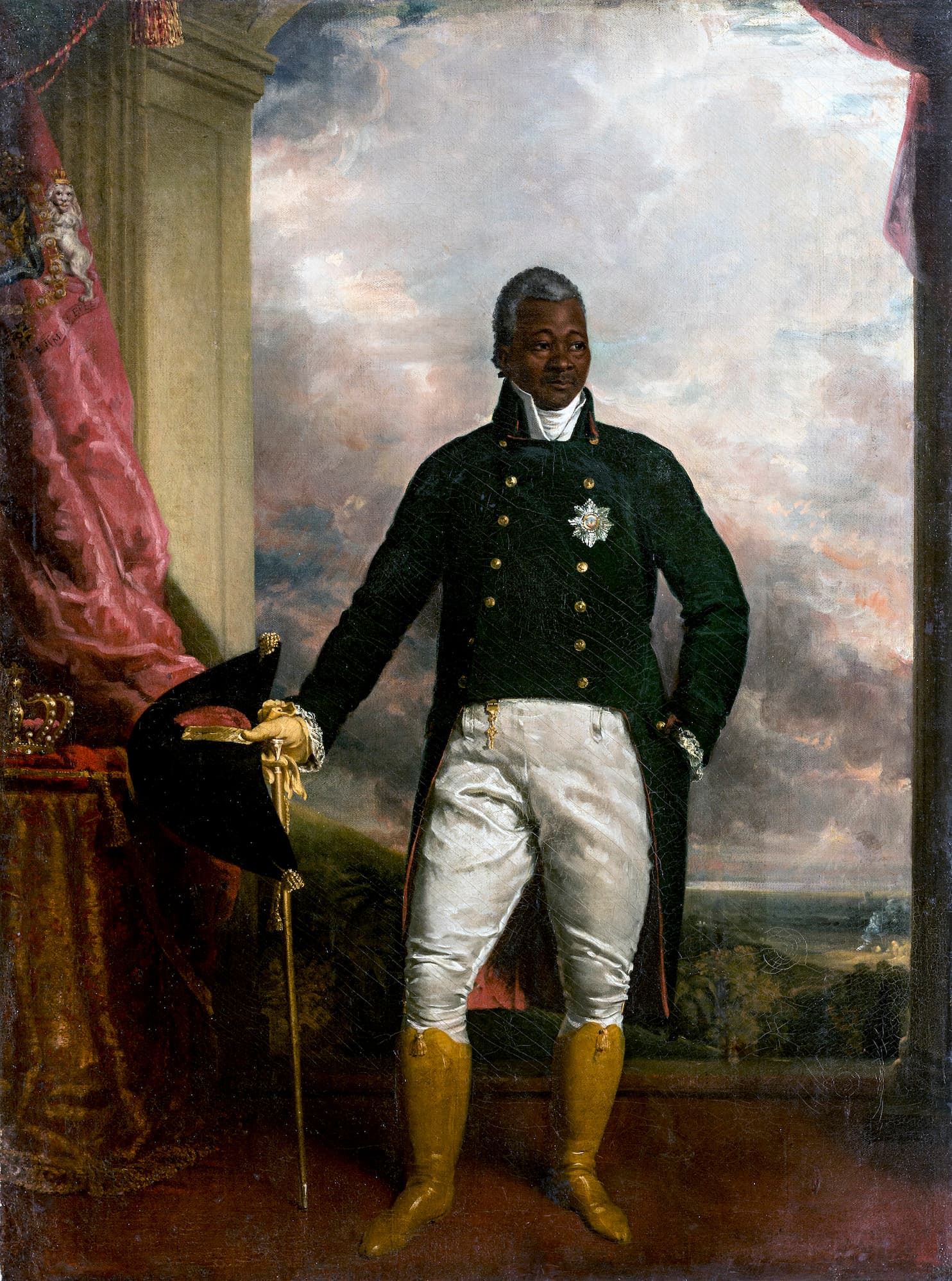
The boy who may have drummed for French forces at the Siege of Savannah in 1779, and who reportedly spent his youth working as a mason, sailor, or stable hand in Saint-Domingue, would die bearing the title of King.
In the high, green, cloud-shrouded peaks of northern Haiti stands the Citadelle Laferrière. It is a stone fortress of staggering, almost megalomaniacal proportions—its walls forty meters high, its prow thrusting into the Caribbean sky like the keel of a stone ship stranded on a mountaintop. It was built to withstand an invasion that never came, constructed on the orders of a man who rose from the hold of a slave ship to wear a golden crown. Henri Christophe—who would style himself Henry I, King of Haiti, Destroyer of Tyranny, and First Crowned Monarch of the New World—understood the language of power. In a world dominated by white empires that viewed a free Black republic as an existential contagion, Christophe realized that survival required more than just winning a war. It demanded an architecture of permanence, a display of statehood so resolute, so undeniably grand, that the crowns of Europe would have no choice but to look upon it with respect, or at least with terror.
The origins of the man who would build the Citadelle are lost in the deliberate obscurities of the late eighteenth-century Caribbean. He was born Christophe Henry, likely in 1767 on the British-held island of Grenada, or perhaps Saint Kitts, the son of a free father and an enslaved mother. Brought to the French colony of Saint-Domingue as a youth, his early life became a tapestry of rumors: that he worked as a mason, a sailor, a stable hand, or a billiard marker. The most persistent legend placed him as the manager of La Couronne, a fashionable hotel and restaurant in the northern capital of Cap-Français, where he allegedly mastered the art of observing, and managing, the grands blancs—the wealthy white planters whose unimaginable wealth was extracted from the blood and sweat of half a million enslaved souls. Whether through purchase or manumission, he secured his freedom before the summer of 1791, when the northern plains of Saint-Domingue erupted in flames, initiating the only successful slave revolution in human history.
When the uprising began, Christophe did not merely join; he commanded. Rising quickly through the revolutionary ranks, he became a trusted general of Toussaint Louverture, the brilliant military commander who guided the colony through the complex, multi-sided wars against France, Britain, and Spain. Christophe’s military genius was matched by a fierce, uncompromising discipline. By 1801, Louverture had promoted him to brigadier-general and placed him in command of Cap-Français. Yet the revolution’s survival was constantly imperiled. When Napoleon Bonaparte dispatched a massive expeditionary force under his brother-in-law, Charles Leclerc, to disarm the population and restore slavery, Christophe was ordered to hold the northern capital. Rather than surrender the crown jewel of the colony to the French, Christophe chose a scorched-earth path, famously setting fire to his own lavishly furnished home to begin the conflagration that reduced Cap-Français to ashes.
Connected to
10 links to entries not yet ingested in the Library.
The war that followed was one of absolute, genocidal ferocity. After Louverture was treacherously captured and deported to die in a freezing French prison, Jean-Jacques Dessalines took command of the revolutionary forces, waging a war of total expulsion. Following the final defeat of the French in late 1803, Dessalines declared the independence of the nation under its indigenous Taíno name: Haïti. Christophe, now governing the northern department, remained a central pillar of the new state. In 1805, he accompanied Dessalines on a brutal campaign into neighboring Santo Domingo to dislodge French forces who were kidnapping Black children to sell into slavery. During this invasion, Christophe’s forces perpetrated devastating reprisal massacres in towns like Moca and Santiago, leaving churches filled with the dead and dragging thousands of captives back across the border. Yet, beneath the shared violence of state-building, fractures were opening. When a conspiracy arose among senior officers to assassinate the increasingly tyrannical Dessalines in 1806, Christophe quietly withheld warning.
With Dessalines dead, the fragile union of the young republic shattered. Christophe retreated to his stronghold in the northern plains, the traditional heartland of the revolution’s agricultural wealth and its most militant veterans. In the south, Alexandre Pétion, a leader of the free people of color, established a rival republic. For the next fourteen years, Haiti would be a house divided. While Pétion’s southern republic chose a path of land redistribution, breaking up the old sugar estates into small subsistence plots for the peasantry, Christophe took a radically different, far more authoritarian path in the north. He believed that a nation of subsistence farmers would remain weak, impoverished, and vulnerable to reconquest. To fund a modern army and defend Haitian sovereignty, the state needed capital.
Christophe’s solution was the corvée—a system of forced agricultural labor that looked, felt, and functioned terribly like the plantation slavery the people had fought so hard to escape. Under his strict direction, the northern state of Haiti was transformed into a highly disciplined, militarized economic engine. The sugar estates remained intact, worked by a population bound to the soil under the watchful eyes of the military. Yet, unlike the colonial era, the wealth generated did not flow to Paris; it filled the state treasury. Through trade with Great Britain, which had recently abolished its own transatlantic slave trade, Christophe’s government amassed an enormous reserve of British pounds. He negotiated a covert agreement with London, promising to respect the borders of Britain’s Caribbean colonies in exchange for the Royal Navy acting as an early warning system against any impending French naval invasion.
To legitimize this authoritarian state, Christophe chose to stage an elaborate pageant of royalty. On March 26, 1811, he declared the north a kingdom, crowning himself King Henry I. It was a calculated political performance. If the European empires rejected the idea of a Black republic, Christophe would present them with a mirror image of their own societies: a hereditary monarchy, complete with a state church, a standing army, and a newly minted aristocracy. He created eighty-seven nobles, a number that eventually grew to over a hundred and thirty, appointing dukes, counts, barons, and knights. Among them were the Duke of Marmelade and the Duke of Limonade—titles derived from the historical French place-names of northern districts, which European satirists mocked in racist caricatures, entirely missing the profound defiance of the gesture.
At the center of King Henry's royal landscape was the Sans-Souci Palace at Milot. A triumph of neoclassical architecture, it was designed to rival the palaces of Europe, boasting terraced gardens, cascading artificial streams, dome-capped rotunda chapels, and floors of polished marble. Here, Christophe established a court of rigid etiquette, where his queen, Marie-Louise, and his young son and heir, Jacques-Victor Henry, presided over a nobility dressed in imported silks and velvets.
But the splendor of Sans-Souci was shadowed by the sheer brutality of the labor that built it. High above the palace, on the peak of Bonnet à l’Évêque, thousands of workers dragged massive cannons and limestone blocks up precipitous mountain paths to construct the Citadelle. The fortress was designed to house ten thousand soldiers and enough provisions to withstand a years-long siege. It was a monument to a collective trauma; its massive walls were built because the people of the north knew that the French, who had ratified treaties in 1814 hinting at a potential return to reclaim their lost property, might return at any moment.
By 1820, the contradictions of Christophe’s kingdom could no longer hold. The state was wealthy, its treasury overflowing, but the people who had built that wealth were exhausted. The corvée had broken the spirit of the northern peasantry, who saw little difference between the king's whip and the colonist's chain. Christophe’s health began to fail; a stroke left him partially paralyzed, unable to ride his horse or project the absolute physical authority upon which his rule depended. Sensing weakness, murmurs of rebellion rippled through his northern army. In the south, Pétion had died, and his successor, General Jean-Pierre Boyer, was poised to march north to unify the country.
On October 8, 1820, facing an imminent military coup and abandoned by his generals, the fifty-three-year-old king took his own life at Sans-Souci Palace, reportedly shooting himself in the heart. Ten days later, his teenage son and heir, Jacques-Victor Henry, was assassinated by mutinous soldiers, ending the brief, glittering dynasty of the Kingdom of Haiti. General Boyer marched into Cap-Henry unopposed, reuniting the north and south under a single republic.
The ruins of Christophe’s kingdom still stand in the northern mountains, slowly reclaimed by the tropical forest. Sans-Souci lies in elegant decay, its empty arches opening to the sky, while the Citadelle Laferrière remains pristine, an empty sentinel overlooking a sea from which no invasion ever came. They endure as monuments to a profound historical paradox: a man who dedicated his life to breaking the chains of slavery, only to forge new ones in the name of preserving that very freedom.