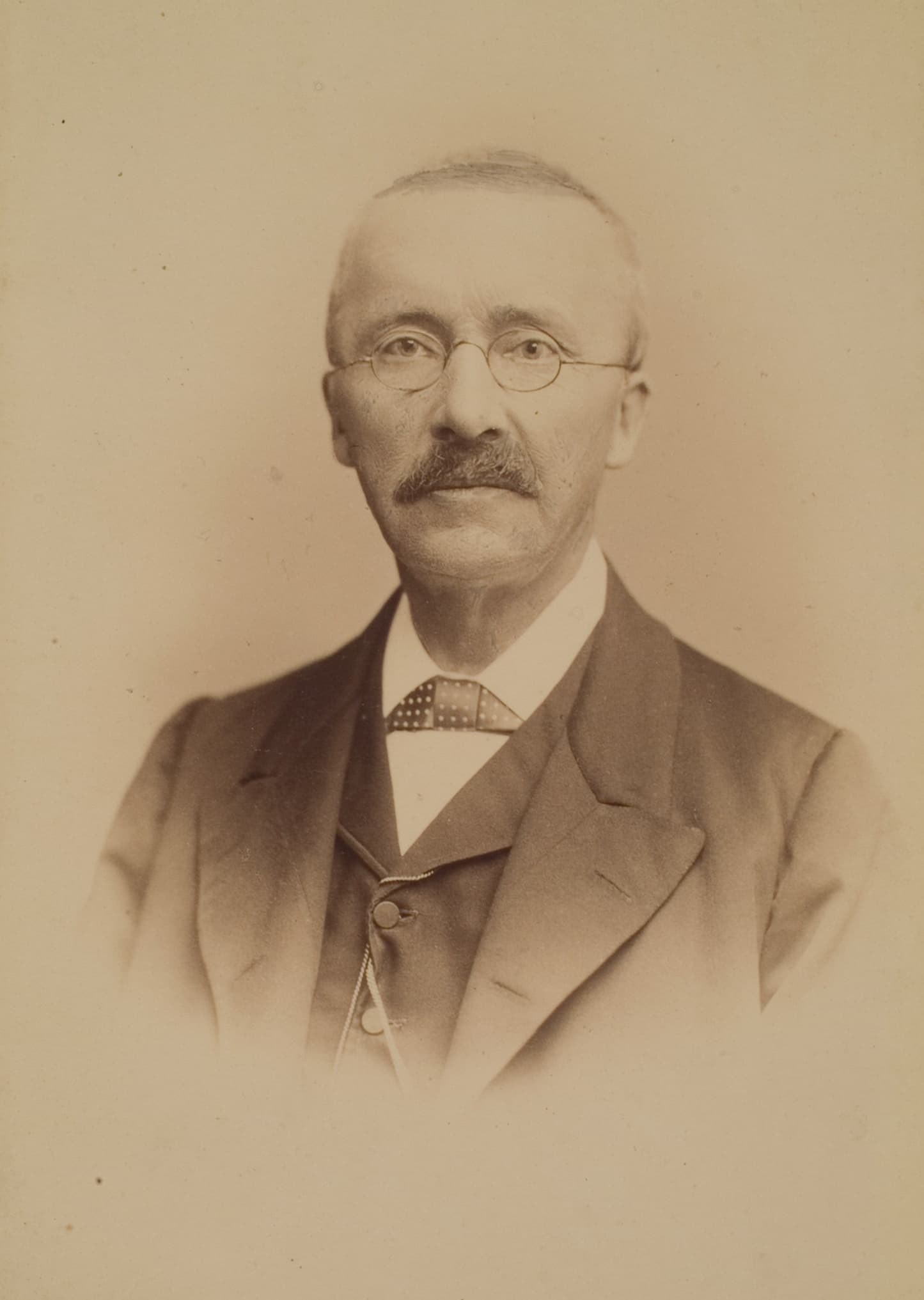
Long before he stood upon the dusty mounds of the Aegean, Heinrich Schliemann was a boy listening to his impoverished pastor father recite the grand, sweeping battles of the Iliad.
In the early summer of 1873, on a dusty, wind-scoured hill in the Ottoman Empire known as Hisarlık, a man driven by a singular, consuming obsession stood at the edge of a deep trench. Heinrich Schliemann was fifty-one years old, a retired merchant of immense wealth and dubious veracity, who had spent his life accumulating fortunes in the markets of St. Petersburg and the goldfields of California. Now, he was hunting for ghosts. Armed with a copy of the Iliad as though it were a topographical map, Schliemann was convinced that the bronze-clad heroes of Homer had once walked these very heights. On June 15, just a day before his scheduled departure, his eyes caught the glint of metal through the dirt, some twenty-eight feet below the surface. Dismissing his Turkish workmen under a pretext, he set to work with a pocketknife. Out of the earth came a hoard of pure copper, silver, and gold: diadems of delicate leaves, heavy necklaces, goblets, and shields. He immediately declared it "Priam’s Treasure," the long-lost wealth of the Trojan king slain by the Neoptolemus.
To the academic establishment of the late nineteenth century, Schliemann was an unbearable intruder—an amateur who had bought his doctorate in absentia from the University of Rostock using a thesis partially plagiarized from others, a self-promoter who wrote his diaries in a dozen languages to showcase his own genius, and a fabulist who claimed that at the age of seven he had promised his father he would find Troy. The reality was far more prosaic, though no less extraordinary. Born in 1822 to a impoverished Lutheran minister in Mecklenburg-Schwerin, Schliemann had been forced out of grammar school at eleven after his father was accused of embezzling church funds. He spent his youth as a grocer’s apprentice, a cabin boy shipwrecked off the Dutch coast, and a low-paid messenger in Amsterdam. Yet he possessed a freakish memory and a ferocious will. He developed his own system of rapid language acquisition, mastering Russian and ancient Greek in a matter of weeks, and eventually conversing in nearly a dozen tongues.
This linguistic virtuosity became the engine of his staggering financial success. Sent to St. Petersburg in 1846 by an import-export firm, he quickly set up his own business, cornering the trade in indigo dye. When his brother died in California during the Gold Rush, Schliemann rushed to Sacramento, where he ran a bank buying and reselling over a million dollars' worth of gold dust in half a year, departing just as local agents began to complain about short-weight shipments. Back in Russia, he made another fortune during the Crimean War as a military contractor. By thirty-six, he was wealthy enough to retire, a man of independent means ready to reinvent himself as the resurrecter of antiquity.
12 links to entries not yet ingested in the Library.
Before he could dig, however, Schliemann had to reconstruct his personal life to fit his romanticized vision of the classical world. He divorced his Russian wife, Ekaterina Lyschin, by temporarily relocating to Indiana to exploit its liberal divorce laws, securing his decree through false claims about his residency. He then wrote to an old friend, an Athenian archbishop, asking him to find a new bride: she had to be a Greek woman, "enthusiastic about Homer," with a "soul impassioned for learning." The archbishop produced his seventeen-year-old cousin, Sophia Engastromenos. When Schliemann unearthed the golden treasures of Hisarlık, he told the world that Sophia had been by his side, tenderly carrying the ancient gold away from the site in her shawl. It was a beautiful, cinematic image that captivated the European public, but it was entirely untrue; Sophia was actually in Athens at the time, mourning her father.
This fabrication was characteristic of the man, but it did not diminish the physical reality of what he had uncovered. Prior to Schliemann's excavations, the consensus among Western scholars was that Troy was either a myth or located at Pınarbaşı, a hilltop at the southern end of the Trojan Plain. It was actually a local English amateur archaeologist and landowner, Frank Calvert, who first identified the mound of Hisarlık as the true site of Troy and persuaded a skeptical Schliemann to dig there.
Yet Schliemann’s methods were as destructive as they were pioneering. Convinced that the Troy of the Iliad must lie at the very bottom of the hill, he drove a massive trench straight down through the center of the mound, ruthlessly hewing his way through the upper layers. In doing so, he obliterated invaluable archaeological strata, including the very layer that modern scholars believe actually corresponded to the Late Bronze Age city of the Trojan War. The "Burnt City" Schliemann identified as Priam’s Troy was eventually revealed to be over a thousand years older, dating from 3000 to 2000 BCE—far too early for Agamemnon’s siege.
The discovery of the gold sparked an international diplomatic crisis. Schliemann smuggled the treasure out of the Ottoman Empire into Greece, prompting the Ottoman government to sue him in a Greek court. After paying a fine of ten thousand gold francs and donating an additional fifty thousand to the Constantinople Imperial Museum to secure future digging permits, Schliemann sought a permanent home for his collection. Denied by the Greeks, the French, and the Russians, the Trojan gold was eventually housed in Berlin in 1881. Its journey would continue long after Schliemann’s death: hidden in a bank vault and then a zoological garden flak tower during the Second World War, the treasure was seized by Soviet SMERSH forces in May 1945 and flown to Moscow, where its presence in the Pushkin Museum was kept secret until 1994.
Unfazed by the controversies in Turkey, Schliemann turned his attention to the Greek mainland. In 1876, under the watchful eye of a Greek supervisor, Panagiotis Stamatakis, he began excavating the ancient citadel of Mycenae. Digging just inside the famous Lion Gate, he uncovered a double ring of stone slabs and, beneath them, six shaft graves containing sixteen skeletons. The bodies were covered in magnificent gold, silver, and ivory ornaments, including several hammered gold funeral masks. Beholding one of these bearded faces, Schliemann famously believed he was looking upon the "Mask of Agamemnon." Though these graves, too, were later shown to belong to an earlier era than the Trojan War, the sheer volume of the treasure revealed, for the first time, the material reality of a rich, pre-Hellenic civilization that had existed long before the classical age of Greece.
In the years that followed, Schliemann’s luck remained mixed but highly publicized. Alongside the brilliant young architect Wilhelm Dörpfeld, who introduced rigorous stratigraphic methods to Schliemann's chaotic excavations, he cleared the Treasury of Minyas at Orchomenus and laid bare the complete ground plan of the Mycenaean palace at Tiryns. He attempted to dig at Alexandria, at Cythera, and at Knossos in Crete, but was blocked by local opposition and bureaucratic obstacles his wealth could not overcome.
By the end of his life, Schliemann was a celebrated, polarizing figure, defended by world leaders like William Gladstone, but dismissed by many peers as a vandal who had desecrated the very history he claimed to love. He died on Christmas Day in 1890 in Naples, following a sudden illness. He left behind a vast fortune split between his Russian and Greek families, and a legacy that forever altered the study of the past.
Before Schliemann, the heroic age of Greece was a literary dream, a tapestry of myths recorded by poets centuries after the fact. By brute force, relentless ambition, and sheer, blind luck, Schliemann dragged those myths out of the earth and into the light. He proved that behind the legends of Homer lay a real, tangible world of bronze, gold, and blood. In doing so, he became the father of pre-Hellenistic archaeology, establishing a discipline that would spend the next century correcting his errors, repairing his damage, and marveling at his discoveries.