Event · 794 CE – 1185 CE · Imperial Japan
Heian period
- Also known as
- Aevum Heian
- Bình an thì đại
- Bình An thời đại
- cultura Heian
- Epoca Heian
- epoca Heian
When Emperor Kammu relocated the capital of Japan to Heian-kyō in 794 CE, he was fleeing a series of disasters that had plagued his previous choice of Nagaoka-kyō.
In the closing years of the eighth century, Emperor Kammu abandoned the city of Nara. It was a departure driven by deep unease. For seventy years, Nara had been the glittering seat of Japanese power, but it had grown choked by the encroaching ambitions of its great Buddhist monasteries. The influence of the Buddhist institutions had become so secular, and the political maneuvers of figures like the monk Dōkyō so brazen, that the emperor sought to physically sever the state from its spiritual captors. After a disastrous, aborted attempt to settle at Nagaoka-kyō—a site plagued by misfortune—Kammu relocated his court in 794 CE to a broad valley cradled by mountains, blessed with river access to the sea, and connected by overland routes to the eastern provinces. He named this new capital Heian-kyō: the Capital of Peace and Tranquility. Today it is known as Kyoto. It would remain the imperial capital for the next millennium, anchoring a four-century epoch where Chinese administrative models slowly withered, giving rise to an insulated, highly stylized, and distinctively Japanese civilization.
At its inception, Heian-kyō was a monumental act of mimicry. Like Nara before it, the city was mapped on a massive grid patterned after Chang’an, the great capital of Tang Dynasty China. Emperor Kammu set out to revive and enforce the Ritsuryō Code, a legal and administrative system adapted from the Tang legal structure. It was an ambitious, perhaps hubristic, attempt to impose a sophisticated, bureaucratic continental apparatus onto a society with vastly different levels of social and economic development. On the frontiers, the court asserted its muscle. Having abandoned universal conscription in 792 CE, Kammu relied on elite forces to subjugate the Emishi, the independent peoples of northern and eastern Honshū who were likely descendants of the displaced Jōmon culture. In 797 CE, Kammu appointed Sakanoue no Tamuramaro as Seii Taishōgun—the "Barbarian-subduing generalissimo." By 801 CE, Tamuramaro’s campaigns had pushed the imperial frontier to the easternmost reaches of the island. Yet, this assertion of central authority was the high-water mark of the direct imperial state. Even as the boundaries of the realm expanded, the mechanisms of central control were beginning to slip.
The true turning point in the Heian consciousness came from across the sea. In 838 CE, the Japanese court suspended its official, imperial-sanctioned missions to Tang China, bringing an end to a tradition of cultural import that had begun in 630 CE. The decision was born of pragmatism and disillusionment. Tang China was fracturing, sliding toward collapse, and its government had begun a severe persecution of Buddhist institutions. As the prestige of Chinese institutions dissolved, Japan turned inward. This isolation sparked a domestic cultural renaissance known as kokufu bunka. Left to its own devices, the court began to digest centuries of Chinese influence, stripping away foreign formalities to reveal an indigenous aesthetic. The most revolutionary vehicle for this transformation was linguistic. From the rigid, prestigious Chinese characters utilized by male bureaucrats, two phonetic syllabaries emerged: katakana, formed from simplified fragments of Chinese characters, and hiragana, a flowing, cursive script. Because women of the court were excluded from formal education in classical Chinese, they embraced hiragana to write in the vernacular. In doing so, they created Japanese literature.
Within the wooden pavilions and silk-screened corridors of the Heian court, life became an obsessive pursuit of taste, ritual, and emotional sensitivity. This insular world was captured with psychological precision by its women writers. In the late tenth and early eleventh centuries, the mother of Fujiwara Michitsuna laid bare the anxieties of marriage in the Kagerō Nikki. Sei Shōnagon, a court lady of razor-sharp wit, cataloged the fleeting pleasures, annoyances, and aesthetics of palace life in her Pillow Book. Towering over all was Murasaki Shikibu’s The Tale of Genji, a sprawling, melancholic masterpiece widely regarded as the world’s first novel, which chronicled the romantic intrigues of the "Shining Prince" and mapped the spiritual weariness of the court. Visual arts underwent a parallel revolution. The heavy, religious iconography of the continent yielded to yamato-e—vividly colored, secular paintings that depicted the daily rhythms, seasonal festivals, and dramatic narratives of the imperial court and local shrines. It was a culture of exquisite refinement, but it was sustained by a fragile and increasingly hollow political economy.
Behind the screens of the imperial palace, power had long since ceased to rest with the emperors. Following Kammu’s death in 806 CE, a succession struggle prompted the creation of new, streamlined offices—the Emperor’s Private Office and the Metropolitan Police Board—designed to bypass the sluggish Chinese-style bureaucracy and allow the sovereign to rule more directly. But these very offices were quickly captured by a single, extraordinarily ambitious aristocratic lineage: the Fujiwara clan. Utilizing a strategy of calculated matrimonial politics, the Fujiwara systematically married their daughters into the imperial line. Generation after generation, Heian emperors found themselves born of Fujiwara mothers and raised in Fujiwara households. The clan perfected the offices of Sesshō (regent for a minor emperor) and Kampaku (spokesman or regent for an adult emperor). Though Emperor Daigo temporarily suspended the regency to rule directly between 897 and 930 CE, he failed to dismantle the clan's underlying influence. By the year 1000 CE, the patriarch Fujiwara no Michinaga operated with such absolute authority that he could enthrone, retire, and dismiss emperors at his whim, effectively running the state through his private family administration.
This concentration of power at court was mirrored by a quiet economic revolution in the provinces. The grand public land systems mandated by the Ritsuryō codes were breaking down. In their place grew the shōen—private, tax-exempt agricultural estates. Initially granted to encourage the clearing of wilderness or to support prestigious religious institutions and noble families, these estates quickly devoured the taxable public domain. Provincial smallholders discovered that by surrendering their land titles to powerful Heian aristocrats or great monasteries, they could secure immunity from government tax collectors and inspectors in exchange for a share of the harvest. The Fujiwara and other great houses amassed immense private wealth from these tax-free enclaves, which operated as autonomous "house governments" entirely outside the reach of the imperial treasury.
As the wealth of the provinces was siphoned away to fund the aesthetic indulgences of Kyoto, the central government lost both the means and the interest to police the realm. The court’s failure to maintain a national currency forced the domestic economy to regress to barter and trade. Though the capital itself remained largely free of large-scale warfare, the countryside grew increasingly lawless, plagued by rampant crime and banditry. Because the court had abolished universal conscription, it possessed no standing national army to enforce order. Instead, the state relied on local appointments of professional warriors—oryoshi and tsuibushi—to suppress regional disturbances. To protect their sprawling estates from bandits and rival families, shōen holders began recruiting and training their own private security forces. They invested in superior military technology: advanced training methods, heavier armor, warhorses, powerful compound bows, and the lethal, curved steel blades that would define the Japanese sword.
Out of this regional instability emerged a new provincial elite: the samurai. While the courtiers in Kyoto spent their days composing poetry and judging incense-blending competitions, these provincial warriors were forging close-knit, militarized clans bound by kinship and vassalage. The court, increasingly desperate to maintain its authority, was forced to call upon these warriors to put down domestic rebellions. In the east, the warrior class proved its utility by suppressing regional uprisings, while in the west, they crushed the pirate-rebel Fujiwara no Sumitomo. In the late eleventh century, brutal conflicts in the far north—the Former Nine Years War and the Latter Three Years’ War—further demonstrated that the central government was utterly dependent on the private military power of provincial clans like the Abe and Kiyohara to maintain the integrity of the state.
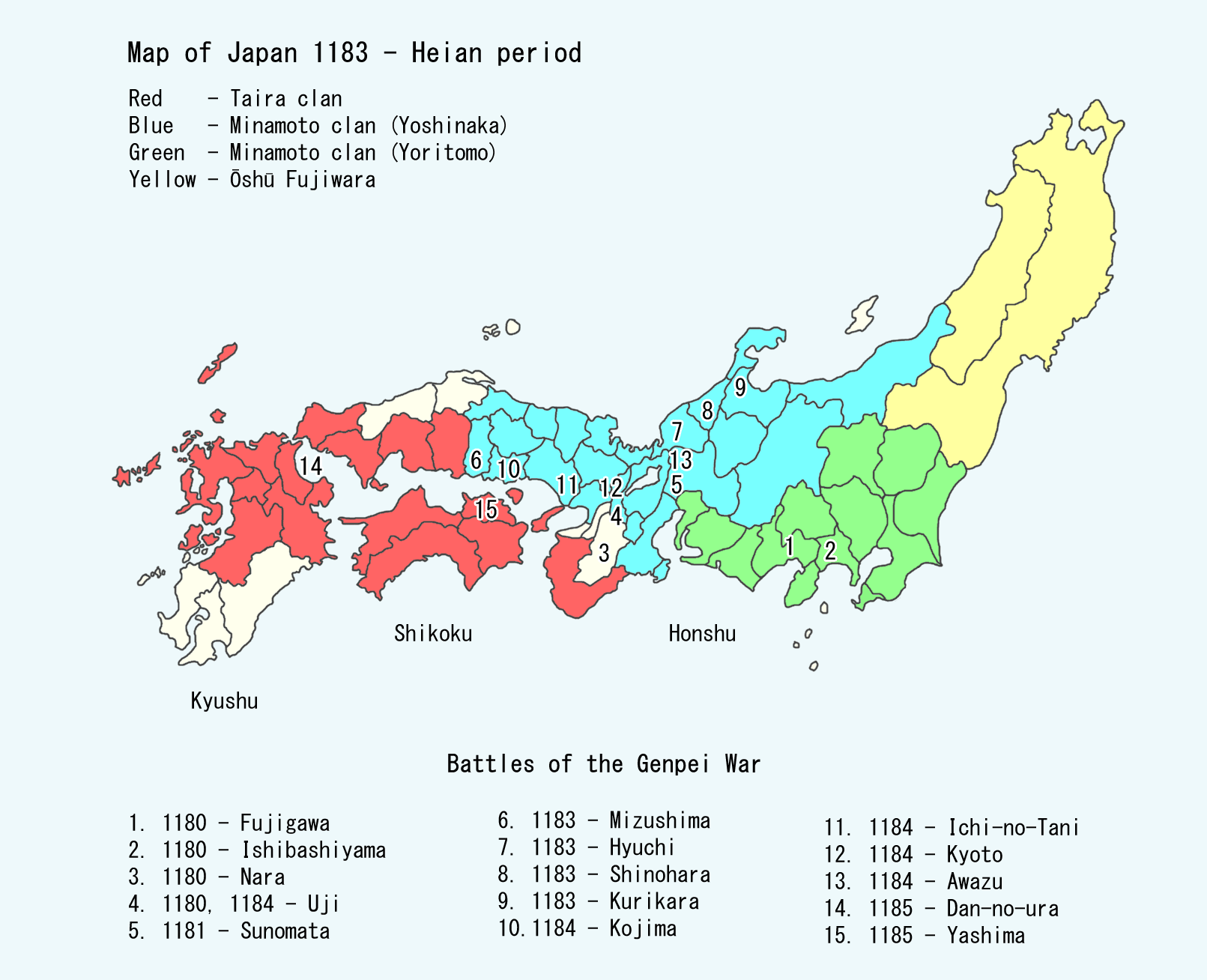
By the twelfth century, the delicate balance that had sustained the Heian golden age began to collapse. The court’s authority, starved of tax revenue and alienated from the provinces by centuries of absenteeism, withered. The watershed came with the Hōgen Rebellion of 1156 CE, a bitter succession dispute within the imperial family and the Fujiwara clan that could only be resolved by bringing the provincial warrior clans directly into the capital to fight. The military class had entered the halls of court power, and they would not leave. Taira no Kiyomori, a ruthless warrior chieftain, seized control of the court and attempted to replicate the old Fujiwara strategy by marrying his daughter into the imperial line and placing his infant grandson on the throne. But the era of courtly intrigue was drawing to a close. The Taira clan's hegemony sparked the devastating Genpei War, a nationwide conflict that culminated in 1185 CE when the rival Minamoto clan, led by Minamoto no Yoritomo, annihilated the Taira.
Yoritomo did not seek to rule from Kyoto, nor did he attempt to integrate his followers into the effete administrative structures of the imperial court. Instead, he established a parallel, military government—the shogunate—in his eastern ancestral home of Kamakura. The long, peaceful reverie of the Heian period was over. The refined, insular world of the courtiers was permanently eclipsed by the ascendancy of the warrior, shifting the locus of Japanese historical development from the quiet elegance of the imperial palace to the austere, martial discipline of the samurai.
Connected to
8 links to entries not yet ingested in the Library.