Person · 1507 BCE – 1458 BCE · Ancient EgyptTier 3 · Curated
Hatshepsut
- Also known as
- חתשפסות
- حتشبسوت
- 哈特謝普蘇特
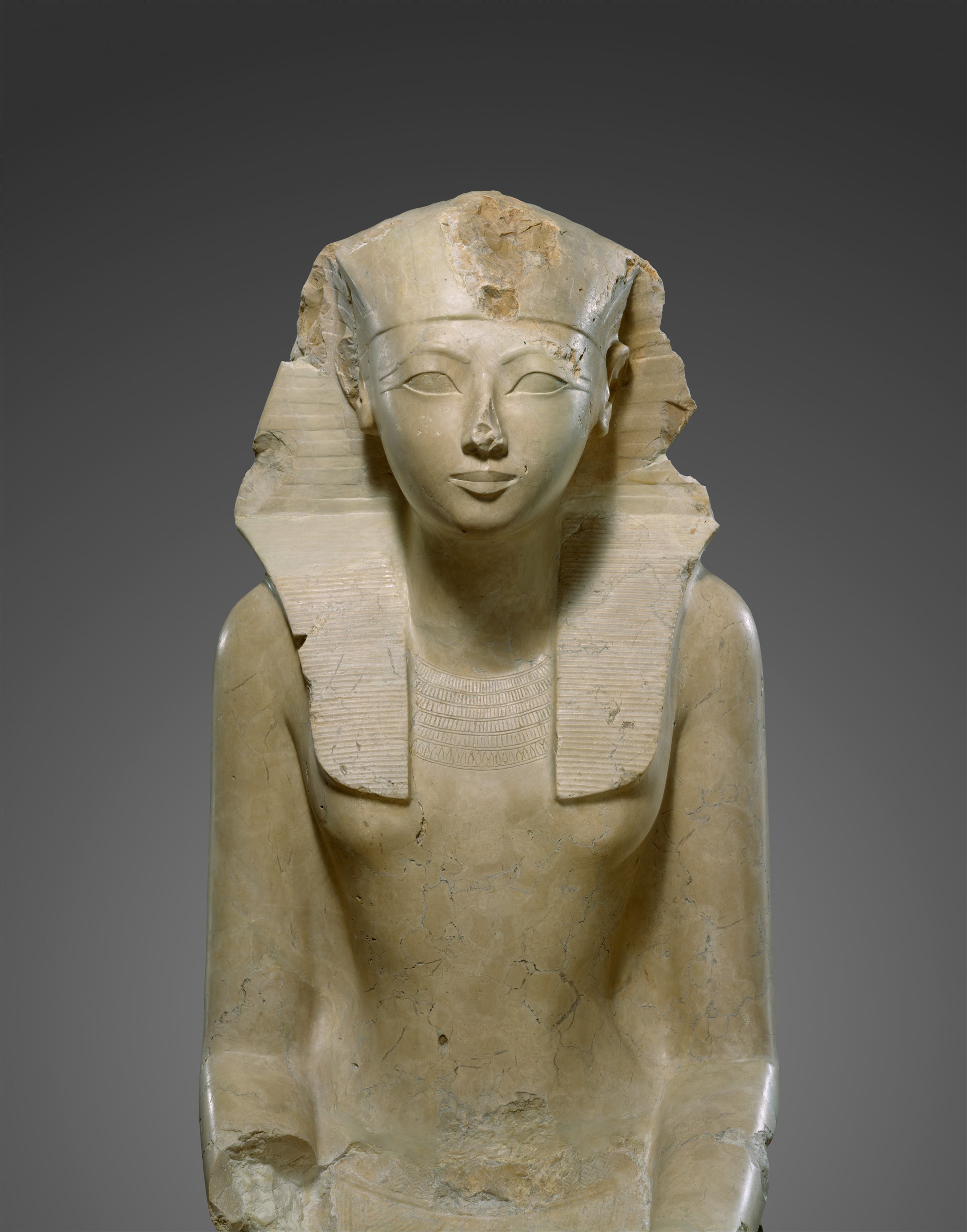
When the young pharaoh Thutmose II died, the Egyptian crown passed to a toddler, Thutmose III.
In the summer of 1829, Jean-François Champollion, the French scholar who had unlocked the secrets of Egyptian hieroglyphs, stood inside the ruins of a spectacular, terraced stone temple at Deir el-Bahari, on the western bank of the Nile opposite Luxor. He was attempting to translate the formal historical inscriptions carved into the limestone walls, but the syntax presented him with an elegant, impossible contradiction. The reliefs before him depicted a sovereign adorned in the unmistakable regalia of a pharaoh—the khat head cloth topped with the rearing uraeus cobra, the shendyt kilt, and the traditional plaited false beard of kingship. Yet the accompanying texts did not match the physical power of the image. Wherever the hieroglyphs referred to this bearded king in the dress of the Pharaohs, the grammatical nouns, pronouns, and verbs were systematically, undeniably feminine. Champollion noted his profound astonishment in his journals, observing that the texts treated this imposing monarch as though a queen were in question, yet no such queen appeared on any of the official king lists handed down from antiquity. The royal lists leaped directly from Thutmose II to the celebrated conqueror Thutmose III, leaving no space for the mysterious figure whom the inscriptions called Maatkare, or Hatshepsut. Champollion had stumbled upon the "Hatshepsut Problem"—a historical puzzle of deliberate erasure, gender performance, and royal legitimacy that would confound Egyptologists for the next century. It was the first modern glimpse of a woman who had successfully commanded the wealthiest empire on earth, only for her successors to wage a quiet, bureaucratic war against her memory, chiseling her face from the stone and leaving her name to dissolve into the desert sands.
Before she was a king, Hatshepsut was a daughter of the military elite, born between 1505 and 1495 BCE during the early, expansionist years of the Eighteenth Dynasty. Her father, Thutmose I, was a charismatic general-king who had pushed Egypt’s borders to new limits, and her mother was his Great Royal Wife, Ahmose. When her father died, the line of succession followed the established patriarchal path: Hatshepsut, then fourteen or fifteen years old, was married to her half-brother, Thutmose II, the son of her father by a lesser wife. As Great Royal Wife, Hatshepsut occupied the traditional pinnacle of female influence in the Egyptian court, but her husband's reign was short and poorly documented, lasting perhaps only a few years. When Thutmose II died, he left behind a daughter, Princess Neferure, whom he had fathered with Hatshepsut, and an infant son, Thutmose III, born to a secondary wife named Isis. The boy was no more than two years old. By all established custom, a regent was required to govern the state until the young pharaoh came of age. Hatshepsut stepped into this role naturally, managing the affairs of the young king as a protective stepmother and royal widow. In the first few years of the regency, she acted within the boundaries of tradition, representing her stepson and maintaining the status quo.
Yet by Year 7 of the young king’s reign, around 1472 BCE, a radical transformation occurred. Hatshepsut did not merely extend her regency; she assumed the absolute position of pharaoh. Rather than deposing the young Thutmose III, she initiated an unprecedented co-regency, back-dating her own accession to his Year 1 and effectively declaring herself the senior co-ruler (the Osiris) while relegating her stepson to the junior role (the Horus). This was not a sudden, violent palace coup, but a carefully orchestrated theological and political elevation. To justify this extraordinary departure from tradition, Hatshepsut’s court administration deployed a sophisticated campaign of divine legitimacy. At her temples in Karnak and Deir el-Bahari, reliefs were carved depicting her divine birth. The myth, preserved in vivid detail, claimed that the state god Amun-Ra had looked down upon the beautiful Queen Ahmose and desired to sire a ruler for Egypt. Amun descended to the palace, taking the physical form of Hatshepsut's father, Thutmose I, to gain access to the queen's chambers. The inscriptions describe the air of the palace filling with the sweet scent of the heavens as the god approached. Once conceived, the fashioning of Hatshepsut was entrusted to Khnum, the ram-headed potter god who shapes the bodies of human children on his wheel, who was instructed to craft a magnificent body and ka (the spiritual life force) for the future king. Heket, the goddess of fertility, and Khnum then escorted the pregnant queen to the birthing chamber, where Hatshepsut was delivered under the direct patronage of the gods. To cement this divine mandate, the Oracle of Amun publicly proclaimed that it was the god’s own supreme will that Hatshepsut take possession of the Two Lands, declaring: "Welcome my sweet daughter, my favorite, the King of Upper and Lower Egypt, Maatkare, Hatshepsut."
This theological narrative was matched by a dramatic, gradual evolution in how Hatshepsut was represented to her subjects. In the earliest years of her regency, artists depicted her as a traditional queen: painted in delicate yellow pigments, dressed in a form-fitting full-body gown, stationary, and referred to solely with feminine titles. As she claimed the pharaonic title, her iconography began to shift into a fascinating, gender-fluid liminal space. Mid-reign reliefs show her wearing a feminine gown but adorned with the heavy atef crown and the ceremonial false beard of the kings. Later statues experiment with a mix of characteristics, depicting her with orange skin paint, topless in the manner of a male pharaoh, yet retaining visible female breasts. By the height of her reign, her portrayal had completed its transformation into absolute, masculine kingship. Her statues were painted in the deep red-brown clay tones traditionally reserved for men; her shoulders were broadened, her chest flattened into muscles, and her posture changed to show her moving and engaged in vigorous physical activity. She wore the shendyt kilt of the warrior-kings. This was not an attempt to fool her people into believing she was physically male, nor was it an early form of personal cross-dressing; rather, it was a symbolic, ritual necessity. In the deeply conservative cosmos of ancient Egypt, the office of the pharaoh was inextricably bound to male archetypes. The king was the living embodiment of Horus, a male deity, and the guardian of Ma'at—the cosmic order of truth, balance, and justice. To represent herself as a traditional woman in her official monuments would have introduced an intolerable cosmic dissonance. By adopting the physical vocabulary of the male pharaoh, Hatshepsut stabilized her position within the patriarchy, projecting herself as both the mother and the father of the realm, an androgynous protector who encompassed all aspects of divine authority.
As a builder, Hatshepsut was among the most prolific and ambitious monarchs in Egyptian history, commissioning hundreds of construction projects throughout both Upper and Lower Egypt to solidify her political and religious base. She restored the ancient Precinct of Mut at Karnak, which had fallen into ruin during the Hyksos occupation of the Second Intermediate Period, and erected twin red granite obelisks at the entrance to the Temple of Amun. At the time of their erection, these obelisks were the tallest in the world, carved from single blocks of stone at the quarries of Aswan and transported down the Nile on specialized barges. One of these monoliths still stands today, the second-tallest ancient obelisk left upright on earth. She also commissioned the Chapelle Rouge, or Red Chapel, at Karnak, built of red quartzite to serve as a sacred barque shrine. Further south, at Beni Hasan, she constructed the cavernous underground Temple of Pakhet, cut directly into the living rock of the eastern cliffs. The temple honored Pakhet, a synthesis of the lioness war goddesses Bast and Sekhmet. On the temple’s architrave, Hatshepsut left a famous, sweeping dedicatory text containing a fierce denunciation of the Hyksos rulers who had previously occupied Egypt, framing her reign as a glorious restoration of native Egyptian purity and divine order.
The undisputed crown jewel of her architectural legacy, however, was her mortuary temple, Djeser-Djeseru—"the Holy of Holies"—constructed at the dramatic desert amphitheater of Deir el-Bahari. Designed by her inner circle of elite advisors—which included the high priest Hapuseneb and her brilliant high steward, the royal architect Senenmut—the temple was a radical departure from the heavy, defensive architecture of previous dynasties. Instead of a towering stone fortress, Djeser-Djeseru was designed as a series of three colonnaded terraces that rose elegantly out of the valley floor, mirroring the horizontal lines of the towering limestone cliffs that rose directly behind it. The terraces were connected by grand central ramps, lined with lush gardens of frankincense and myrrh trees planted in specially imported soil. The temple was not merely a place for her posthumous cult; it was a physical manifestation of her domestic stability and international reach.
On the walls of the middle terrace of Deir el-Bahari, Hatshepsut had her artists record the details of her most celebrated foreign policy achievement: the grand maritime expedition to the legendary Land of Punt, located somewhere along the coast of the Red Sea, likely in modern-day Somalia or Eritrea. Re-establishing the trade routes that had been severed during the Hyksos occupation, Hatshepsut funded and equipped a fleet of five large merchant vessels that set sail from the Red Sea coast. The reliefs depict the Egyptian delegation arriving in Punt, where they were received by the local ruler and his wife, Queen Ati, who is depicted with striking realism, showing physical traits that have fascinated historians for generations. The expedition returned to Egypt laden with exotic treasures: gold, ivory, ebony, skins, and, most importantly, thirty-one live, root-balled myrrh trees. This is the earliest recorded attempt in human history to transplant foreign trees from one continent to another. Hatshepsut’s officials planted these trees on the terraces of her mortuary temple, where their sweet-smelling sap could rise to please the gods. The expedition also brought back vast quantities of charred frankincense resin, which the queen proudly ground into kohl eyeliner for her own eyes—the first recorded use of the substance for cosmetic purposes in Egyptian history.
For twenty-one years and nine months, Hatshepsut ruled Egypt in a state of immense prosperity and general peace. While early modern scholars characterized her foreign policy as entirely passive and pacifist, more recent analysis suggests she may have personally led or authorized military campaigns in Nubia and Canaan to secure the borders. She was so secure in her power that in her fifteenth year on the throne, she celebrated a Heb Sed jubilee—an ancient festival of rejuvenation traditionally reserved for kings who had ruled for thirty years. Historians have debated the reasoning behind this irregular timing. The scholar Jürgen von Beckerath suggested that Hatshepsut calculated her thirty years from the death of her father, Thutmose I, from whom she derived her legitimacy, which would imply her husband Thutmose II had ruled for nearly fourteen years. Alternatively, the historian Kara Cooney has proposed that she was celebrating thirty years of her father's entire dynasty, or perhaps simply marking her own thirtieth year of life. Whatever the reason, the jubilee was a triumphant display of her authority, marked by the commissioning of another pair of massive obelisks. One of these broke during its extraction from the granite bedrock of Aswan and was abandoned in the quarry, where it remains today. This "Unfinished Obelisk" offers modern archaeologists an invaluable, step-by-step blueprint of ancient Egyptian quarrying techniques, showing how workers channeled the hard stone using diorite balls and wooden wedges soaked in water.
Hatshepsut disappeared from the historical record in Year 22 of Thutmose III's regnal count, around 1458 BCE. A single stone stela erected at Armant records that on the tenth day of the second month of the season of Peret, Thutmose III became the sole ruler of Egypt, a date corresponding to January 16, 1458 BCE. It is presumed that the great queen died on or shortly before this day. In preparation for her death, Hatshepsut had abandoned the modest tomb she had constructed when she was merely the Great Royal Wife of Thutmose II and had ordered the expansion of KV20, the tomb originally quarried for her father in the Valley of the Kings. She extended the burial chamber, transforming it into a double interment site where she and her beloved father could rest side by side in matching stone sarcophagi. Yet the peace she sought in death was short-lived. Some decades after her departure, an extraordinary campaign of iconoclasm was unleashed against her memory. Across Egypt, her stone cartouches were systematically chiseled away, her names were erased from temple walls, and her images were defaced. At Deir el-Bahari, dozens of her monumental sandstone and granite statues were dragged from their niches, smashed with sledges, and buried in a massive pit. At Karnak, her towering obelisks were enclosed behind stone walls to hide them from the public eye.
For generations of Egyptologists, this systematic erasure was interpreted as a dramatic, vengeful family drama. Early scholars assumed that Thutmose III, having chafed under his stepmother’s long regency, immediately seized the throne upon her death and, in a fit of bitter resentment, ordered the destruction of her monuments to exact his revenge—a pharaonic damnatio memoriae. However, modern archaeological dating has thoroughly dismantled this narrative. The destruction of Hatshepsut’s monuments did not begin immediately after her death in 1458 BCE. Instead, it was initiated very late in the sole reign of Thutmose III, nearly twenty years after she had died, and continued into the reign of his son, Amenhotep II. This decades-long delay suggests that the motivation was political and dynastic rather than personal and emotional.
Historians like Donald Redford have argued that the erasure was a pragmatic political necessity for Thutmose III. As an aging king preparing the succession for his own son, Amenhotep II, Thutmose needed to ensure that his lineage was secure and unassailable. By removing Hatshepsut from the official records, he could adjust the timeline of the Eighteenth Dynasty so that the line of succession flowed directly from his father, Thutmose II, to himself, without the "unorthodox" interruption of a female king. Joyce Tyldesley, Peter Dorman, and Gay Robins have further suggested that the campaign was designed to extinguish the very memory of successful female kingship. While a previous female ruler, Sobekneferu of the Twelfth Dynasty, had been tolerated by history because her reign ended in national decline and could be dismissed as a tragic anomaly, Hatshepsut’s reign had been a spectacular, glittering success. A prosperous, powerful female king was a direct threat to the conservative Egyptian world view, which held that a woman on the throne was an affront to Ma'at. To protect the monarchy from the precedent of female rule, her history had to be rewritten. In many places, this rewriting was carried out with surprising care: rather than smashing every image, workers often left her figure intact in deep, inaccessible shrines where only the gods could see, while removing her public cartouches. In other instances, her name was simply replaced with those of her father, Thutmose I, or her husband, Thutmose II, preserving the structures while altering the identity of their creator.
This bureaucratic attempt to erase Hatshepsut came close to succeeding, but her spectacular architecture could not be so easily silenced. In the late nineteenth and early twentieth centuries, excavations at Deir el-Bahari began to reveal the sheer scale of the cover-up. When Herbert E. Winlock and the Metropolitan Museum of Art expedition excavated the temple's hillside in the 1920s and 1930s, they uncovered the massive pit where Hatshepsut's smashed statues had been dumped. Piecing together thousands of fragments of stone like a colossal jigsaw puzzle, conservators reconstructed the images of the female pharaoh, bringing her muscular, bearded, yet strangely delicate features back into the light of day. Among the debris, they also found smaller personal artifacts that had escaped destruction: a lioness-headed throne, a senet game board made of red jasper bearing her pharaonic title, and a small signet ring.
The mystery of her physical remains, however, would take even longer to resolve. In 1903, Howard Carter had discovered a small, unassuming tomb in the Valley of the Kings known as KV60. Inside, he found the mummies of two women: one lay in a coffin identified as Hatshepsut’s wet nurse, Sitre In, while the other, an obese, unidentified woman, lay directly on the floor. For over a century, the floor mummy, designated KV60A, remained in obscurity. Then, in the spring of 2007, Dr. Zahi Hawass had the mummy transferred to the Egyptian Museum in Cairo for advanced CT scanning. The scan revealed that the woman was in her fifties when she died, suffering from arthritis, bad teeth, and bone cancer. The critical clue came from a completely different object: a small wooden canopic box found in the royal mummy cache at DB320, which bore Hatshepsut’s name and contained a mummified liver or spleen alongside a single broken molar tooth. When the team compared the tooth from the box to the jaw of the KV60A mummy, they discovered that the root of the tooth perfectly matched a missing molar socket in the mummy's mouth.
The discovery led to a wave of international publicity, with Hawass declaring that the mummy of Hatshepsut had finally been identified. The CT analysis of her remains suggested a tragic, deeply human end for the great queen. The bone cancer that killed her was likely caused by a skin lotion she used to treat a chronic, genetic skin disease. The lotion, preserved in a decorative flask, was found to contain high levels of benzopyrene, a highly carcinogenic coal tar derivative. In her efforts to soothe her painfully itchy, irritated skin, the pharaoh had inadvertently poisoned herself over many years. Yet even this dramatic identification has been met with scholarly skepticism. In 2011, subsequent dental analysis suggested that the tooth from the canopic box was actually a molar from a lower jaw, whereas the missing tooth in the KV60A mummy's mouth was from the upper jaw, casting lingering doubts on whether the obese woman on the floor of KV60 is indeed the lost king of Egypt.
The debate over her bones, like the debate over her monuments, remains a central theme in the study of the Eighteenth Dynasty. Today, the ruins of Deir el-Bahari stand as a monument to both her extraordinary ambition and the limits of state censorship. The scars of the chisels on the temple walls—where her name was scraped away to leave raw, empty limestone cartouches—remain visible to millions of modern visitors, serving as a permanent record of the clash between her historic achievements and the patriarchal forces that sought to bury them. Her legacy is no longer defined by her disappearance, but by her resilience; she remains the first great woman of history whose voice, despite every effort of her successors, managed to break through the silence of three thousand years. How many other rulers, male or female, were successfully erased from the sands of Egypt, their monuments so thoroughly demolished that no Champollion could ever find their trace? And what does her rise tell us about the fragile nature of absolute power when it challenges the traditional boundaries of gender and time?
From the archives
Granite seated statue of Hatshepsut in male pharaonic regalia, from her mortuary temple. Public domain · Metropolitan Museum of Art · via Wikimedia CommonsDjeser-Djeseru, the mortuary temple of Hatshepsut at Deir el-Bahari. Built into the cliffs at western Thebes. CC BY-SA · via Wikimedia CommonsReliefs from Deir el-Bahari depicting the expedition to Punt — the diplomatic centrepiece of her reign. Public domain · via Wikimedia Commons
Connected to
2 links to entries not yet ingested in the Library.