Place · Indus Valley Civilization
Harappa
- Also known as
- Cultura d'Harappa
- Cultura de Harappa
- Cultura de Jarappa
- Cultura Jarappa
- Harapa
- Harapa
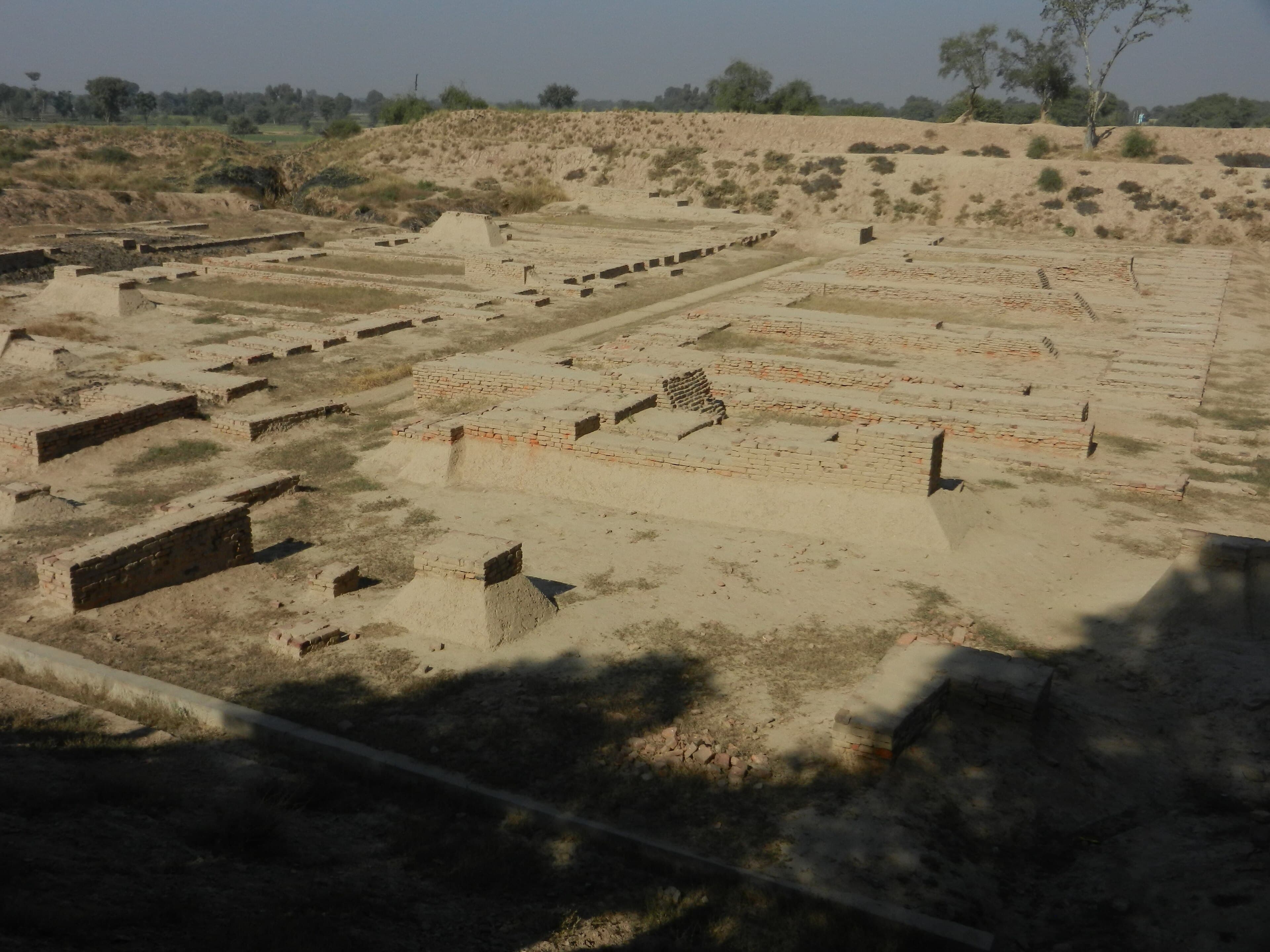
For thousands of years, a vast metropolis lay quiet beneath the soil of Punjab, its grand clay brick houses and advanced drainage systems preserved in the earth long after the Ravi River shifted its course.
In the humid heat of 1857, British engineers laying the tracks of the Lahore-Multan Railway encountered an obstacle that was also a stroke of extraordinary luck. To stabilize the heavy iron rails of this new imperial artery across the Punjab, they needed hundreds of thousands of tons of ballast—hard, uniform material to pack beneath the wooden ties. Nearby, rising from the dry plains near a former course of the Ravi River, stood a series of massive, weathered mounds composed of millions of high-quality, kiln-fired clay bricks. For months, laborers systematically dismantled these ancient structures, carting away the robust masonry of an unknown civilization to lay the literal foundation of British industrial progress. Only decades later did the world realize that the trains of the Raj were rolling over the pulverized bones of one of the greatest urban experiments in human history.
When the Archaeological Survey of India finally began systematic excavations in the 1920s, the site of Harappa gave its name to an entire lost world: the Bronze Age Indus Valley, or Harappan, Civilization. What emerged from the earth was not a monument to a singular, all-powerful king—there were no soaring pyramids, no colossal palaces, no triumphal arches celebrating bloody conquests—but rather an astonishingly sophisticated triumph of civic organization. At its height during the Mature Harappan phase, between 2600 BCE and 1900 BCE, Harappa was a bustling metropolis of perhaps 23,500 residents, spanning some 150 hectares of densely arranged, flat-roofed brick homes, administrative quarters, and fortified citadels. It was an urban center sustained not by imperial tribute, but by a sprawling network of trade, agricultural surplus, and a meticulous, almost obsessive commitment to standardization and public health.
Walking through the streets of Harappa during its golden age would have felt remarkably modern, characterized by a semi-orthogonal civic layout. While differing in specific topography from its sister city Mohenjo-daro to the south, Harappa shared the same fundamental dedication to hydraulic engineering. The city was divided into differentiated living quarters and fortified sectors, with houses constructed of standardized clay bricks. Most remarkably, these homes were integrated into a sophisticated civic drainage infrastructure. Waste water from private bathrooms was channeled through clay pipes into brick-lined street sewers, which were equipped with manholes for regular cleaning—a level of sanitation unmatched in the ancient Mediterranean or Mesopotamia, and not to be seen again in the region until the modern era.
This structural order was mirrored in the economic life of the city. Harappan merchants operated within a highly standardized system of weights and measures that conformed to a strict, graduated scale. To secure their goods, they utilized small, square seals carved from steatite (soapstone), beautifully engraved with exquisite motifs of animals—most notably the humped bull—and human figures. Many of these seals bear a mysterious, pictographic script. For a century, philologists and cryptographers from around the world have attempted to crack this code, debating whether it represents a proto-Dravidian tongue or another non-Vedic language. Yet the script remains stubbornly silent, refusing to yield its secrets. Despite this linguistic mystery, the physical evidence of Harappa’s commerce is loud and clear. Its merchants established trade routes that snaked along the Indus River, stretching across the Arabian Sea to the Persian Gulf, Elam, and the great cities of Sumerian Mesopotamia, where Harappans even maintained procurement colonies. From the highlands of Badakshan in modern Afghanistan, they brought precious blue lapis lazuli; from southern India, near Karnataka, they sourced gold and copper; and from their own fertile hinterlands, they exported dyed cotton textiles, wheat, rice, and carnelian.
Connected to
4 links to entries not yet ingested in the Library.