The boy who would nearly dismantle the Roman Republic began his mission with a childhood oath, swearing to his father that he would never be a friend to Rome.
In the winter of 207 BCE, a damp bundle was hurled over the palisade of a Carthaginian camp in the rugged mountain fastnesses of Calabria. It bounced through the dirt, settling near the watch posts of an army that had spent eleven years marring the soil of the Italian peninsula. When the soldiers retrieved the object and brought it to their commander, Hannibal, the son of Hamilcar Barca, recognized the features of his younger brother, Hasdrubal. The severed head, carried swiftly across the length of Italy by the victorious legions of Gaius Claudius Nero after the Battle of the Metaurus, was a silent, grimly literal message from the Roman Senate. It was the ultimate testament to the iron-clad will of a republic that refused to die, and it signaled the shattering of Hannibal’s grandest strategic design: the unification of the Barcid forces from Spain with his own veteran army in the heart of Italy. Hannibal, who had spent his youth scaling the Pyrenees and defying the frozen passes of the Alps with war elephants, looked upon the face of his brother and saw his own destiny written in the cold clay. He was a general who possessed an unrivaled mastery of the battlefield, yet he was also an island of tactical genius floating in a sea of strategic isolation, abandoned by his own government, starved of reinforcements, and locked in an embrace with an adversary that grew stronger every time it bled.
The roots of this desperate campaign lay in a sacrificial chamber in Carthage, or perhaps in the ancient Phoenician colony of Gades, where a nine-year-old boy was brought before a roaring sacrificial fire by his father, Hamilcar Barca. The elder Barca, a veteran of the First Punic War who had watched Carthage lose its maritime empire to the rising Roman Republic, was preparing to carve out a new dominion in the Iberian Peninsula to restore his family’s and his city’s fortunes. Before departing, Hamilcar demanded that his young son place his hand upon the sacrificial victim and swear a solemn, lifelong oath: that he would "never be a friend of Rome." Whether Hannibal promised, as Polybius later recorded, a silent geopolitical enmity, or whether he vowed to his father, as other traditions suggest, to "use fire and steel to arrest the destiny of Rome," the oath became the defining axis of his life. After Hamilcar drowned in an Iberian river and his successor, Hasdrubal the Fair, was assassinated in 221 BCE, the twenty-six-year-old Hannibal was acclaimed commander-in-chief by the army, a choice swiftly confirmed by the Carthaginian government. He was a figure of immediate, magnetic authority; Roman historian Livy recounted that the old veterans fancied they saw Hamilcar himself returned to them in his youth, possessing the same bright, burning look, the same fire in his eye, and the same absolute mastery of both obedience and command.
From the archives
Hannibal's route across the Alps in 218 BCE, from Mommsen's history of Rome.
Public domain · via Wikimedia Commons
The opening of Cannae, 216 BCE. The Roman centre advances against Hannibal's inverted crescent.
CC BY-SA · via Wikimedia Commons
The double envelopment complete. Roman infantry pinned, cavalry returned to seal the rear.
Public domain · via Wikimedia Commons
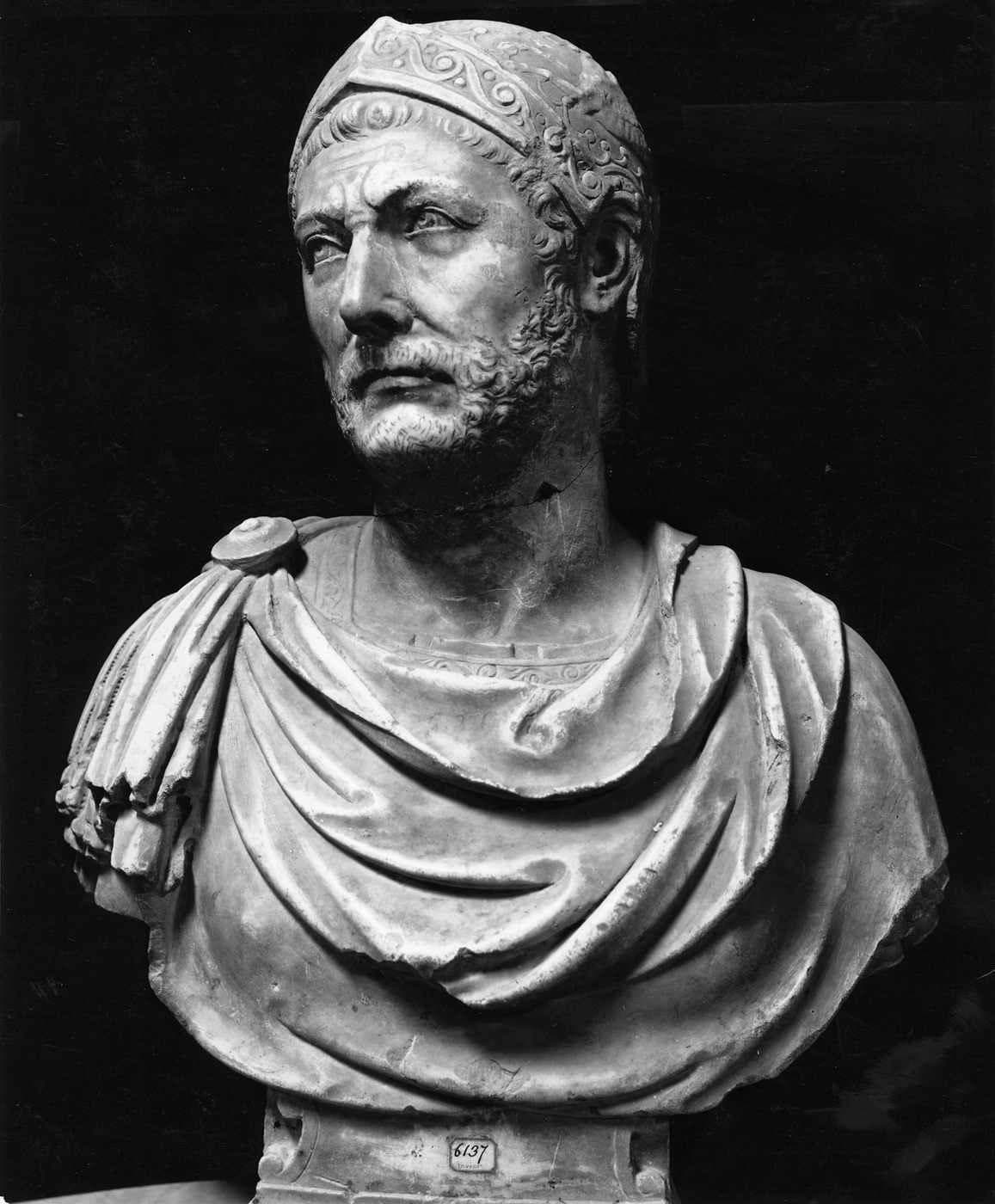
Marble bust traditionally identified as Hannibal Barca; Capua, found 1900s.
To unleash the storm he had promised his father, Hannibal turned his eyes to Saguntum, an Iberian city south of the Ebro River that had entered into a protective alliance with Rome. Recognizing that the treaty signed between Rome and Hasdrubal the Fair prohibited Carthaginian expansion north of the Ebro, Hannibal deliberately used Saguntum as a catalyst for war, besieging the city for eight grueling months until it fell. When Roman envoys arrived in Carthage to demand his surrender, Quintus Fabius Maximus Verrucosus stood before the Carthaginian Senate, gathered the folds of his toga, and offered them a choice between peace and war; the Carthaginians defiantly told him to choose, and Fabius let fall the folds, declaring he gave them war. What followed was one of the most daring logistics-driven invasions in ancient history. Hannibal calculated that Carthage, lacking a dominant navy after its previous defeats, could not strike at Italy by sea. He must instead march overland, a journey of thousands of miles across the Pyrenees, through the hostile territories of the Gauls, and over the formidable barrier of the Alps. Setting out from New Carthage in the late spring of 218 BCE with an army of Libyan and Spanish mercenaries, he fought his way to the Rhône by September, outmaneuvering local tribes who attempted to block his passage, and plunged into the alpine heights as winter began to lock the passes in ice.
The exact pass Hannibal traversed has remained an arena of fierce scholarly disputation from antiquity to the modern era. While Polybius noted that the route was already a matter of intense debate in his own day, modern geoarchaeologists and historians have scrutinized every high saddle of the Western Alps. Some influential theories have long pointed to the Col de Montgenèvre, the Col de la Traversette, or the northern routes of the Little St. Bernard and the Col de Mont Cenis. In recent decades, researchers like Patrick Hunt have argued for the Col de Clapier, citing its wide view of the Italian plains and year-round snow pockets, suggesting that Celtic guides may have intentionally misled the Carthaginian general. Conversely, biostratigraphic and archaeological investigations led by W. C. Mahaney have pointed strongly to the Col de la Traversette, the highest and most southerly pass, aligning with the agricultural writings of Varro. Peat bogs near the summit of the Traversette have revealed deep, highly disturbed sedimentary layers containing unique concentrations of Clostridia bacteria associated with the manure of thousands of horses and mules, radiocarbon-dated to approximately 218 BCE. Whichever frozen track his army climbed, the cost of the crossing was catastrophic. Livy painted a vivid picture of the descent, describing how Hannibal was forced to split rockfalls by heating the stone with massive wood fires and drenching the glowing fissures with sour wine and vinegar to crumble the barrier. By the time Hannibal descended into the Po Valley, the brutal cold, mountain ambushes, and sheer physical exhaustion had claimed nearly half his force; he emerged into Italy with only 20,000 infantry, 4,000 cavalry, and a fraction of his war elephants, most of which would perish in the damp, freezing winter that followed.
Despite these catastrophic losses, Hannibal immediately began to demonstrate the supreme tactical flexibility that would make his name a synonym for terror in the streets of Rome. Recognizing that he could not win a war of attrition against the massive manpower reserves of the Roman confederation, his grand strategy was to shatter Rome's system of Italian alliances by proving the Republic was powerless to protect its partners. At the River Ticinus in November of 218 BCE, his superior Numidian and Spanish cavalry routed the forces of Consul Publius Cornelius Scipio, forcing the Romans to evacuate the plain of Lombardy. Weeks later, at the Trebia, Hannibal drew the impetuous Consul Tiberius Sempronius Longus across a freezing, swollen river into a meticulously prepared trap, concealing a force of a thousand cavalry and a thousand infantry under his younger brother Mago in a brush-choked ravine to strike the Roman rear. In the spring of 217 BCE, seeking a secure base further south, Hannibal marched his men through the flooded, toxic marshes of the Arno River for four days and three nights, an ordeal of sleeplessness and disease during which he contracted severe conjunctivitis, permanently losing the sight in his right eye. Emerging into Etruria, he executed the first recorded turning movement in military history, bypassing the camp of Consul Gaius Flaminius at Arretium to cut him off from Rome. Provoked by the systematic devastation of the Tuscan countryside, Flaminius rushed into a blind pursuit, marching his legions through a thick morning mist into a narrow defile along the shores of Lake Trasimene. Hannibal had lined the hills above with his veterans; at his signal, they swept down upon the trapped Romans, driving thousands into the red-tinted waters of the lake in the most devastating ambush of a Roman field army ever recorded.
In the wake of Trasimene, the Roman Senate, panicking, bypassed normal consular elections to appoint Quintus Fabius Maximus as dictator. Fabius understood that to fight Hannibal in a pitched battle was to invite ruin; he initiated the strategy of attrition that would forever bear his name, dogging the Carthaginian army’s heels from the high ground, cutting off foragers, and refusing to engage. Though this "Fabian strategy" was deeply unpopular in Rome, where it was branded as cowardice, it nearly trapped Hannibal in the lowlands of Campania. In the narrow pass of the Ager Falernus, Fabius blocked all exits, seemingly dooming the Carthaginian army to starvation. Hannibal, however, responded with a classic piece of ancient generalship: he had his men tie bundles of dry brushwood to the horns of two thousand oxen, set them ablaze in the dead of night, and drive them up the heights. The Roman guards, seeing a moving line of flickering lights, believed the Carthaginians were attempting an escape over the ridges and rushed to intercept them, leaving the main pass unguarded. Hannibal silently marched his entire army, baggage train and all, through the dark lowlands to safety. It was a humiliating blow to Fabian prestige, and when the dictator's term expired, the Roman populace clamored for a return to the aggressive, direct traditions of Roman warfare.
This brings us to the summer of 216 BCE, on the hot, dust-blown Apulian plain near the Aufidus River, where the supreme drama of Hannibal's tactical genius was enacted. The Roman Senate had raised an army of unprecedented scale—an enormous force of eight legions, numbering between 50,000 and 80,000 men under the alternating daily command of the cautious Lucius Aemilius Paullus and the aggressive Gaius Terentius Varro. Hannibal had seized a vital Roman grain depot at Cannae, forcing the Romans to march south to protect their remaining supplies. On the morning of August 2, with the dry, choking Volturnus wind blowing grit directly into the eyes of the Roman soldiers, Varro took command and drew up his massive force in a dense, exceptionally deep formation, intending to use the sheer physical weight of his infantry to crush the Carthaginian center. Hannibal, observing this, devised a deployment that defied all conventional military logic. He placed his most reliable veterans, the heavily armed Iberian and Gallic infantry, in the center, but drew them up in a thin, outward-curving crescent that bowed toward the Roman line. On the wings, hidden slightly back from the crescent, he placed his highly disciplined Libyan mercenaries, armed with captured Roman gear. On the flanks, he stationed his cavalry, with the heavy Iberian and Gallic horse under Hasdrubal on the left and the swift Numidians under Maharbal on the right.
As the trumpet blasts echoed across the dry plain, the massive Roman central column surged forward, a solid wall of bronze and iron. Hannibal's thin crescent of Gauls and Spaniards met the shock, holding briefly before executing a slow, deliberate, fighting retreat. To the Roman legions, it appeared that the enemy center was breaking under their immense pressure. Shouting in triumph, the Roman center surged deeper into the pocket, packing themselves tighter and tighter as they pressed forward. But this retreat was the closing of a trap. As the Carthaginian center bent backward, transforming from a convex crescent into a concave pocket, the two wings of elite Libyan mercenaries remained stationary on the flanks. The Romans had marched straight into a deep U-shaped corridor. Suddenly, Hannibal gave the order: the Libyans wheeled inward, striking the dense, disordered Roman columns on both flanks. At the same moment, the Carthaginian cavalry completed their work. On the left, Hasdrubal’s heavy horse had shattered the Roman cavalry, swept around the rear of the entire Roman army, and joined Maharbal’s Numidians to drive the remaining Roman horse from the field. Now, Hasdrubal’s victorious cavalry turned and slammed directly into the rear of the packed Roman infantry.
The encirclement was absolute. The massive Roman army, compressed into a helpless mass, was so tightly packed that soldiers could not draw their swords or raise their shields. For hours, the battle became a systematic slaughter. The Carthaginians, moving around the perimeter of the trapped mass, cut down the outer ranks, layer by layer. The heat was suffocating; the dust kicked up by tens of thousands of trampling feet choked the dying. By the time the sun began to set over the Aufidus, the Roman field army had ceased to exist. Between 50,000 and 70,000 Romans lay dead in the dust, including Consul Lucius Aemilius Paullus, eighty senators, and dozens of military tribunes and magistrates—nearly thirty percent of the entire Roman governing class killed in a single afternoon. It was one of the bloodiest single days of combat in human history, a masterclass in the double envelopment that would be studied in military academies for over two thousand years, inspiring commanders from Alfred von Schlieffen to Norman Schwarzkopf Jr.
In the immediate aftermath of this unimaginable triumph, Maharbal, the commander of Hannibal's Numidian horse, urged his general to march directly on Rome, promising that within five days they would dine in the Capitol. Hannibal, knowing he lacked the heavy siege equipment, engineers, and supply lines required to reduce a fortified city of Rome's size, hesitated and declined. In frustration, Maharbal is said to have uttered the famous, damning indictment: "Hannibal, you know how to gain a victory, but not how to use one." Whether this assessment was fair or whether Hannibal’s caution was a sober recognition of his logistical limits, his decision marked the high-water mark of his Italian campaign. While major cities like Capua and Tarentum defected to him, and Philip V of Macedon pledged his support, the core of the Roman confederation held. The Romans, displaying a terrifying, singular resilience, refused to negotiate. They forbade mourning, refused to ransom the prisoners captured at Cannae, and returned immediately to the Fabian strategy of attrition. They raised new legions from teenagers and slaves, choosing to bleed Hannibal slowly rather than face him in the open field again.
For the next thirteen years, the war in Italy degenerated into a grinding, frustrating stalemate. Hannibal was forced to lead his shrinking army back and forth across the rugged terrain of southern Italy, launching brilliant tactical counter-strikes but unable to achieve a decisive, war-ending blow. He was fighting a shadow war against his own domestic political realities. In Carthage, the peace party, led by the wealthy oligarch Hanno II the Great, actively thwarted his campaign. Hanno, whose wealth depended on stable trade with Rome, resented the Barcid family's dominance and argued that sending reinforcements to Italy would only prolong an unnecessary war. Consequently, Hannibal’s urgent requests for men, money, and siege engines were consistently delayed or denied. He was forced to rely on local mercenaries whose loyalty depended on dwindling plunder. While Hannibal continued to win minor engagements, slaying Roman consuls like the famous Marcus Claudius Marcellus in 208 BCE, his strategic position was crumbling. The Romans systematically reclaimed his conquests, recapturing Capua in 211 BCE and Tarentum in 209 BCE, and executing ruthless campaigns of pacification that isolated the Carthaginian general in the toe of the Italian boot.
The final act of the Second Punic War was written not in Italy, but on the sands of North Africa. A brilliant, young Roman commander, Publius Cornelius Scipio—who had survived the slaughter of Cannae and studied Hannibal's tactics with obsessive care—had conquered Carthaginian Spain and convinced the Roman Senate to allow him to launch a counter-invasion of Africa. Scipio's rapid successes in the Carthaginian heartland forced the home government to recall Hannibal from Italy in 203 BCE. After nearly fifteen years of campaign, having left a record of his deeds engraved on bronze tablets in the temple of Juno Lacinia at Crotona, Hannibal sailed away from the land he had terrorized but could not conquer. In 202 BCE, the two greatest generals of the age met at Zama, a short distance from Carthage. In a fruitless pre-battle conference, the two men expressed mutual admiration, but negotiations failed over Roman anger regarding the breach of previous treaties. In the battle that followed, Scipio turned Hannibal’s own tactics against him. Having secured the alliance of the formidable Numidian cavalry king Masinissa, the Romans possessed cavalry superiority for the first time. When Hannibal unleashed his eighty war elephants, Scipio’s disciplined legions simply stepped aside into pre-arranged lanes, blowing loud trumpets to panic the beasts and drive them back into the Carthaginian lines. The Roman and Numidian cavalry swept Hannibal's horse from the field, then returned to strike his infantry from the rear. The Carthaginian army collapsed, losing 20,000 men, and Carthage was forced to accept a humiliating peace that stripped her of her empire, her fleet, and her independence.
Yet, even in defeat, Hannibal's story was far from over. Showcasing a versatility that matched his military genius, the forty-six-year-old general was elected suffete, the chief magistrate of Carthage, and immediately set about reforming the corrupt, stagnant administration of his city. He dismantled the lifelong terms of the oligarchs in the tribunal of the Hundred and Four, making them subject to annual direct elections, and audited the state's finances to prove that Carthage could pay its massive war indemnity to Rome without raising taxes on its citizens. These financial reforms, while immensely popular with the common people, earned him the bitter enmity of the Carthaginian aristocracy. Alarmed by Carthage's rapid economic recovery and egged on by Hannibal's political rivals, the Roman Senate sent a delegation in 195 BCE to demand his surrender, alleging he was conspiring with King Antiochus III of the Seleucid Empire. Realizing his compatriots would betray him to save themselves, Hannibal fled into voluntary exile, embarking on a long, wandering journey through the Hellenistic East that would occupy the final fifteen years of his life.
This long exile was a tragic, restless odyssey through a Mediterranean world increasingly dominated by the shadow of Rome. Hannibal traveled first to the ancient mother-city of Tyre, then to the Seleucid court at Ephesus, where he offered his services to Antiochus III. He urged the king to equip a fleet and land an army in southern Italy, offering to lead the invasion himself, but the Seleucid courtiers, jealous of his reputation, persuaded Antiochus to keep the legendary general at a distance. When war broke out between the Seleucids and Rome, Hannibal was given only a minor naval command in Cilicia; his fleet, built from scratch under wartime shortages, was defeated by the faster, more experienced Rhodian navy at the Battle of Side in 190 BCE. Following the decisive Seleucid defeat at Magnesia, the peace terms dictated by Rome demanded Hannibal's immediate surrender. He fled once more, seeking temporary refuge at the royal court of Artaxias I in Armenia—where legend holds he designed the plans for the new capital city of Artaxata—before finally finding asylum with King Prusias I of Bithynia, who was engaged in a regional conflict with Rome's ally, Eumenes II of Pergamon. Hannibal lent his tactical genius to Bithynia, famously winning a naval battle against Eumenes by launching clay pots filled with venomous snakes onto the decks of the Pergamenian ships, but his presence was a constant provocation to the Roman Republic.
In the end, the Republic’s memory proved as long as Hannibal’s exile. Around 183 BCE, the Roman ex-consul Titus Quinctius Flamininus discovered Hannibal's location in Bithynia and pressured King Prusias to surrender him. Realizing that the fortified villa he occupied at Libyssa was surrounded by soldiers and that all paths of escape were blocked, Hannibal chose to deny his enemies their final triumph. He took a vial of poison he had long carried with him, reputedly in a ring. Before drinking, he is said to have written a final, scathing letter to his pursuers, declaring: "Let us relieve the Romans from the anxiety they have so long experienced, since they think it tries their patience too much to wait for an old man's death." He died in his sixties, far from the red soil of North Africa, in a small village on the shores of the Sea of Marmora. The precise year of his death remained a subject of controversy among ancient historians—Polybius recording 182 BCE, Sulpicius Blitho 181 BCE, and Cornelius Nepos suggesting 183 BCE, the very same year his great conqueror, Scipio Africanus, died in his own self-imposed exile.
Hannibal’s legacy remained an indelible scar upon the Roman psyche. For centuries after his death, whenever danger threatened the Republic, the terrifying cry of "Hannibal ad portas"—"Hannibal is at the gates!"—would echo through the streets of Rome, a linguistic relic of the sheer panic he had once inspired. Yet, as the centuries softened the memory of his raids, even his enemies could not withhold a grudging, awe-stricken admiration for his achievements. He had held a diverse, multi-ethnic army of Gauls, Spaniards, and Libyans together in a hostile country for fifteen years without a single mutiny, surviving on his wits, his tactical daring, and the deep, personal loyalty of his men. The monument of white marble later erected over his suspected tomb at Libyssa by the Roman Emperor Septimius Severus, himself of North African descent, stood as a testament to a warrior who had transcended his own defeat to become a universal symbol of the tragic, defiant struggle against overwhelming historical destiny. His life poses a haunting question that still echoes across the study of ancient empires: can supreme tactical genius ever overcome a fundamental lack of political unity and strategic support at home, or are the brilliant victories of a single general ultimately destined to be swallowed up by the relentless, bureaucratic machinery of a state organized for perpetual war?