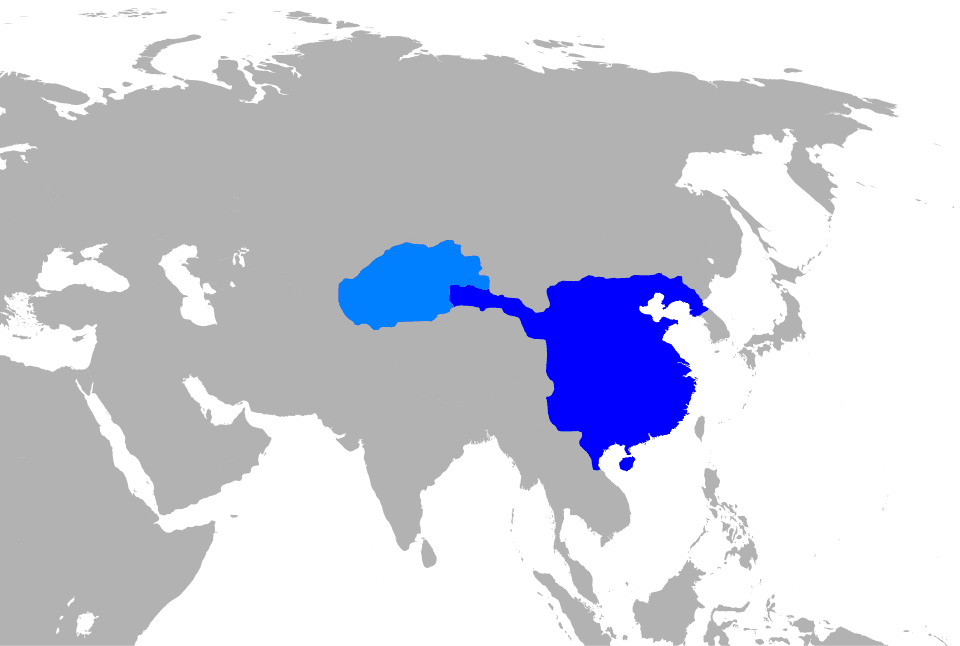
When the peasant rebel Liu Bang established the Han dynasty in 202 BCE, he initiated a four-century epoch that permanently forged the identity of a civilization.
The modern Chinese name for the Milky Way is Tianhe, the Celestial River, but in the classical tongue, it was sometimes written as Han—a cold, silver stream of stars cutting across the night sky. In 206 BCE, when the brilliant but brutal Qin dynasty splintered into civil war, a peasant-born rebel named Liu Bang was exiled by his chief rival to a minor fief along the Han River in southwestern Shaanxi. Within four years, Liu Bang had outmaneuvered his aristocratic nemesis, Xiang Yu, defeating him at the Battle of Gaixia. Crowned as Emperor Gaozu, Liu Bang named his new empire after his old place of exile. It was an act of political naming that would outlast the stars; more than two millennia later, the majority of the world’s most populous nation still refer to themselves as the Han people, their speech as the Han language, and their script as Han characters.
The Han dynasty (206 BCE–220 CE) inherited a unified China that was physically exhausted. The preceding Qin had forged the empire through relentless militarism and draconian laws, only to collapse in a heap of rebellions within fifteen years. Gaozu’s initial task was to heal a fractured realm while keeping his own victorious generals from tearing it apart. He divided the empire: the western third, including the new capital of Chang'an, was ruled directly by the central government through administrative commanderies, while the eastern two-thirds were split into ten semi-autonomous kingdoms ruled by his wartime allies. This was a fragile compromise. Suspecting their loyalty, Gaozu systematically replaced these independent kings with members of his own imperial clan, the Liu. Yet blood proved no guarantee of obedience. The kingdoms still wielded significant autonomy, a tension that exploded in 154 BCE with the Rebellion of the Seven States. The imperial court crushed the uprising and stripped the regional kings of their authority, turning them into mere pensioners who collected taxes but could no longer appoint their own officials. From then on, the central government’s bureaucrats ruled supreme.
With domestic rivals subdued, the Han faced an existential threat along their northern borders: the Xiongnu. This nomadic confederation, unified under the formidable chieftain Modu Chanyu, controlled a vast expanse of the Eurasian Steppe stretching from Manchuria to Samarkand. In 200 BCE, Gaozu marched north to confront them, only to be surrounded and soundly defeated at Baideng. Realizing that the young empire could not win a war of attrition, the Han initiated the heqin policy—a humiliating system of appeasement disguised as diplomacy. The Han court sent imperial princesses to marry the Chanyu and paid regular, massive tributes of silk, grain, and wine. It was a cold peace. Despite the treaties and the reopening of border markets under Emperor Wen, Xiongnu raiders regularly breached the Great Wall, riding south to plunder Chinese settlements.
12 links to entries not yet ingested in the Library.
The paradigm shifted dramatically with the ascension of Emperor Wu in 141 BCE. Impatient with the cost and indignity of appeasement, Wu rejected the cautious consensus of his older ministers. In 133 BCE, after a failed Han attempt to lure and assassinate the Chanyu at Mayi, Wu launched a series of massive, aggressive military campaigns into the heart of the steppe. Led by legendary commanders like Huo Qubing and Wei Qing, Han armies pushed the Xiongnu north of the Gobi Desert, eventually reaching as far as Lake Baikal. To consolidate these bloody gains, the Han seized the Hexi Corridor, establishing four new frontier commanderies and settled them with soldiers, convicts, and subsidized civilian pioneers. By 51 BCE, the northern threat was fractured; the Xiongnu leader Huhanye submitted to Chang'an as a tributary vassal, and his rival Zhizhi Chanyu was hunted down and killed by Han forces in modern Kazakhstan.
These steppe wars did more than secure the borders; they opened China to the wider world. Seeking allies against the Xiongnu, Emperor Wu had dispatched a diplomat named Zhang Qian into the mysterious western regions. Though Zhang Qian failed to secure military alliances, he returned after years of captivity and travel with astonishing reports of sophisticated urban civilizations in Fergana, Sogdiana, and Bactria, as well as whispers of the Indus River valley and the Parthian Empire. These contacts laid the foundations of the Silk Road. Soon, Han embassies and merchant caravans were traversing the Tarim Basin, exchanging Chinese silk for Roman glassware and Central Asian horses. In 60 BCE, the court established the Protectorate of the Western Regions to police and defend these vital desert oases. Under Emperor Wu, Han arms also pushed south, annexing the kingdom of Nanyue in modern Guangdong and northern Vietnam, absorbing the Dian kingdom of Yunnan, and marching into the northern Korean Peninsula to establish the Lelang and Xuantu commanderies.
Governing this gargantuan empire—which a nationwide census in 2 CE recorded as housing more than 57 million people—demanded an unprecedented administrative apparatus. Under Emperor Wu, the court officially adopted Confucianism as the state ideology, blending its moral philosophy with the cosmic theories of the scholar Dong Zhongshu. To staff the bureaucracy, the state sponsored Confucian education, creating a class of scholarly gentry who earned their posts through merit rather than noble birth. Yet maintaining this state was fabulously expensive. To fund his foreign conquests and colonize the frontiers, Emperor Wu nationalized the private salt, iron, and liquor industries, establishing state monopolies run by former merchants. The government also monopolized the minting of copper coinage in 119 BCE, creating a standardized currency that would remain the fiscal bedrock of China for centuries. These interventionist policies sparked fierce intellectual debates between "Modernists," who advocated for state-run enterprises to fund defense, and "Reformists," who argued that such monopolies squeezed the peasantry and corrupted the Confucian state.
The Western Han came to a sudden halt in 9 CE when Wang Mang, an idealistic Confucian regent, usurped the throne and established his short-lived Xin dynasty. Wang Mang’s radical land reforms and administrative overhauls triggered widespread chaos, compounded by devastating floods. He was overthrown and killed in 23 CE during a period of civil war, paving the way for a prince of the Liu imperial line, Emperor Guangwu, to restore the dynasty in 25 CE. This second era, known as the Eastern Han, shifted the capital eastward to Luoyang. The Eastern Han abandoned many of the aggressive state monopolies of the Western Han, ushering in a period of remarkable scientific and cultural flourishing. This was the era that witnessed the invention of paper, the development of ship rudders for steering, the use of negative numbers in mathematics, and the creation of hydraulic-powered armillary spheres. In Luoyang, the scientist Zhang Heng constructed a bronze seismometer utilizing an inverted pendulum, capable of registering the precise cardinal direction of earthquakes occurring hundreds of miles away.
Yet beneath this golden age of science and commerce, the political foundations of the Eastern Han were decaying. After 92 CE, a succession of child emperors ascended the throne, transforming the imperial palace into a claustrophobic battleground. Power was violently contested between three factions: the families of the Empresses (consort clans), the military nobility, and the palace eunuchs—castrated servants who controlled access to the young emperors and used their proximity to power to accumulate vast fortunes. As the court at Luoyang consumed itself in purges and conspiracies, the provincial peasantry was neglected. Heavily taxed and displaced by land-grabbing elites, desperate farmers turned to salvationist Taoist movements. In 184 CE, these grievances exploded into the Yellow Turban Rebellion and the Five Pecks of Rice Rebellion, massive peasant uprisings that shattered the central government's authority.
To suppress the rebellions, the court was forced to grant unprecedented autonomy to provincial military governors. The cure proved fatal to the dynasty. When Emperor Ling died in 189 CE, military officers marched on the palace and massacred the eunuchs, but the power vacuum was quickly filled by rival warlords. The final decades of the Han were a fiction; the last emperor, Xian, was a powerless pawn moved between competing generals. The dynasty officially ended in 220 CE when Cao Pi, the king of Wei and son of the warlord Cao Cao, forced Emperor Xian to abdicate, plunging China into the fractured, romanticized era of the Three Kingdoms. The Han had fallen, yet they had set the mold. For the next two thousand years, through every cycle of collapse and reunion, the memory of the Han remained the political ideal: a single, literate, bureaucratically sophisticated civilization stretching from the steps of the north to the tropical shores of the south, united under the sky.