Long before he was crowned Emperor of Ethiopia in 1930, the young nobleman Tafari Makonnen was already consolidating power, serving as Regent Plenipotentiary under Empress Zewditu and securing his path to the throne by defeating the army commander Ras Gugsa Welle Bitul at the…
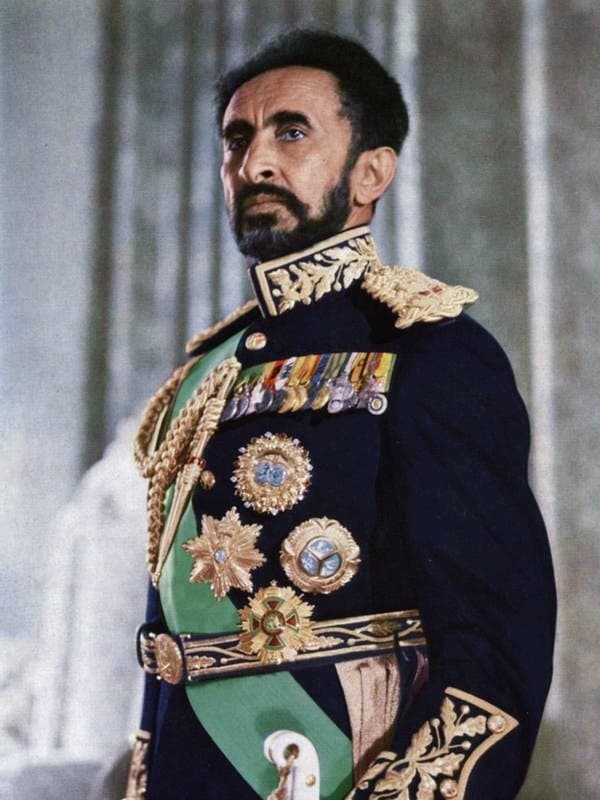
On 2 November 1930, inside the Holy Trinity Cathedral in Addis Ababa, a thirty-eight-year-old nobleman of slight stature and piercing gaze was crowned Emperor of Ethiopia. He took the regnal name Haile Selassie—"Power of the Trinity"—and assumed a title designed to echo across millennia: "By the Conquering Lion of the Tribe of Judah, His Imperial Majesty Haile Selassie I, King of Kings of Ethiopia, Lord of Lords, Elect of God." The ceremony was not merely an assertion of sovereignty over a complex, multi-ethnic empire; it was a performance of ancient legitimacy. According to the Kebra Nagast, Ethiopia’s fourteenth-century national epic, the country’s monarchs descended directly from Menelik I, the son of King Solomon and the Queen of Sheba. Yet, as the foreign dignitaries looked on, they beheld a ruler who straddled two worlds: a man deeply rooted in the medieval traditions of the Solomonic dynasty, but also an ambitious modernizer who wore European military regalia and sought to drag his isolated mountain empire into the twentieth century.
Born Tafari Makonnen in 1892 in the village of Ejersa Goro, the future emperor was a child of the high nobility, his lineage tracing back to the Shewan Amhara king Sahle Selassie. His father, Ras Makonnen, had been a brilliant general under Emperor Menelik II, playing a decisive role in defending the empire from European colonial ambitions at the Battle of Adwa. Raised with the expectations of his class, young Tafari was educated by both Ethiopian Orthodox tutors and French Capuchin friars, gaining a cosmopolitan perspective rare among his peers. By his teens, he was already navigating the treacherous waters of provincial administration, serving as a governor first in Sidamo and later in his father’s old stronghold of Harar. In 1911, he secured a vital political alliance by marrying Menen Asfaw, a noblewoman of Ambassel. It was a union of mutual respect and political strategy that lasted half a century, surviving court intrigues, wars, and exile.
Tafari’s rise to supreme power was a masterclass in patient, calculated political maneuvering. The path to the throne was blocked by Lij Iyasu, the designated heir of Menelik II, whose erratic behavior and leanings toward Islam alienated the powerful Ethiopian Orthodox Christian establishment and the conservative nobility. In 1916, a coalition of conservative nobles, led by the veteran Minister of War Fitawrari Habte Giyorgis, deposed Iyasu. In the delicate power-sharing arrangement that followed, Menelik's daughter, Zewditu, was crowned Empress, while the young Tafari was named Crown Prince and Regent Plenipotentiary. For fourteen years, Tafari served as the de facto administrator of the empire, slowly consolidating power while the Empress focused on prayer and fasting. He weathered rebellions and dismantled opposition, notably defeating the Empress’s former husband, Ras Gugsa Welle Bitul, at the Battle of Anchem in 1930. When Zewditu died shortly thereafter, the regency ended, and the era of Haile Selassie began.
+ 12 further connections to entries not yet ingested
As Emperor, Haile Selassie viewed modernization not as an imitation of the West, but as a shield against it. He understood that to preserve Ethiopia’s independence, he had to centralize the state and reform its archaic institutions. In 1931, he introduced the nation’s first written constitution, and in 1942, he officially abolished slavery. However, his efforts to centralize authority frequently collided with the traditional, landed aristocracy—the Mesafint—who bitterly resisted any erosion of their feudal privileges. To secure the center, Selassie’s administration often suppressed regional identities, relocating Amhara populations into southern provinces and actively discouraging regional languages. In later years, his government faced intense criticism for its autocratic nature, including the suppression of the Harari people and the marginalization of the Oromo language in education and public administration.
The ultimate test of Selassie’s modernization project arrived in 1935, when Fascist Italy, seeking revenge for its nineteenth-century defeat at Adwa, invaded Ethiopia. Despite a courageous defense, the Ethiopian forces, largely equipped with outdated weaponry, were overwhelmed by the modern Italian war machine, which deployed poison gas and aerial bombardment. Forced into exile in the United Kingdom, Selassie refused to concede defeat. In June 1936, he stood before the League of Nations in Geneva, a solitary, dignified figure in a dark cloak, warning the assembled diplomats that their failure to collective security would invite their own ruin. "It is international morality that is at stake," he declared. "God and history will remember your judgment." Though his plea fell on deaf ears at the time, his words proved prophetic. From his exile, and later from Anglo-Egyptian Sudan where he helped coordinate the Ethiopian resistance, Selassie kept the flame of Ethiopian sovereignty alive until British and Ethiopian forces liberated the country in 1941 during the East African campaign of World War II.
Restored to his throne, Selassie dedicated the post-war decades to elevating Ethiopia’s stature on the world stage. He became a champion of internationalism, leading Ethiopia into the United Nations and positioning Addis Ababa as the diplomatic capital of a rapidly decolonizing Africa. In 1963, he presided over the creation of the Organisation of African Unity, serving as its first chairman. In these continental forums, Selassie acted as a moderate, mediating force, pushing back against the radical, anti-Western rhetoric of socialist leaders like Kwame Nkrumah, whose vision of a "United States of Africa" Selassie viewed as a threat to his own crucial Western alliances. He also aggressively expanded Ethiopia's borders, dissolving the UN-mandated federation with Eritrea in 1962 to annex it as a province, a move that ignited a bitter, decades-long war of secession.
Yet, while Selassie’s international prestige reached its zenith, the domestic foundations of his regime were rotting. To the outside world, he was an elder statesman of global stature; to a growing movement of young, educated Ethiopians and military officers, he was an archaic autocrat presiding over a stagnant, impoverished feudal society. The pace of his reforms was too slow for a generation exposed to global education, and his suppression of dissent grew increasingly heavy-handed. The disconnect between his international image and domestic reality was further highlighted by a bizarre global phenomenon: across the Atlantic in Jamaica, the Rastafari movement had emerged in the 1930s, proclaiming Selassie as the returned Messiah, Jah, and the living God. Though Selassie himself was a devout practitioner of the Ethiopian Orthodox Church, he respected the movement, even if he did not claim the divinity they ascribed to him.
The end came not with a grand battle, but with the quiet, devastating collapse of his authority amidst widespread famine and economic hardship. In 1974, a creeping military coup led by a Marxist-Leninist junta known as the Derg stripped the aging Emperor of his power, eventually deposing him entirely. Backed by the Soviet Union, the Derg abolished the ancient monarchy and began a brutal reign of terror. For nearly two decades, the fate of the deposed Emperor remained shrouded in mystery. It was only in 1994, three years after the fall of the Derg regime, that the public learned the truth: Haile Selassie had been assassinated in his bed at the Jubilee Palace on 27 August 1975. In November 2000, his excavated remains were finally laid to rest with full imperial honors at the Holy Trinity Cathedral in Addis Ababa. He left behind a complicated legacy—remembered by some as a tyrant who prioritized imperial prestige over his people’s basic welfare, and by others as a visionary father of modern Africa who stood as a symbol of black independence in an era of colonial domination.