Person · 374 CE – 413 CE · Korean Kingdoms
Gwanggaeto the Great
- Also known as
- Gwanggaeto
- Gwanggaeto
- Gwanggaeto
- Gwanggaeto
- Gwanggaeto
- Gwanggaeto
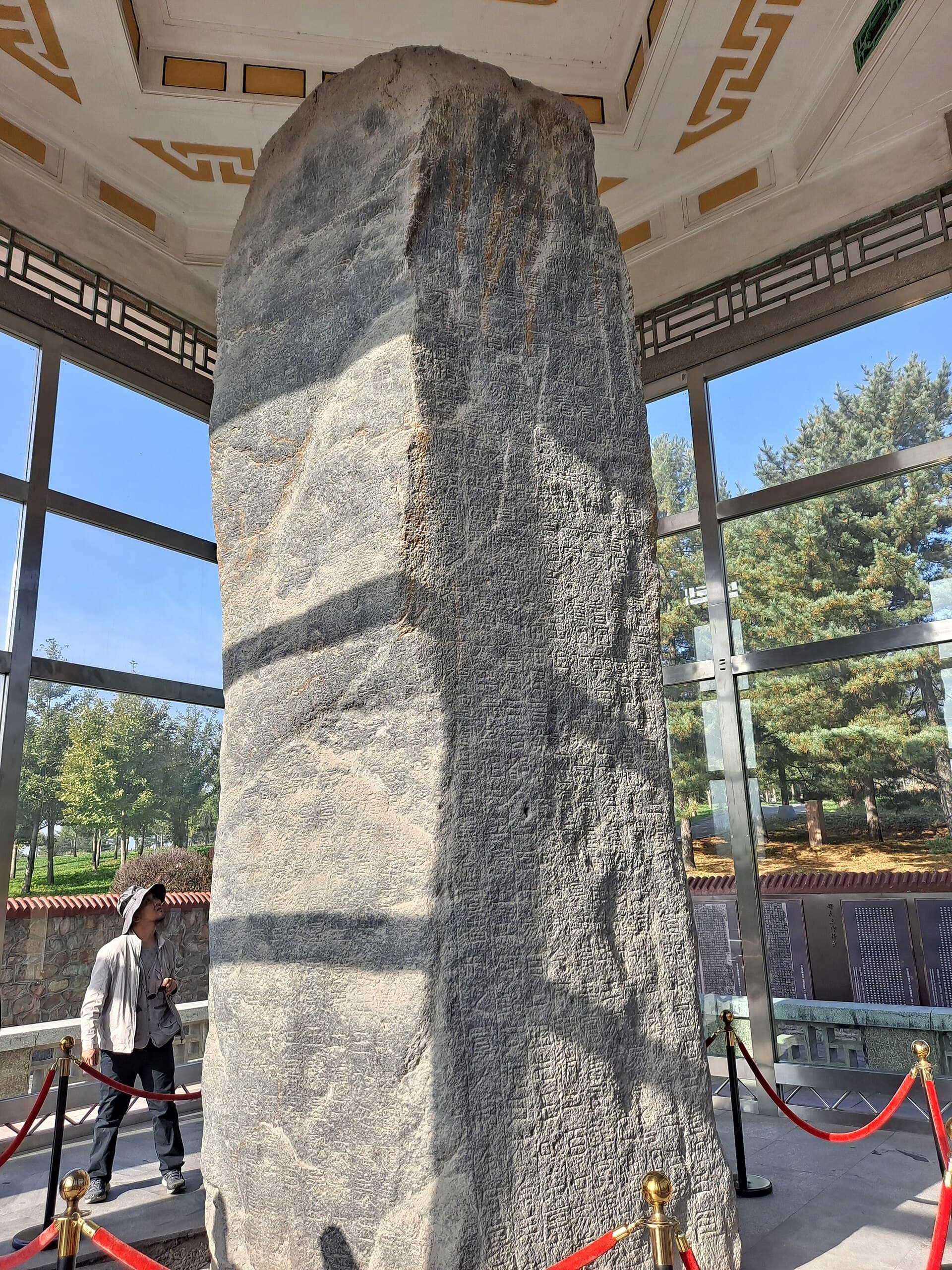
To understand the scale of what King Gwanggaeto achieved, one must look at the state of Goguryeo when he was born in 374 CE.
In the late nineteenth century, near the banks of the Yalu River where the modern border between China and North Korea traces its uneasy line, local residents cleared away centuries of overgrowth to reveal a colossal column of dark, weathered tuff. Standing over six meters tall, the pillar was carved from a single block of stone, its four vertical faces etched with thousands of Chinese characters. Erected in 414 CE by a grieving son, the Gwanggaeto Stele is the largest engraved monument of its kind in the world. It is a text of immense, towering ambition, designed to broadcast the exploits of a man who died at just thirty-eight years old, yet left an indelible mark on the landscape of Northeast Asia. The monument does not merely record a list of battles; it announces a cosmic shift. It names its subject "Entombed in Gukgangsang, Broad Expander of Domain, Peacemaker, Supreme King"—a monarch known to history simply as Gwanggaeto the Great.
To understand the world into which Gwanggaeto was born in 374 CE, one must look to the humiliation of his grandfather, King Gogukwon. Three years before Gwanggaeto’s birth, the northern Korean kingdom of Goguryeo was nearly annihilated by its southern rival, Baekje. Led by the energetic King Geunchogo, Baekje forces had stormed north, sacked the city of Pyongyang, and killed Gogukwon on the battlefield. For a generation, Baekje reigned supreme, its influence stretching across the Yellow Sea to the Chinese mainland and south to the Japanese archipelago. Goguryeo was left broken, its prestige shattered. The response of Gwanggaeto’s immediate predecessors was not a rash rush for vengeance, but a quiet, calculated retreat. Under King Sosurim, Goguryeo pacified its neighbors, adopted Buddhism to forge a unified social and political consciousness, and initiated profound military reforms. They built a state designed to endure, biding their time until the instrument they were forging could be wielded by a leader of singular resolve.
That leader emerged in 391 CE when the seventeen-year-old Gwanggaeto ascended the throne. He did not merely take the crown; he redefined the office. Breaking with the traditional practice of adopting Chinese era names, Gwanggaeto declared his own reign-era: Yeongnak, meaning "Eternal Rejoicing." By claiming the title of Taewang, or Supreme King, he was signaling to the fractured dynasties of China and the rival kingdoms of the peninsula that Goguryeo was no longer a tributary client, but an empire equal in dignity and sovereignty to any power on Earth.
His actions quickly matched his rhetoric. In 392 CE, Gwanggaeto turned his army south toward Baekje, the authors of his family’s historical shame. Leading forty thousand troops, he tore through the frontier, capturing ten walled cities in a single, lightning campaign. When the Baekje monarch, King Asin, attempted a series of desperate counterattacks over the following years, Gwanggaeto’s reformed military machine ground them to dust. Even as these campaigns raged, Gwanggaeto displayed a sophisticated grasp of statecraft; in 393 CE, he ordered the construction of nine Buddhist temples in Pyongyang, cementing the faith that unified his people’s spiritual life while his armies secured their physical borders.
The climax of the southern war came in 396 CE. Gwanggaeto launched a massive, coordinated land and sea assault down the Han River, striking directly at the Baekje capital of Wiryeseong, located in modern-day Seoul. The city fell. King Asin was forced to submit, surrendering a royal prince and ten of his government ministers as hostages to ensure his kingdom’s compliance.
Yet, Gwanggaeto refused to be defined by a single frontier. He was a sovereign who fought on all horizons simultaneously. In 395 CE, while the Baekje campaign was still active, he rode west across the Liao River, shattering the Khitan Baili clans, destroying three tribes, and wiping out hundreds of nomadic camps. In 398 CE, he pushed northeast to subjugate the Sushen, the Tungusic ancestors of the Jurchens and Manchus, securing his northern flank.
This vast, multi-front expansion was put to its ultimate test at the turn of the fifth century. In 399 CE, a desperate plea for help arrived from Silla, the kingdom occupying the southeastern corner of the peninsula. Silla was being crushed under a combined invasion by Baekje—violating its prior submission—alongside the Gaya confederacy and allied Wa troops from the Japanese archipelago. In 400 CE, Gwanggaeto dispatched an expeditionary force of fifty thousand infantry and cavalry. The Goguryeo army swept south, annihilating the coalition and reducing Gaya to a permanent decline from which it would never recover. Silla was saved, but its salvation came at the price of its independence; Gwanggaeto established Silla as a de facto protectorate. To ensure their loyalty, he kept a Silla prince, Silseong, as a hostage at his court for a decade before personally returning him to Silla and installing him on the throne.
While Gwanggaeto’s forces were occupied in the far south, the Xianbei state of Later Yan, ruled by the Murong clan in Liaoning, saw an opportunity and struck at Goguryeo’s western borders. It was a tactical miscalculation. Repulsing the initial invasion, Gwanggaeto launched a retaliatory campaign in 402 CE, seizing the vital fortress of Sugun near the Later Yan capital. When Later Yan attempted counter-offensives against the Liaodong fortresses in 405 and 406 CE, Gwanggaeto’s defenses held firm. He systematically absorbed the entire Liaodong peninsula, reclaiming the ancient territories of Gojoseon, the legendary first kingdom of the Korean people.
By the time of his death from an unspecified illness in 412 CE, Gwanggaeto had transformed a besieged, secondary state into the dominant empire of Northeast Asia. His conquests included sixty-four walled cities and fourteen hundred villages, creating a domain that spanned from the plains of Inner Mongolia and western Manchuria to the Russian Maritime Province and the southern reaches of the Korean peninsula.
Gwanggaeto’s legacy survived him not only in the vast territory he secured, but in the stability of the empire he left behind. His son, King Jangsu, inherited a secure, prosperous state and ruled for seventy-nine years—the longest reign in East Asian history—building upon his father’s achievements to maintain a golden age that lasted for two centuries.
Today, Gwanggaeto remains a towering figure in the historical imagination of the Korean peninsula. He is one of only two Korean rulers to be posthumously awarded the title "the Great." His name adorns modern naval destroyers, and his exploits are celebrated in literature, television, and even the martial arts patterns of Taekwon-Do. Yet, the physical reality of his empire remains divided. The great stele raised in his honor sits in Ji'an, China, on the northern bank of the Yalu River, while the descendants of the people he united look across that same river from the south. The monument, much like the empire Gwanggaeto built, stands as a silent witness to a moment when the borders of Northeast Asia were drawn by a single, extraordinary will.
Connected to
- citizen ofGoguryeo37 BCE
+ 9 further connections to entries not yet ingested