Event · 320 CE – 550 CE · Gupta and Medieval India
Gupta Empire
- Also known as
- Carstvo Gupta
- Dinastia Gupta
- Dinastia Gupta
- Dinastia Gupta
- Dynastia Guptów
- Empayar Gupta
Long before its grandest courts took shape, the foundations of the Gupta Empire were quietly laid in the ancient region of Magadha, where the monarch Sri Gupta issued silver coins stamped with his own portrait bust in the late third century CE.
In the late third century CE, in the fertile basin of Magadha where the Ganges flows wide and flat, a local ruler named Sri Gupta issued a series of modest silver coins. Stamped with his portrait bust and his name in the elegant curves of the Brahmi script, these coins were the quiet opening notes of a dynasty that would redefine the cultural geography of South Asia. For generations, the collapse of the great Kushan Empire had left the northern plains of India fractured, a patchwork of tribal republics, forest kingdoms, and small-scale principalities. From this fragmented landscape, Sri Gupta and his successor, Ghatotkacha, ruled as regional lords, claiming only the title of Maharaja—a designation then common among independent tribal chieftains. Yet, within a few decades, their descendants would command an empire stretching from the Arabian Sea to the Bay of Bengal, inaugurating a period that later generations would romanticize as the golden age of classical India.
The transformation from local sovereignty to imperial dominance accelerated dramatically around 319 CE with the accession of Chandragupta I. Abandoning the modest titles of his predecessors, he styled himself Maharajadhiraja—the "King of Great Kings." This leap in prestige and power was cemented by his marriage to Kumaradevi, a princess of the ancient and influential Licchavi clan. The alliance was so foundational to the identity of the young state that it was commemorated on gold coins depicting the king and queen side by side. By the time Chandragupta I passed the throne to his son, Samudragupta, in the mid-fourth century, the Guptas had established a firm geopolitical anchor in the Indo-Gangetic Plain, prepared to launch a campaign of expansion that would reshape the subcontinent.
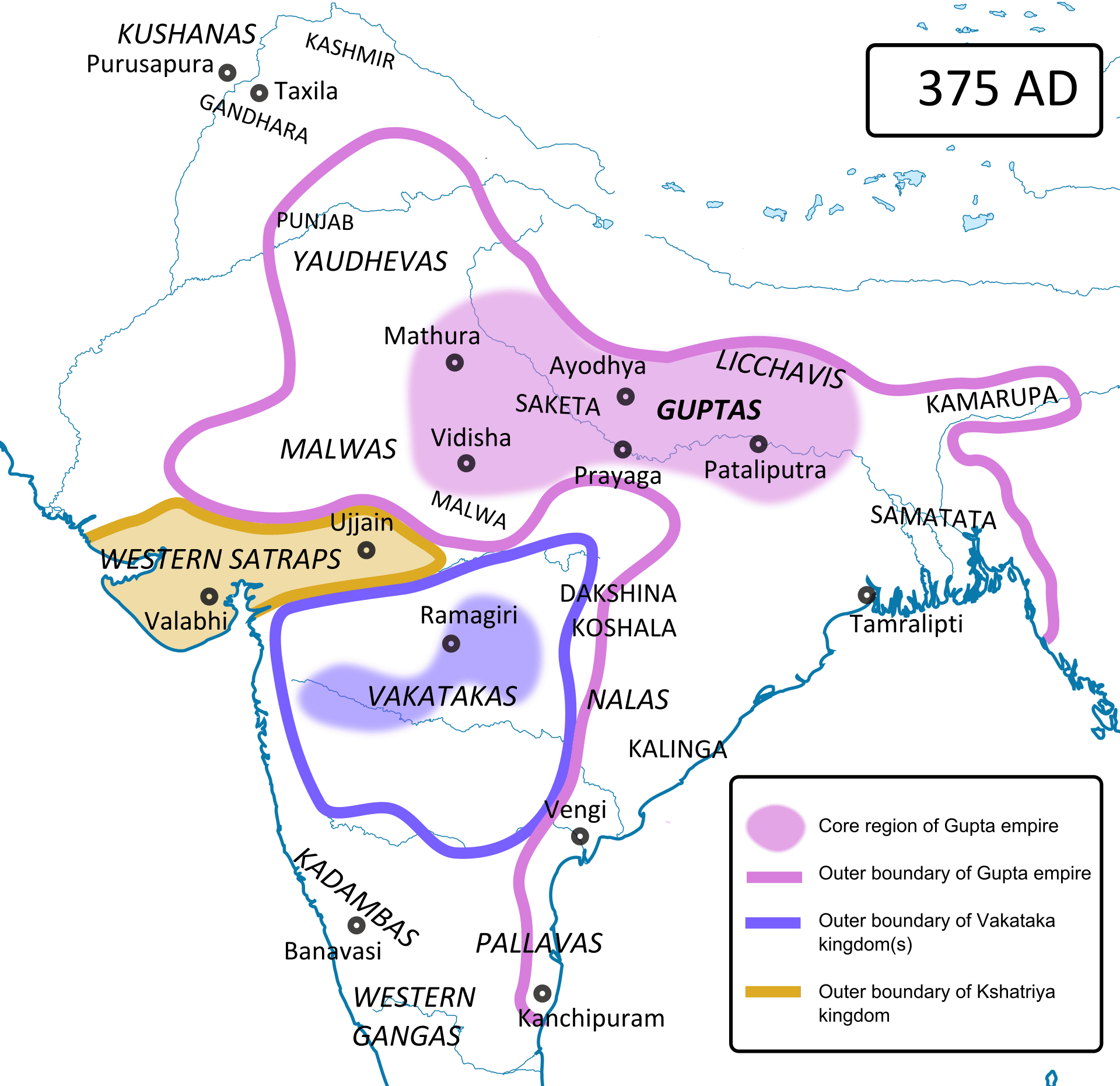
Samudragupta, who ruled from approximately 335 to 375 CE, was a monarch of immense physical energy and intellectual ambition. Much of what is known of his reign is preserved on a towering sandstone column, the Allahabad Pillar, which bears a long, elegant panegyric composed by his courtier Harisena. In verses of sophisticated Sanskrit, Harisena records how Samudragupta systematically "uprooted" eight kings of Aryavarta in the north, integrated the wild forest tracts of central India, and marched his armies along the eastern coast to the far south, defeating twelve rulers of the Dakshinapatha, including the Pallava regent of Kanchi. Rather than attempting the impossible task of directly administering this vast territory, Samudragupta established a sophisticated tributary system. Frontier kingdoms like Nepal and Samatata, along with tribal aristocracies like the Malavas and Yaudheyas, paid tribute and performed obeisance, while foreign monarchs—such as King Meghavarna of Simhala (modern Sri Lanka)—sent diplomatic missions to seek goodwill and permission to construct Buddhist monasteries. To celebrate this sprawling network of vassals, Samudragupta revived the ancient, grand Brahmanical ritual of the , releasing a sacred horse to wander at will as a symbol of his unchallenged sovereignty, and minting gold coins that depicted the sacrificial horse alongside his own image playing the , a traditional stringed instrument.
Connected to
- had as citizenChandragupta II4th c. CE
- had as citizenSamudragupta335 CE
+ 4 further connections to entries not yet ingested