Event · 918 CE – 1392 CE · Korean Kingdoms
Goryeo
- Also known as
- Cao Ly
- Dinasti Goryeo
- Dinasti Goryeo
- Dinastia Goryeo
- dynastia Korjo
- Gorijo
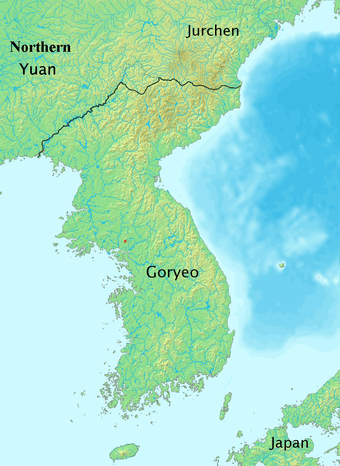
The modern name of Korea traces its ancestry back to a state born from chaos in 918 CE.
In the autumn of 942, an embassy from the Khitan Liao dynasty arrived at the gates of Kaesong, the newly established capital of the Goryeo dynasty. They came bearing gifts of friendship: thirty envoys and fifty sturdy camels, intended as a diplomatic overture to the nascent power on the southern peninsula. Goryeo’s founder, Wang Kŏn—known posthumously as Taejo, or the Grand Progenitor—responded with an act of calculated defiance. He ordered the thirty Khitan diplomats exiled to an isolated island and had the fifty camels tied beneath the Manbu Bridge, where they were left to starve to death.
To Taejo, the Khitans were "savage beasts" who had committed an unforgivable offense. Sixteen years earlier, they had extinguished Balhae, a northern kingdom that Taejo regarded as his "relative country," a shared descendant of the ancient empire of Goguryeo. The Manbu Bridge Incident was not merely a diplomatic insult; it was a declaration of Goryeo’s founding ethos. This was a state built on the premise of ancestral restoration, a kingdom that looked north toward lost plains and historic glories, and whose very name—derived from Goguryeo and eventually whispered by foreign merchants as "Korea"—symbolized a resurrected identity.
Goryeo’s birth in 918 emerged from the chaotic twilight of the Later Three Kingdoms period. For over two centuries, the peninsula had been tenuously held together by Later Silla, but by the late ninth century, Silla’s rigid aristocratic "bone-rank" system had fractured under the weight of regional rebellions. Warlords resurrected the ancient names of Baekje and Goguryeo, carving the land into warring fiefdoms. Among them was Kung Ye, a charismatic but increasingly unhinged Buddhist monk who claimed to read minds, declared himself the Maitreya Buddha, and executed his own family in fits of paranoia. In 918, Kung Ye’s own generals deposed him, raising Wang Kŏn, a brilliant maritime military commander from a prominent local clan in Kaesong, to the throne.
Unlike his predecessor, who was consumed by vengeful hatred for the dying Silla state, Taejo practiced a magnanimous statecraft. When the rival military leader Kyŏn Hwŏn of Later Baekje sacked the Silla capital, forcing its king to commit suicide, Taejo marched to Silla’s defense. Though he suffered a catastrophic defeat that nearly cost him his life, his chivalry won the hearts of the peninsula. By 935, the last king of Silla voluntarily surrendered his crown to Goryeo. When Kyŏn Hwŏn was deposed by his own son in a bitter succession dispute, the aged warlord fled to Goryeo, where his former archrival Taejo welcomed him deferentially. Armed with a massive force of over eighty thousand soldiers, and with the deposed Kyŏn Hwŏn riding at his side, Taejo crushed the remnant Later Baekje forces in 936.
Yet the "true national unification" celebrated by Korean historians was achieved not just by conquering the south, but by absorbing the north. When the Khitans destroyed Balhae, its crown prince and tens of thousands of households fled south. Taejo embraced them, granting the Balhae royalty land, nobility, and status within the Goryeo royal family. This massive influx of northern refugees, which continued well into the twelfth century, fundamentally altered the demographic and cultural landscape of the peninsula. While the old Silla territories were reduced to war-torn remnants around Gyeongju, Goryeo's administrative centers in Kaesong and the rebuilt Western Capital of Pyongyang thrived under a dominant population of northern descent. By dismantling Silla's restrictive caste system and absorbing the elite of Baekje, Silla, and Balhae, Goryeo forged a singular, resilient Korean identity out of three centuries of fragmentation.
Holding this diverse coalition together required immense political dexterity. To bind the regional lords, known as hojok, to his new dynasty, Taejo married twenty-nine women from prominent provincial families, fathering twenty-five sons and nine daughters. While this secured immediate peace, it left a minefield of succession disputes for his heirs. It fell to his fourth son, King Gwangjong, who ascended the throne in 949, to centralize the state. In 956, Gwangjong initiated a radical land and slavery reform, freeing thousands of prisoners of war and refugees who had been enslaved by regional nobles during the wars. This masterstroke simultaneously crippled the private armies of the hojok and swelled the royal treasury with new taxpayers. Two years later, Gwangjong instituted the national civil service examinations, opening the bureaucracy to talent and education rather than noble birth, and firmly establishing a civilian government.
With internal stability secured, Goryeo entered a golden age of cultural and economic sophistication. While the state valued education and civil administration, it maintained a formidable military apparatus, practicing a "Northern Expansion Doctrine" to reclaim ancestral Goguryeo lands. The kingdom constantly clashed with the northern empires of Liao and Jin. Later, in the thirteenth century, it faced the full fury of the Mongol Empire. Though Goryeo was eventually forced to become a vassal state of the Mongol-led Yuan dynasty, marrying its crown princes to Mongol princesses, it clung fiercely to its administrative autonomy. When the Yuan dynasty began to crumble in the fourteenth century, Goryeo launched military campaigns to reclaim its northern territories.
Through all its geopolitical trials, Goryeo was anchored by Buddhism, which became the state religion and achieved its historical zenith during this era. In the eleventh century, the capital of Kaesong alone boasted seventy temples. It was a cosmopolitan metropolis where commerce flourished and international merchants, including traders from as far as the Middle East, arrived to trade spices, glass, and silk.
In its twilight years during the fourteenth century, Goryeo found itself beset by external crises, fending off massive invasions by the Red Turban Rebels from China and relentless raids by professional Japanese pirates. The final crisis, however, came from within. When the court ordered an army to march north to attack the newly established Ming dynasty, a prominent general named Yi Sŏnggye realized the folly of the campaign. At the Yalu River, he turned his army back toward Kaesong, executing a coup d'état that deposed the last Goryeo monarch in 1392 and established the Joseon dynasty.
Though Goryeo fell, its legacy was indelible. It had taken a fractured peninsula of deeply suspicious regional populations and welded them into a single people with a shared history. When Western merchants returned to their home ports carrying stories of the rich, Buddhist kingdom peninsula, they brought with them the name they had heard in the bustling markets of Kaesong: Korea.
Connected to
- religionBuddhism
- in country · containsGoryeo918 CE
- followed byJoseon1392 CE
- had as citizenTaejo of Goryeo877 CE
+ 3 further connections to entries not yet ingested