Golden Horde
- Also known as
- Altan Ord
- Altın Orda
- Altın Orda
- Altın Orda Devleti
- Altın Orda Hanlığı
- Altın Ordu
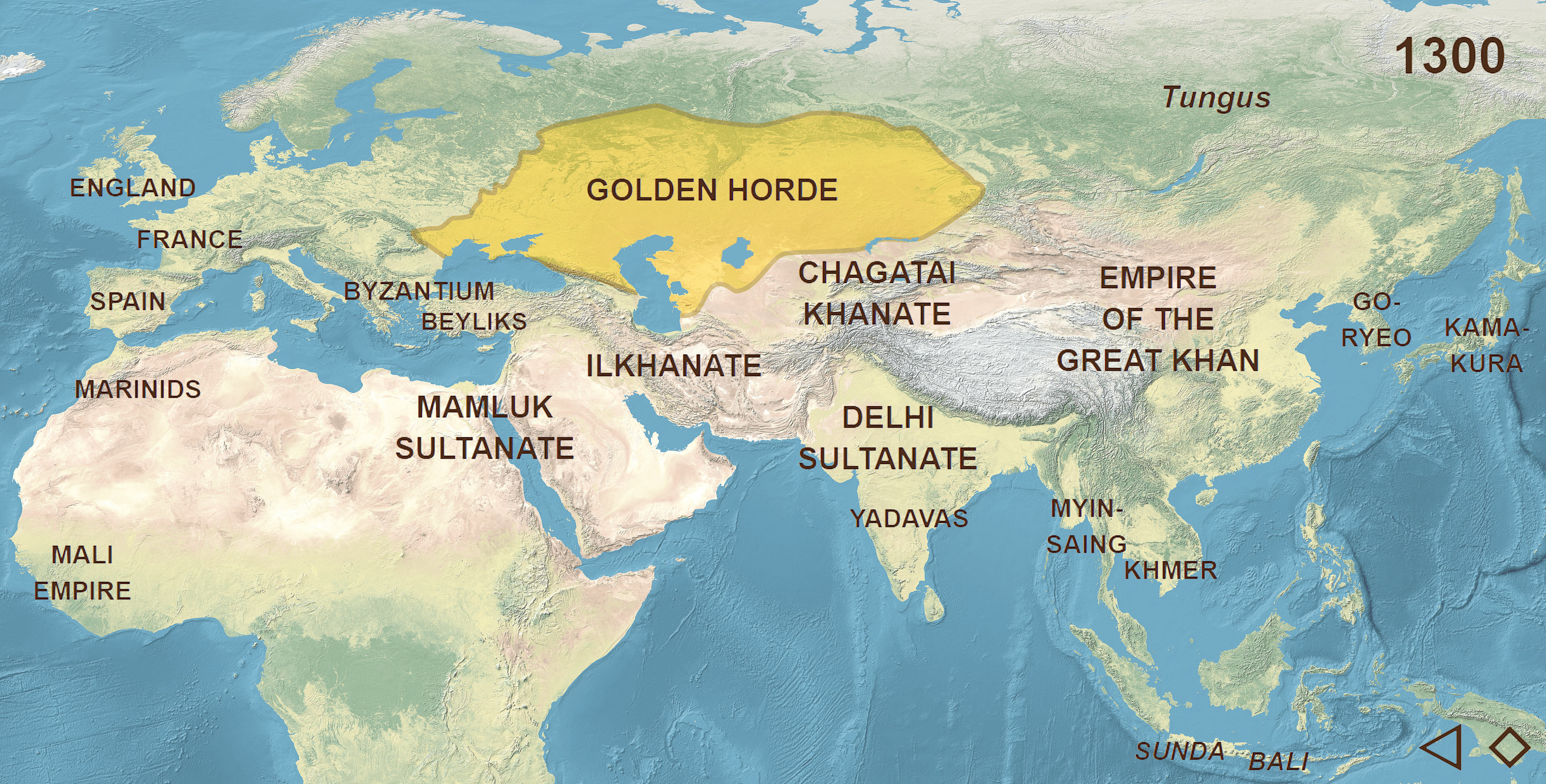
When the vast empire of Genghis Khan fractured in the mid-thirteenth century, the northwestern wilderness fell to the descendants of his eldest son, Jochi.
In the spring of 1242, a great silence fell over the Danube. Only a year earlier, the Mongol armies commanded by Batu Khan and the brilliant strategist Subutai had shattered the combined chivalry of Central Europe at Legnica and Mohi, leaving the fields of Poland and Hungary strewn with the bodies of dukes and knights. Yet, just as the road to the Holy Roman Empire and the Adriatic lay open, a horseman arrived from the Far East with news that changed the course of European history: the Great Khan Ögödei was dead in Karakorum. Bound by Mongol law and political survival to participate in the election of a successor, the princes of the blood halted their advance. Turning back through the ruins of Hungary and Bulgaria, Batu withdrew his forces to the vast, windswept grasslands of the Kipchak Steppe, along the lower reaches of the Volga River. He never returned to Mongolia. Instead, in 1243, he pitched his magnificent imperial tents on the riverbank, founding a sovereign state that would dominate the forests of Russia, the plains of Eurasia, and the trade routes of the Silk Road for more than two centuries.
This westernmost fragment of the fractured Mongol Empire was officially known to its rulers as the Ulugh Ulus—the "Great State"—or the Ulus of Jochi, named for Batu’s father, the eldest son of Genghis Khan. To the Russian chroniclers who paid them tribute, and eventually to the wider world, it became legendary as the Golden Horde. The name itself was a shimmering fragment of steppe imagery, likely inspired by the golden-hued wartime tents of the khans, or perhaps the actual gilded pavilion Batu erected at his new capital of Sarai. To the sedentary peoples of Eastern Europe, the "Horde"—derived from ordo, the Mongol word for a mobile palace camp—evoked an image of terrifying, inexhaustible cavalry. Yet the state Batu built was far more than a permanent military campaign. It was a sophisticated, highly adaptive imperial enterprise. While Mongol remained the language of the ruling court, the state quickly took on the character of the Kipchak and Cuman nomads who populated the steppe, turning the Golden Horde into a thoroughly Turkicized empire.
At its zenith, the Horde was a colossus. Its borders stretched from the dense forests of Siberia and the Ural Mountains in the north to the Black and Caspian seas in the south, bordering the Caucasus and the rival Mongol Ilkhanate. To the west, its authority reached the Danube, making the grand princes of Russia its tax collectors and vassals. The system was remarkably efficient: Russian rulers, including the legendary Alexander Nevsky, were forced to make long, humiliating pilgrimages to Sarai to prostrate themselves before the khan, secure their (decrees of investiture), and deliver heavy annual tributes. Those who resisted, like Michael of Chernigov in 1246, were executed; those who complied, like Daniel of Galicia, returned to their principalities visibly transformed, equipping their own cavalry in the heavy iron cuirasses and barding of the Mongol style. Under the long, stable reigns of Batu’s successors—most notably Özbeg Khan in the early fourteenth century—the Horde reached its cultural and military peak. Özbeg embraced Islam as the state religion, integrating the khanate into the wealthy, literate network of the wider Muslim world, while maintaining a military apparatus so formidable that none of his neighbors dared challenge his borders.
Connected to
- in country · containsGolden Horde1243 CE
+ 6 further connections to entries not yet ingested