Event · 100 CE – 12th c. CE · West African Empires
Ghana Empire
- Also known as
- Carstvo Gana
- Carstvo Gana
- Carstvo Ghana
- Daular Gana
- Daular Ghana
- Dola la Ghana
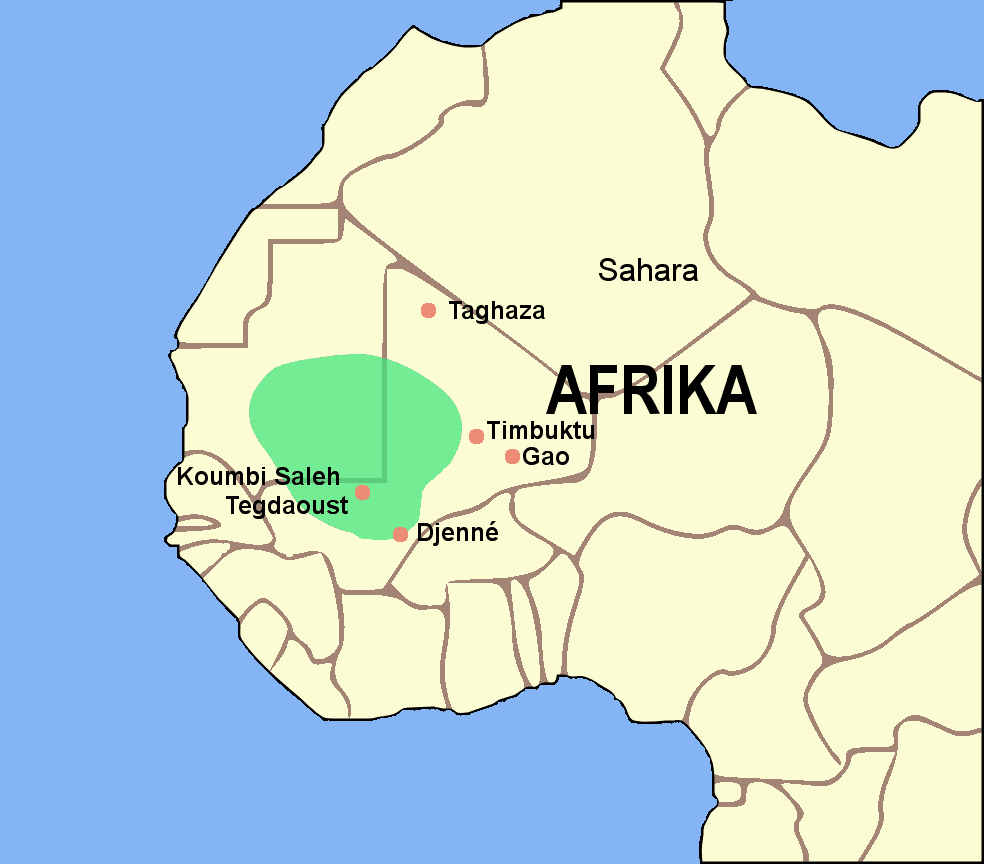
Long before the name was claimed by a modern West African nation in 1957, Ghana was the title of a warrior king who ruled a vast western-Sahelian empire.
Deep in the western Sahel, where the dry grasslands of the southern Sahara begin to yield to the well-watered basins of the Senegal and Niger rivers, a collective memory persists of a Great Snake named Bida. According to the oral traditions of the Soninke people, Bida was a protective deity who demanded a yearly sacrifice of a young maiden. In return, the serpent granted the land a steady fall of rain and an endless, glittering supply of gold. The myth tells of a time when the covenant was broken—the serpent was slain by a grieving lover, and as its severed head flew across the Sahel, it cursed the land with a devastating drought, scattering the gold fields and driving the people to wander. This fragment of a lost epic, the legend of Wagadu, encapsulates the ecological and economic paradox of the Ghana Empire: a civilization born of water, sustained by an invisible abundance of gold, and ultimately undone by the shifting sands of the desert.
To the medieval Arab world, this realm was not Wagadu but Ghana—a name derived not from the land itself, but from the title of its sovereign, meaning "warrior" or "war chief." To others, the monarch was the Kaya Maghan, the "king of gold." The empire’s origins, long obscured by the fantastical theories of colonial-era historians who sought to attribute its monuments to "white" Libyan, Berber, or Judeo-Syrian elites, have been firmly reclaimed by modern archaeology as a purely indigenous triumph. Around 1600 BCE, at sites along the Dhar Tichitt, Dhar Walata, and Dhar Nema cliffs in modern-day southern Mauritania, ancestors of the Soninke developed a complex, stone-masoned agro-pastoral culture. As the Saharan climate gradually dried, these proto-Mande communities migrated southward into more hospitable territories. By the late third century CE, a temporary return of wetter conditions in the Sahel coincided with two monumental shifts: the introduction of the camel to the western Sahara and the spread of ironworking. Armed with iron weapons and riding horses, Soninke warriors consolidated a network of chiefdoms into a formidable confederation.
What emerged was a state designed to exploit one of history’s greatest geographic disparities. To the north lay the salt-rich pans of the Sahara; to the south, beyond the empire's direct territorial control, lay the hidden goldfields of the Upper Senegal and Niger rivers. Wagadu itself possessed no gold mines. Instead, it operated as a colossal, armored customs house. By maintaining an absolute monopoly on the trade routes, the Ghana kings decreed that all gold nuggets entering their territory belonged to the crown, while the general populace was permitted to trade only in gold dust. This kept the market from being flooded and preserved the astronomical value of the metal. By the ninth century, when the Persian geographer al-Khwarizmi featured Ghana on his world map, and the Arab writer al-Fazari declared it the "Land of Gold," the trans-Saharan trade was a highly organized, lucrative reality. Caravans numbering thousands of camels braved the dunes to exchange Saharan salt, Mediterranean copper, and North African textiles for West African gold, ivory, and skins.
By the tenth century, the wealth of the Kaya Maghan was legendary across the Mediterranean. In the 970s, the traveler Ibn Hawqal wrote that the King of Ghana was "the wealthiest king on the face of the earth," describing a ruler whose influence stretched to the desert trading hub of Aoudaghost, which Ghana eventually conquered and garrisoned in 990 to secure its northern commercial flank. At its zenith, the empire was a vast confederation of vassal states—including Takrur, Jaara, Soso, and Gajaaga—standing in varying degrees of submission to the central authority. In the mid-eleventh century, the Cordoban scholar al-Bakri compiled the most detailed portrait of the empire at its height, during the reign of Tunka Manin, who succeeded his uncle Ghana Bassi in 1063. Al-Bakri described a court of dazzling, theatrical opulence. When the king gave audience, he sat in a pavilion surrounded by ten horses adorned with gold-trapper trappings. Behind him stood ten pages holding shields and swords decorated with gold, while the sons of vassal kings stood at his right hand, their hair splendidly plaited with gold thread. Even the guard dogs protecting the royal pavilion wore collars of gold and silver.
This display of wealth was not merely vanity; it was the machinery of statecraft. The court of Wagadu was a delicate compromise between the traditional ancestral religions of the Soninke and the Islamic faith of the merchants who brought the empire its wealth. The capital, likely located at Koumbi Saleh in modern Mauritania, was divided into two distinct towns situated six miles apart. One town was Muslim, boasting twelve mosques, salaried imams, muezzins, and scholars of Islamic law. The other town, known as al-Ghaba ("the forest"), was the royal residence, a sacred grove where the traditional priests tended to the state cults and where the kings of Ghana were buried in domed tombs. Though the rulers themselves remained loyal to their ancestral gods, they recognized the administrative utility of literacy and international law; the king’s ministers, his treasurers, and his interpreters were almost exclusively chosen from the literate Muslim merchant class.
Yet, this dual identity contained the seeds of tension. By the late eleventh century, the rise of the Almoravids—a militant, puritanical Berber Islamic movement in the western Sahara—disrupted the delicate equilibrium. While later chronicles suggest a sudden, catastrophic Almoravid invasion and conquest of Ghana, contemporary evidence paints a more complex picture of gradual political fragmentation, economic disruption, and shifting trade routes. The Almoravids did contest Ghana’s northern borders, and Tunka Manin engaged in a tense diplomatic and military dance with the Almoravid leader Yusuf ibn Tashfin. Over several decades, the pressure of nomadic incursions, combined with internal rebellion among vassal states like Soso and Takrur, chipped away at the empire’s authority. Furthermore, the ecological balance of the Sahel was fracturing. The wet period that had nurtured the rise of Wagadu was giving way to a drier, harsher climate, desiccating the pastures that sustained the great horse herds of the Soninke nobility.
By the twelfth and thirteenth centuries, the grand confederation had dissolved. Power shifted southward to newer, more fertile centers of gravity, culminating in the rise of the Mali Empire, which eventually absorbed the remnants of Wagadu as a vassal territory. Though the physical cities of the empire fell into ruin, swallowed by the advancing sands of the Mauritanian desert, the ghost of Wagadu remained a potent symbol of African sovereignty and prosperity. When the British colony of the Gold Coast achieved its independence in 1957 under the leadership of Kwame Nkrumah, it discarded its colonial name. In tribute to the ancient, golden warrior-state of the western Sahel, the new nation chose to call itself Ghana—ensuring that the title of the ancient kings of Wagadu would endure as a modern beacon of self-determination.
Connected to
2 links to entries not yet ingested in the Library.