Place · 15th c. BCE · Ancient Egypt
Gaza City
- Also known as
- Azah
- Azza
- Azzah
- Belt ta' Gaża
- Cathair Gaza
- Cidade de Gaza
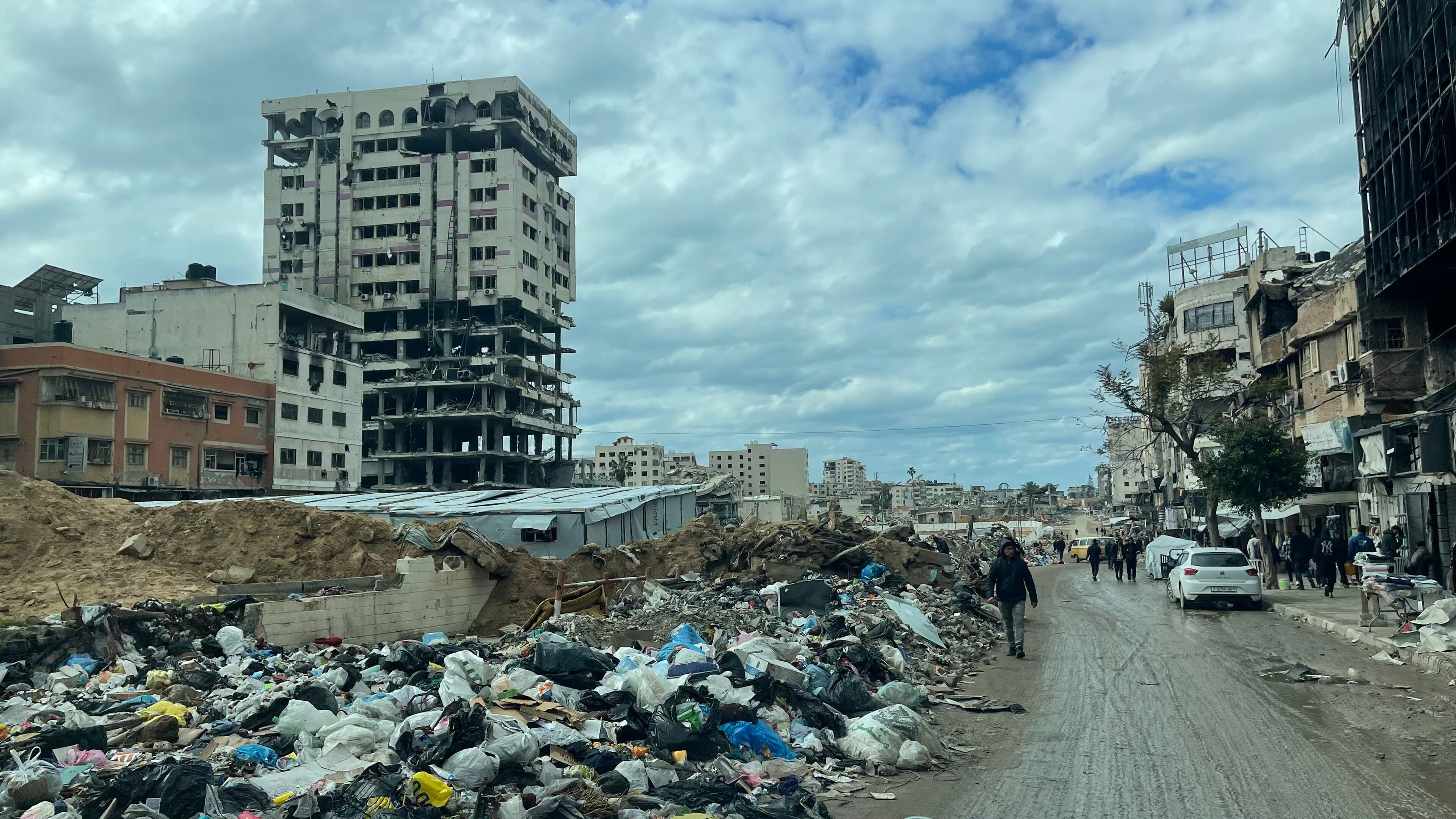
Few places on the Mediterranean have been so relentlessly claimed, rebuilt, and shattered as Gaza City.
Before it was a border, a prison, or a ruin, Gaza was a hinge. To the ancient world, it was the place where the arid expanse of the Sinai finally gave way to the green promise of the Levant. For caravans arriving from the Red Sea laden with frankincense and myrrh, or for armies marching out of the Nile Delta, Gaza was the threshold. It is one of the oldest continually inhabited cities on Earth, its name first carved into the stone military records of the Pharaoh Thutmose III in the fifteenth century BCE. The Egyptians called it gꜣḏꜣtw, while a common Hebrew folk etymology linked it to the Semitic root for strength, ʿ-z-z. But the oldest pronunciation of its name likely began with a softer, deeper sound—a voiced velar fricative, ḡ—rendering it Ḡazza. It was a name that tasted of the desert and the sea, belonging to a city that belonged to everyone and, therefore, to no one for very long.
The earliest urban life in the area did not sit precisely where the modern city lies, but shifted along the landscape. It began five thousand years ago at Tell es-Sakan, an Egyptian fortress built on Canaanite soil just to the south, which was abandoned and re-founded across millennia. Later, the center of gravity drifted toward the riverbed of the Wadi Ghazza at Tell el-Ajjul. By the time Thutmose III established his empire, Gaza had become a vital station on the King’s Highway and Egypt’s administrative capital in Canaan. For three and a half centuries, the Pharaohs ruled this coastal shelf, until the twelfth century BCE, when a seafaring people known as the Philistines arrived, absorbing Gaza into their pentapolis—a league of five great city-states. Under their rule, Gaza solidified its identity as a maritime gateway, a place where the wealth of the Mediterranean met the overland trade of the Nabataeans.
To conquer the ancient world, one had to conquer Gaza, a reality that repeatedly brought the city to the edge of annihilation. In 332 BCE, Alexander the Great marched south toward Egypt, finding his path blocked by Gaza’s formidable walls. It took a grueling five-month siege to breach them. In his fury at their resistance, Alexander had the city’s defenders slaughtered, its women and children sold into slavery, and repopulated the empty streets with inhabitants from the surrounding hills, organizing Gaza into a Greek polis. Under the Seleucid Empire, it was briefly renamed Seleucia, transforming into a prestigious center of Hellenistic philosophy and learning. Yet the tides of empire returned. In 96 BCE, the Hasmonean king Alexander Jannaeus besieged the city once more, destroying it so thoroughly that he slaughtered five hundred senators who had sought sanctuary within the temple of Apollo.
Each destruction, however, was followed by a resurrection. Rebuilt under the Roman general Pompey Magnus in 63 BCE, Gaza entered an era of unprecedented coastal prosperity. While Jerusalem to the east was shattered by Jewish rebellions and Roman wrath, Gaza flourished. Its Mediterranean port at Maiuma became a bustling emporium. By the second century CE, Gaza was governed by a diverse five-hundred-member senate composed of Greeks, Romans, Phoenicians, Jews, Persians, Egyptians, and Bedouin. When the Emperor Hadrian visited in 130 CE, he was so taken by the city's cosmopolitan energy that he inaugurated athletic and oratorical games in a newly built stadium. The city’s coins bore the likenesses of Roman emperors alongside local deities, chief among them Marnas, the ancient lord of rain and grain.
Even as Christianity slowly displaced the old gods—a transition accelerated between 396 and 420 CE under Bishop Porphyry, who oversaw the destruction of Gaza’s pagan temples under imperial decree—the city retained its intellectual luster. The Byzantine philosopher Aeneas of Gaza proudly called his hometown "the Athens of Asia." It was a place of remarkable coexistence; excavations have revealed that a grand synagogue stood on the coast in the sixth century CE, even as the Empress Aelia Eudocia funded a massive Christian cathedral atop the ruins of the Temple of Marnas.
In approximately 638 CE, the direction of Gaza’s history shifted permanently toward the east. The Arab Muslim commander Amr ibn al-As captured the city after a long and stubborn resistance. Because Islamic tradition held that Hashim ibn Abd Manaf, the great-grandfather of the Prophet Muhammad, was buried there, the conquering army spared the civilian population, though they executed the Byzantine garrison. The city’s transition to its new identity was swift. The Cathedral of Saint John was converted into the Great Mosque of Gaza. By 767 CE, the city had given birth to Muhammad ibn Idris ash-Shafi'i, the founder of the Shafi'i school of Sunni jurisprudence, cementing Gaza’s place as a crucible of Islamic law.
Yet, the Christian and Jewish communities endured, their survival tied to the soil. Though Islamic law prohibited the consumption of alcohol, the Muslim governors permitted their non-Muslim neighbors to maintain the region's famous vineyards, turning grapes into a lucrative export crop bound for Egypt. This delicate prosperity was constantly threatened by the city's geography. Positioned at the edge of the desert, Gaza was frequently caught in the crossfire of nomadic tribal wars, such as the devastating Qays–Yaman conflict of the late eighth century, which left the city in ruins. Each time, the trade routes revived it. By the tenth century, the Arab geographer al-Maqdisi could still describe Gaza as a thriving, bustling town, the final checkpoint on the high road to Egypt.
The medieval era brought the Crusader wars, turning Gaza back into a fortress. Conquered by Christian forces in 1100, the city was handed to the Knights Templar, who built a castle to guard the kingdom's southern flank. The Great Mosque was briefly restored to a church, only to be reclaimed by Saladin in 1187. The city’s fortifications were repeatedly built up and torn down by treaty, until the year 1260, when the Mongol armies of Hulagu Khan swept south, reducing Gaza to the southernmost limit of their conquests and leaving it in ashes.
When the Ottoman Empire absorbed the region in the sixteenth century, Gaza had been reduced to little more than a quiet village, battered by centuries of war, plagues of locusts, and catastrophic flooding. Yet, under the rule of the Ridwan dynasty in the early Ottoman period, Gaza experienced a final, pre-modern golden age of peace and commerce. By 1893, its modern municipality was established. The twentieth century, however, brought the end of the imperial consensus. Falling to British forces during the First World War, Gaza was integrated into Mandatory Palestine, its destiny tied to the gathering storm of modern nationalism.
The pivotal rupture occurred in 1948. Following the Arab-Israeli War, the newly formed Gaza Strip came under Egyptian administration. The city’s population exploded overnight, overwhelmed by an influx of Palestinian refugees displaced from their homes during the Nakba. This sudden demographic shift transformed Gaza from a provincial coastal town into a dense, traumatized hub of displacement. Occupied by Israel during the Six-Day War of 1967, and later transferred to the Palestinian National Authority in 1993 under the Oslo Accords, the city remained a lightning rod. Following the 2006 Palestinian elections and the subsequent factional conflict between Fatah and Hamas, the latter assumed control of the city. What followed was a punishing land, air, and sea blockade enforced by Israel and supported by Egypt, which strangled the city's economy and restricted the movement of its young population—three-quarters of whom were under the age of twenty-five.
By the early twenty-first century, Gaza City was a place of profound paradox: a land of ancient heritage, home to Palestine's only port and a population of nearly 600,000, yet entirely cut off from the world. The outbreak of war in October 2023 marked the most destructive chapter in the city's five-thousand-year history. Intense Israeli airstrikes systematically dismantled the modern city and much of its ancient heart, including invaluable cultural heritage sites in the Old City. By 2026, the vast majority of its inhabitants had been killed, evacuated, or forced to flee to the south, leaving behind a silent landscape of pulverized concrete. Gaza, which had survived the Pharaohs, the Philistines, Alexander, the Romans, the Mongols, and the Crusaders, was once again reduced to a monument of human conflict—a city waiting, as it always had, on the edge of the desert and the sea, for its next re-creation.
Connected to
- in countryByzantine Empire395 CE
- in countryMamluk Sultanate of Egypt1250 CE
- in countryOttoman Empire1299 CE
- in countryRoman Empire27 BCE
+ 12 further connections to entries not yet ingested