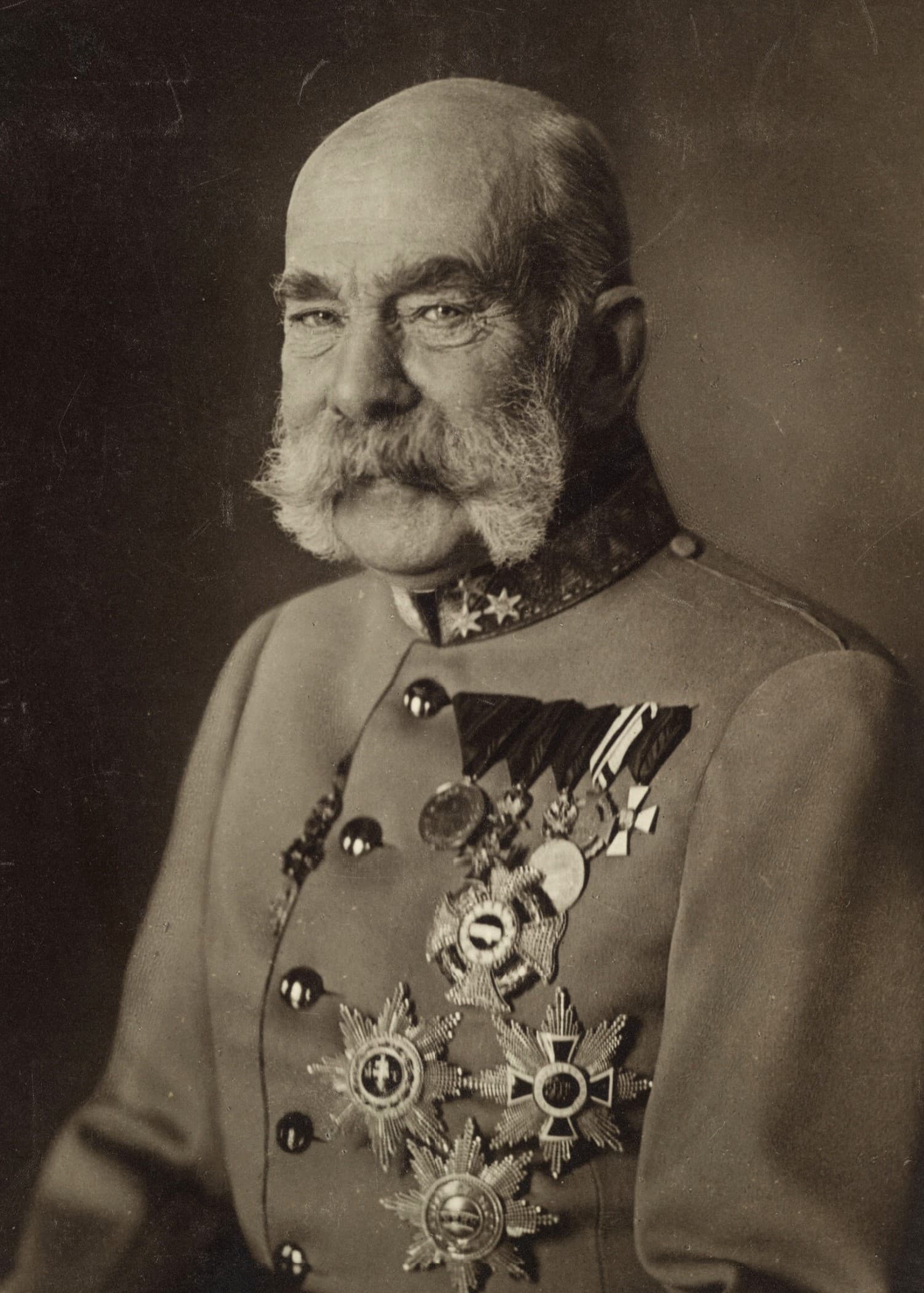
To rule the Habsburg domains in 1848 was to inherit a world fractured by revolution, and Franz Joseph I assumed this burden at just eighteen years old after his uncle Ferdinand I abdicated in the midst of the Hungarian uprising.
To understand the tragedy of Franz Joseph I, one must begin not with the grand, sweeping tragedies of his later years—the assassin’s blade, the self-inflicted gunshot in a hunting lodge, the spark in Sarajevo—but with the relentless routine of his mornings. Long before dawn, while the Schönbrunn Palace was still wrapped in the damp chill of a Viennese winter, a servant would wake the Emperor at four o’clock. By a quarter past, dressed in the austere, buttoned-up uniform of an Austrian military officer that he wore almost exclusively since his thirteenth year, he was seated at his writing table. Before him lay the mountains of state papers: petitions, military promotions, reports on crop yields, and police briefs. He called himself the "first bureaucrat of the empire," and he meant it literally. In an age of steam engines, telegraphs, and radical political philosophies, Franz Joseph sought to govern an empire of fifty million souls—Germans, Hungarians, Czechs, Poles, Italians, Croats, and Serbs—with the meticulous, unyielding focus of a clerk. He believed, with an intensity instilled in him by his formidable mother and his ultramontane tutors, that his authority was granted by divine grace and that to delegate, to compromise, or to rest was to betray a sacred trust.
This life of iron discipline was forged in the fires of 1848, the year of revolutions that nearly swept the ancient House of Habsburg into oblivion. The young archduke, affectionately called "Franzi" by a family that saw him as their ultimate savior, was only eighteen when the storm broke. Across Europe, thrones were shaking. In Vienna, the venerable Chancellor Metternich fled in disguise; in Hungary, a parliament asserted its ancient rights; and in Italy, the Austrian armies were hard-pressed. Franz Joseph’s uncle, Emperor Ferdinand, was a gentle man disabled by severe seizures and entirely unfit to master the chaos. His father, the retiring Archduke Franz Karl, possessed no ambition for the crown. In December 1848, at Olmütz in Moravia, where the court had fled for safety, a dynastic coup was quietly executed. Ferdinand abdicated, Franz Karl renounced his rights, and the eighteen-year-old Franz Joseph was proclaimed Emperor. The name "Franz Joseph" was deliberately chosen to evoke his great-granduncle, Joseph II, the eighteenth-century reformer who had sought to modernize the empire from above. Yet the young man who took the throne was no revolutionary; he was a restorer.
The early years of his reign were defined by a brutal reassertion of imperial authority. Under the guidance of his steel-willed Prime Minister, Prince Felix of Schwarzenberg, Franz Joseph adopted a policy of uncompromising centralism. He received his baptism of fire under the legendary Field Marshal Radetzky in Italy, handling himself with a calm dignity that won the devotion of his soldiers. If Italy was secured by Austrian arms, Hungary proved a far more dangerous existential threat. Unlike the other crown lands, the Kingdom of Hungary possessed a historic constitution dating back to the thirteenth century, which strictly limited the power of the Habsburg crown. In April 1848, Ferdinand had ratified the "April Laws," establishing modern civil and political rights in Hungary. But Franz Joseph, advising that he was not bound by his uncle’s concessions, arbitrarily revoked them. To the Hungarian parliament, this was an unconstitutional act of war; they refused to recognize the uncrowned youth as their king, declaring that without a proper coronation and oath, the throne remained "orphaned."
+ 12 further connections to entries not yet ingested
The resulting conflict was not a mere rebellion, but a total war for independence. Franz Joseph’s government issued the Stadion Constitution in March 1849, an autocratic document that sought to dissolve the Hungarian Diet, partition the kingdom into five military districts, and strip Hungary of its territorial integrity. In response, the Hungarian parliament, led by the fiery Lajos Kossuth, declared total independence from the House of Habsburg. It was a baptism of blood for the young Emperor, who was forced to watch his empire tear itself apart until the military tide turned and the Hungarian armies were finally crushed.
For the first two decades of his reign, Franz Joseph ruled as an autocrat, resisting the rising tide of constitutionalism and nationalism that threatened to fracture his multi-ethnic domains. Yet, history refused to stand still for the bureaucrat-emperor. The international stage brought a succession of bitter humiliations. In 1859, during the Second Italian War of Independence, Austrian dominance in Italy began to shatter, forcing the cession of Lombardy. Seven years later, in the Austro-Prussian War of 1866, the Prussian army decisively defeated the Austrian forces. Though the Peace of Prague spared Austria from ceding territory to Prussia, it settled the "German Question" permanently: Germany would be unified under Prussian, not Habsburg, leadership, and Austria was cast out of the German fold.
These military disasters forced Franz Joseph’s hand. Realizing that he could not hold his empire together by force alone, he capitulated to the demands of his most powerful subjects. The resulting Austro-Hungarian Compromise of 1867—the Ausgleich—reconstituted the state as a "dual monarchy." Austria and Hungary became two sovereign states under a single ruler, sharing only a common foreign policy, military, and finance system. Franz Joseph was finally crowned King of Hungary in Budapest, swearing the ancient oaths he had spent his youth trying to bypass. It was a pragmatic masterpiece of political survival, but it was also a pact with the devil. By elevating the Germans in Austria and the Magyars in Hungary, the Compromise alienated the empire’s vast Slavic populations, leaving the structural cracks in the Habsburg edifice to widen over the coming decades.
While the empire entered a period of forty-five years of relative peace, Franz Joseph’s private life was a succession of Greek tragedies. In 1854, he had married his first cousin, the beautiful and rebellious Duchess Elisabeth in Bavaria, known to history as "Sisi." It was a marriage born of genuine passion on his part, but it quickly soured under the suffocating etiquette of the Viennese court and Elisabeth's fragile mental health. She spent decades fleeing Vienna, traveling the world to escape her husband's structured existence.
The tragedies began to mount with the precision of a curse. In 1867, his brother Maximilian, who had been installed as the Emperor of Mexico with French backing, was captured and executed by a firing squad in Querétaro. Far worse was to follow. In 1889, Franz Joseph’s only son and heir, the brilliant but unstable Archduke Rudolf, entered a suicide pact with his teenage mistress, Mary Vetsera, at the imperial hunting lodge of Mayerling. The death of Rudolf broke something in the Emperor, leaving him without a direct heir who understood his vision of the state. Nine years later, in 1898, the Empress Elisabeth was stabbed to death by an Italian anarchist on the shores of Lake Geneva. Franz Joseph received the news at his writing desk; he reportedly wept in silence, whispering that no one would ever know how much he had loved her.
As the twentieth century dawned, the aging Emperor became a living relic, a human bridge to an era that had long since vanished. He had outlived his contemporaries, his wife, his son, and the political consensus that had created his empire. His new heir presumptive, his nephew Archduke Franz Ferdinand, was a man of modern ideas whom the Emperor thoroughly disliked and whose morganatic marriage he tolerated with cold disdain.
The empire’s focus had turned inevitably toward the Balkans, a region simmering with nationalist rivalries that brought Austria-Hungary into direct conflict with both the decaying Ottoman Empire and the expansionist Russian Empire. In 1908, Franz Joseph authorized the formal annexation of Bosnia and Herzegovina, territories his troops had occupied since the Congress of Berlin in 1878. The annexation provoked the Bosnian Crisis, deeply angering Serbia and its protector, Russia, and turning the Balkans into a powder keg.
On June 28, 1914, the spark was struck in Sarajevo. The assassination of Archduke Franz Ferdinand by a Serbian nationalist was an outrage that the aging Emperor, now eighty-three, could not ignore. Assured of German support and believing that the honor of his dynasty was at stake, Franz Joseph signed the ultimatum to Serbia and, subsequently, the declaration of war. It was an act that activated a complex web of European alliances, plunging the world into the cataclysm of World War I.
He did not live to see the end of the conflict or the total dissolution of the empire he had spent sixty-eight years trying to preserve. On November 21, 1916, as the guns of the Western and Eastern Fronts raged, Franz Joseph died quietly at the Schönbrunn Palace. He had worked at his writing table until his final hours, a bureaucrat to the last, signing papers with a trembling hand. He was succeeded by his grand-nephew, Charles I, who would rule for just two years before the ancient Habsburg monarchy dissolved into the nation-states of modern Europe, leaving the long, dutiful reign of Franz Joseph as the twilight monument of a world that was no more.