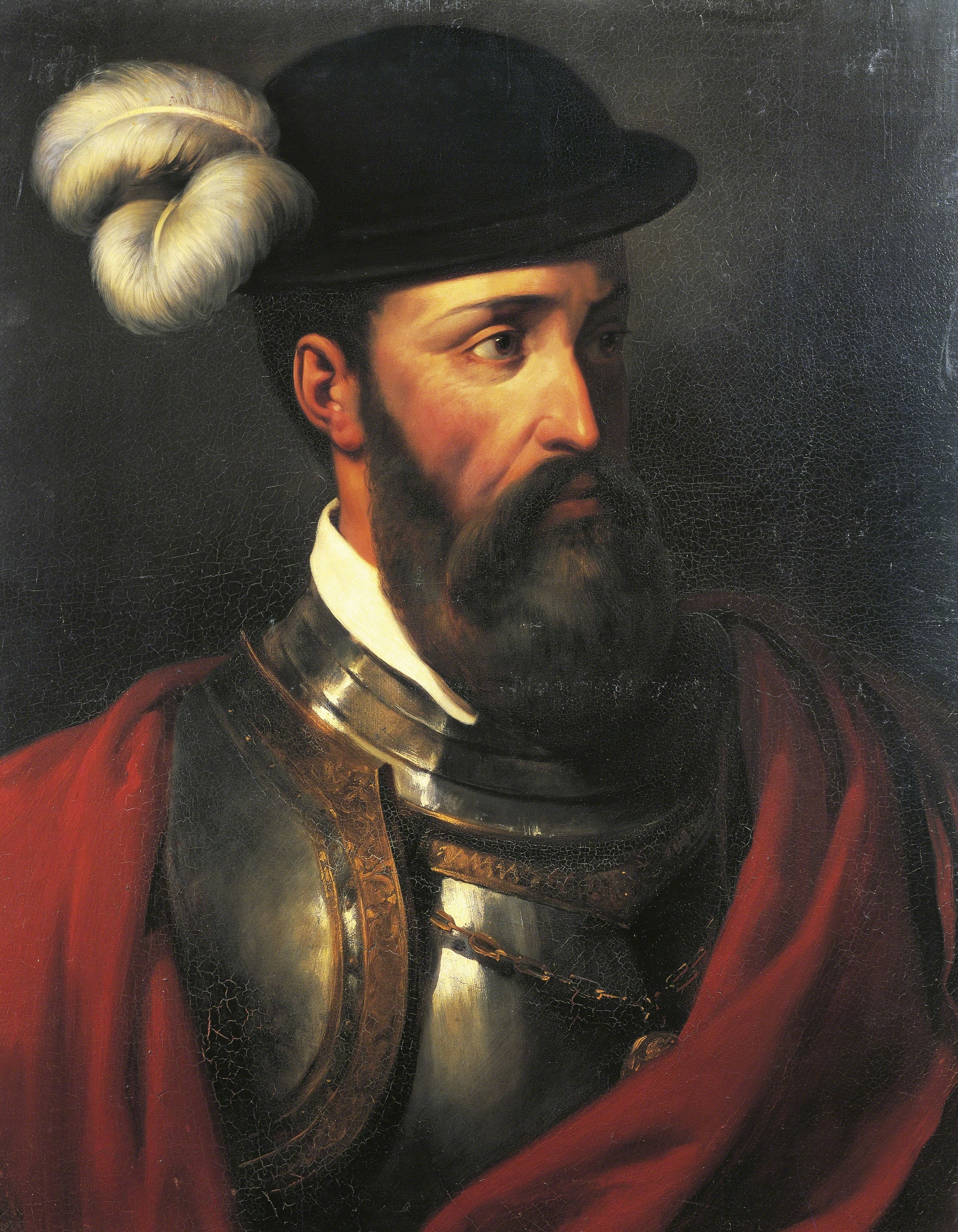
Before he dismantled the largest empire in the Americas, Francisco Pizarro was an illiterate youth from Trujillo, Spain, born into poverty to a family of pig farmers.
In September 1527, on a desolate patch of mud and scrub off the Pacific coast of Colombia called the Isla de Gallo, a Spanish captain named Francisco Pizarro drew a line in the wet sand with his sword. To his men, who were starved, rotting from tropical fevers, and desperate to board the rescue ships sent by the governor of Panama, Pizarro offered a choice of two horizons. Pointing to the north, where the rescue vessels waited to return them to the safety of the colony, he warned of Panama and its poverty. Turning to the south, where the gray ocean stretched into the unknown, he promised Peru and its riches. He then stepped across the line. Only thirteen men followed him. For seven months, this tiny, forgotten remnant huddled on a neighboring rock, eating whatever shellfish they could scrape from the cliffs, waiting for a single ship that their partners in Panama had begged, pleaded, and finally bribed the colonial administration to send. They were men of no inheritance, led by a man who had spent his youth herding pigs in the dust of Extremadura. Yet when that single ship finally arrived, they did not sail north to safety; they ordered the pilot to steer south, toward an empire of whose scale, wealth, and sophisticated administrative machinery they had not the slightest concept.
To understand the sheer audacity of this gamble, one must look to the dry, hard plains of Trujillo, Spain, where Pizarro had been born in the 1470s. The illegitimate son of an infantry colonel and a woman of very humble means, he grew up entirely unschooled and illiterate, a social non-entity in a society where bloodline and breeding were everything. When the first reports of the Americas began filtering back to the taverns of Seville, they must have sounded less like geography and more like an exit. By 1509, Pizarro was on the Atlantic, sailing with Alonso de Ojeda toward the swampy, hostile shores of Urabá. He was not a man of sudden, brilliant inspiration, but rather one of terrifying physical endurance and low-key reliability. He survived the collapse of Ojeda’s settlement; he stood beside Vasco Núñez de Balboa in 1513 when they hacked their way through the Isthmus of Panama to become the first Europeans to gaze upon the Pacific Ocean; and, when the political winds shifted, he was the officer chosen by the new governor, Pedro Arias Dávila, to arrest Balboa and deliver him to the executioner’s block. For his quiet, cold-eyed loyalty, Pizarro was rewarded with cattle, a native workforce, and the mayoralty of the newly founded Panama City.
But a comfortable life as a colonial magistrate was not enough for a man who had watched his distant cousin, Hernán Cortés, dismantle the Aztec Empire and win a fortune that rivaled those of European kings. In 1522, reports began circulating of a wealthy kingdom far to the south, referred to by various indigenous leaders as "Virú" or "Pirú." Pizarro, now in his late forties—an age when most Spanish conquerors of his generation were either dead or retired—formed a pact with Diego de Almagro, a battle-hardened soldier of fortune, and Hernando de Luque, an influential priest who secured the necessary financial backing. Together, they formed the , agreeing to conquer and split the spoils of whatever lay in the southern darkness. Their initial efforts were disastrous. The first expedition in 1524 sailed straight into relentless storms, starvation, and poison-arrow skirmishes; Almagro lost an eye to an indigenous archer, and the men returned having named their stops along the coast "Port of Hunger" and "Burned Port." The second expedition in 1526 was little better, nearly disintegrating under the weight of disease and mutiny before the pilot, Bartolomé Ruiz, sailed south of the equator and captured a large native balsa raft loaded with fine cotton textiles, delicate ceramics, and exquisite ornaments of gold, silver, and emeralds. It was the first physical proof that the southern empire was not a myth.
12 links to entries not yet ingested in the Library.
Armed with this evidence and the memory of the warm, silver-adorned welcome they finally received at the northern Inca outpost of Tumbes, Pizarro realized he could no longer rely on the fickle governors of Panama, who viewed his expeditions as a wasteful drain on colonial manpower. In the spring of 1528, he sailed to Spain to appeal directly to the crown. King Charles V was captivated by the illiterate captain and the gold and silver trinkets he displayed. In July 1529, at Toledo, the Crown executed the famous capitulación, naming Pizarro governor, captain-general, and viceroy of the newly designated province of New Castile for two hundred leagues down the Pacific coast. Almagro and Luque were left in secondary, far less lucrative positions—a seed of deep, poisonous resentment that would eventually tear the conquest apart.
When Pizarro returned to Panama and finally sailed south in January 1531 on his third and decisive expedition, he commanded just three ships, one hundred and eighty men, and twenty-seven horses. It was a ludicrously small force with which to invade an empire of millions. But Pizarro possessed a weapon more potent than steel or gunpowder: political timing. As his small band marched inland from their newly founded base at San Miguel de Piura, they discovered that the Inca Empire was bleeding to death from a savage civil war. The death of the previous emperor had triggered a war of succession between two brothers, Huáscar and Atahualpa. Atahualpa had just emerged victorious, his armies occupying the historic capital of Cuzco, when reports reached him of strange, bearded men riding giant beasts moving up the steep Andean passes.
The climax came in November 1532 in the high-altitude mountain plaza of Cajamarca. Atahualpa, confident in his divine status and surrounded by an army of thousands, agreed to meet the small Spanish contingent. Pizarro, drawing directly from the playbook Cortés had used in Mexico, hid his cavalry and artillery in the dark recesses of the stone buildings surrounding the square. When Atahualpa entered the plaza on a golden litter, flanked by thousands of unarmed retainers, a Spanish priest approached him with a Bible, demanding his submission to the Christian God and the Spanish King. Atahualpa threw the book to the ground in disdain. In an instant, Pizarro unleashed his trap. The roar of small cannons and the terrifying, thunderous charge of armored horses threw the tightly packed crowd into a panic. The Spanish slaughtered thousands of unarmed attendants in a matter of hours without losing a single soldier. Pizarro himself rushed through the melee to drag Atahualpa from his litter, capturing him alive.
Held hostage in his own empire, Atahualpa quickly realized what his captors valued above all else. He offered to fill a large room with gold as high as his hand could reach, and twice over with silver, in exchange for his freedom. For months, llamas arrived from the farthest corners of the Andes, laden with the treasures of temples and palaces—golden sun disks, delicate statues, and heavy vessels—only to be melted down into crude bullion bars. Yet despite receiving the vast ransom, Pizarro had no intention of releasing a sovereign who could instantly rally an army of millions. In July 1533, after staging a mock trial charging the emperor with treason and other crimes, Pizarro had Atahualpa executed by garroting. By November of that year, the Spanish rode into the imperial capital of Cuzco, completing the formal collapse of the Inca state and cementing Spanish rule over the Andes.
The conquest brought Pizarro unimaginable wealth and the title of Marquis, but it did not bring him peace. The unequal distribution of the spoils of Cajamarca had permanently fractured his partnership with Diego de Almagro. Though Almagro had helped defeat the final, desperate Inca rebellion that attempted to recapture Cuzco in 1536–1537, the tension over the exact geographical boundaries of their respective governorships erupted into an outright civil war between the conquistadors. In 1538, Pizarro’s forces defeated Almagro's faction in battle, and Almagro was subsequently executed. The bitterness, however, survived him. On June 26, 1541, a group of Almagro’s heavily armed supporters stormed Pizarro’s palace in Lima, the coastal city he had founded to replace Cuzco as the capital of Peru. Though now an old man in his sixties, Pizarro fought savagely, killing several of his attackers before he was run through the throat. As he fell to the tiled floor, he drew a cross in his own blood on the ground, kissed it, and died. He left behind a vast, conquered territory that would soon become the silver engine of the Spanish Empire, reshaping global economics and cementing a new colonial order across South America.