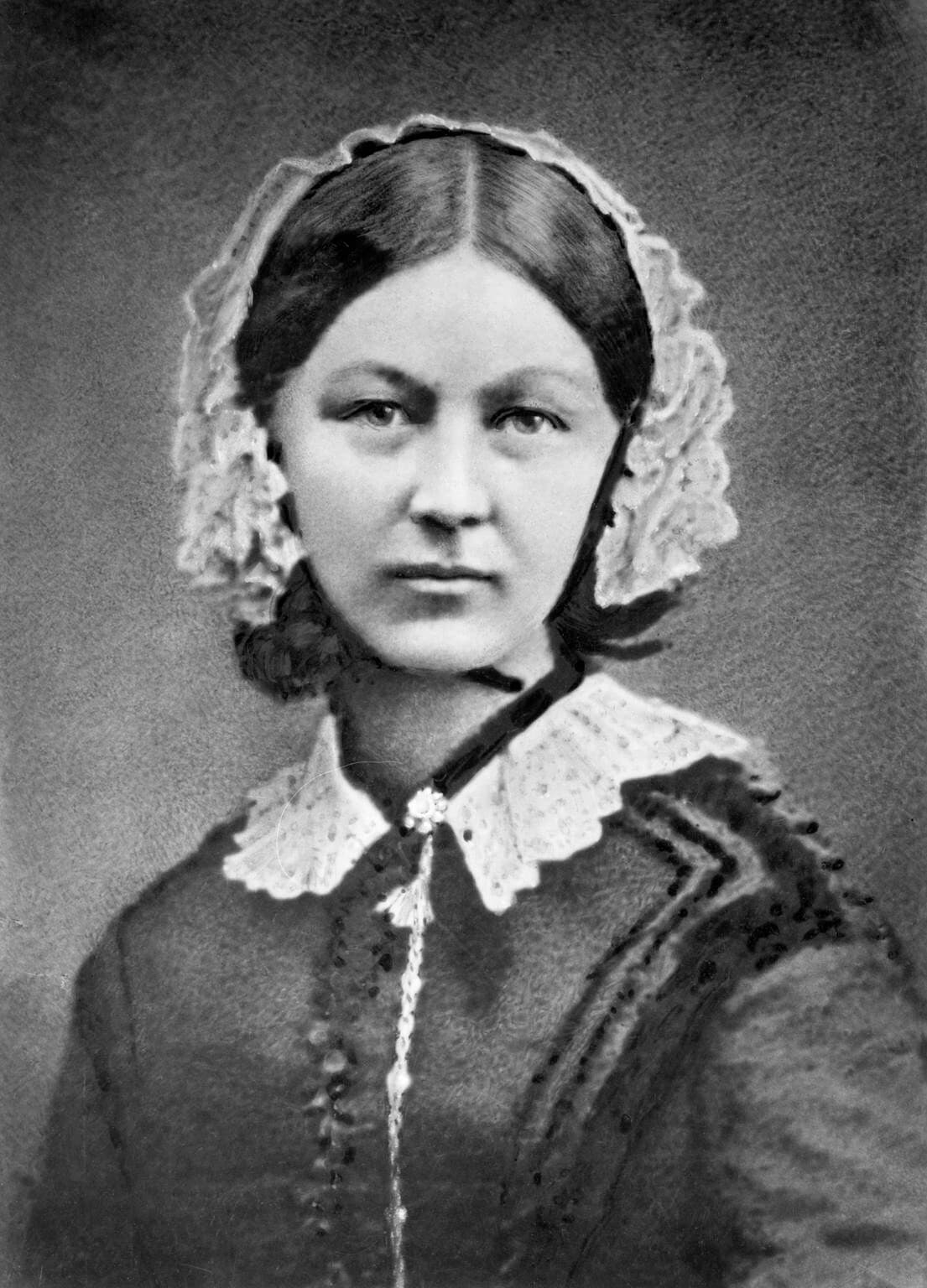
To the wounded soldiers of the Crimean War, Florence Nightingale was a phantom of mercy, moving through the dark wards of Constantinople with a lantern to check on the suffering.
In February 1837, among the manicured lawns and quiet woodlands of Embley Park in Hampshire, a seventeen-year-old girl of immense privilege experienced what she believed to be a direct summons from God. It was not a call to the quiet piety of Victorian womanhood, nor to the domestic grace expected of a wealthy, well-connected heiress. It was a vague but insistent demand to devote her life to the service of others. For Florence Nightingale, born in the Tuscan city that gave her her name, this spiritual awakening collided violently with the rigid social architecture of her class. To her mother, Fanny, and her sister, Parthenope, the announcement seven years later that she intended to enter the disreputable, physically hazardous world of nursing was not a holy calling but a familial tragedy. In early Victorian England, hospitals were dark, chaotic places of misery, and nurses were widely regarded as coarse, uneducated women of the lowest social stratum. Yet, Nightingale possessed a quiet, severe determination and an intellect sharpened by a father who believed in the advanced education of women. Guided by her father’s tutoring, she had mastered history, philosophy, classical literature, and mathematics—particularly a rare, precise genius for collecting and analyzing numerical data. To escape the suffocating expectations of a brilliant marriage and a life of decorative leisure, she chose a path of intellectual and physical exile, setting in motion a quiet revolution in the care of the human body.
Before she ever saw a battlefield, Nightingale constructed her own education from the margins of the grand tour expected of her class. She rejected the persistent, nine-year courtship of the poet and politician Richard Monckton Milnes, convinced that the domestic confines of marriage would strangle her calling. Instead, she traveled, observing the world with a clinical, diagnostic eye. In Paris, she formed a lifelong, transformative friendship with the eccentric, brilliant hostess Mary Clarke, who lived entirely among male intellectuals and treated women as the natural equals of men—a revelation to Nightingale, whose own mother prized social conformity above all. On her travels through Egypt and Greece, accompanied by her rescued pet owl, Athena, tucked into her pocket, Nightingale wrote deeply philosophical reflections on spiritual grandeur, yet her mind remained anchored to the practical mechanics of human suffering. In 1850, during a visit to the Lutheran religious community at Kaiserswerth-am-Rhein in Germany, she observed the disciplined work of deaconesses caring for the sick and destitute. She stayed for six months, undergoing rigorous medical training that laid the intellectual foundation for her life’s work. Upon returning to London, sustained by a generous annual allowance of £500 from her father, she assumed the superintendency of the Institute for the Care of Sick Gentlewomen on Upper Harley Street. She was no longer a rebellious daughter playing at philanthropy; she was a highly trained administrator, systemizing medicine and hygiene in an age when both were governed by superstition and neglect.
12 links to entries not yet ingested in the Library.
The pivot of Nightingale’s life, and the myth-making moment of the Victorian era, came with the outbreak of the Crimean War. In 1854, reports began filtering back to London of the catastrophic conditions at the British military hospital in Scutari, the Selimiye Barracks on the Asiatic side of the Bosporus. While France and Britain fought alongside the Ottoman Empire against Russia, British soldiers were dying not from Russian bullets, but from the invisible enemies of typhus, typhoid, cholera, and dysentery. Under the authorization of her close friend Sidney Herbert, the Secretary at War whom she had met in Rome years earlier, Nightingale mobilized a team of thirty-eight women—including fifteen Catholic nuns and volunteer nurses—and set sail for Constantinople. What they found upon arrival in November 1854 was a monument to administrative indifference and sanitary squalor. The barracks were overcrowded, the sewers defective and blocked, the ventilation nonexistent, and medicines virtually unavailable. The overworked military medical staff met the arrival of these female intruders with cold hostility. During that first brutal winter, over four thousand soldiers perished in the facility. Faced with a mounting horror that she attributed to poor nutrition, stale air, and exhaustion, Nightingale appealed to the press, prompting a public outcry that forced the British government to commission the engineer Isambard Kingdom Brunel to design a prefabricated civilian hospital, shipped in pieces to nearby Renkioi.
It was amidst this squalor that the legend of "The Lady with the Lamp" was born. The public back in England, fueled by vivid press reports, conjured an image of a gentle, ministering angel gliding through the dark corridors of Scutari, comforting the dying with a soft word. The reality was far more formidable. Nightingale was a tireless, demanding administrator who would stand for twenty hours at a stretch to supervise the admission of the wounded, steeling herself to attend agonizing amputations in the operating room. At night, carrying her solitary lamp, she made her rounds through miles of crowded wards, but her days were spent in a furious battle against military bureaucracy. She implemented strict hygiene protocols, including mandatory handwashing, and lobbied the state for intervention. When the British government’s Sanitary Commission finally arrived in March 1855 to flush out the defective sewers and improve the ventilation, the death rate at Scutari plummeted from a staggering 42 percent to a mere 2 percent. Though Nightingale herself contracted a near-fatal fever in May 1855, she refused to abandon her post, remaining in Turkey until the British evacuated in the summer of 1856.
When the war ended, Nightingale returned to England not as a conquering hero seeking a public triumph, but in quiet anonymity. She slipped back into the country aboard a French vessel, escaping to her Derbyshire home before the press or public could organize a reception. The physical toll of the Crimea permanently shattered her health, turning her into a semi-invalid who spent much of the remainder of her long life working from her bed. Yet, her seclusion was not a retirement; it was an mobilization of intellectual influence. Armed with a £50,000 public fund raised in her honor, she established the Nightingale Training School for nurses at St Thomas’ Hospital in 1860, creating the world’s first secular nursing school and elevating the occupation from a desperate trade to an honorable, highly skilled profession for women. In 1858, she published her landmark work, Notes on Nursing, which redefined the discipline as the meticulous management of fresh air, light, warmth, cleanliness, quiet, and diet, aiming to preserve the patient's vital force.
Nightingale’s true genius, however, lay in her pioneering use of statistics to wage war on institutional ignorance. She understood that while stories might move the heart, numbers moved governments. To illustrate the preventable nature of military deaths in the East, she designed the "polar area diagram"—a precursor to the modern circular histogram or pie chart, often called the Nightingale rose diagram—which visually demonstrated that the vast majority of soldier deaths were caused by preventable diseases rather than battlefield wounds. This innovation allowed politicians and civil servants to comprehend complex data at a glance, transforming the field of public health. Operating from her sickbed, she became a formidable political force, serving as a trusted, demanding advisor to politicians like Sidney Herbert, and drawing up confidential government reports on the Army Medical Corps. Her reformist zeal extended far beyond the British soldier; she advocated for better hunger relief and sanitation in India, worked to abolish harsh laws targeting prostitutes, and actively expanded the horizons of professional work available to women.
By the time she died in London on 13 August 1910, having received the Order of Merit from King Edward VII three years prior, Florence Nightingale had dismantled the Victorian ideal of the passive, ornamental woman. She did not merely comfort the sick; she systematized their survival, leaving behind a world where compassion was armed with mathematics, and nursing was recognized as both a science and an art.