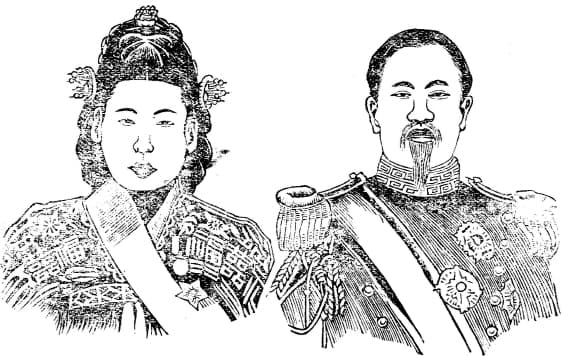
To her contemporaries, she was known simply as Queen Min—a woman who, in accordance with the customs of the late Joseon dynasty, was never given a personal name.
In the spring of 1866, a sixteen-year-old girl from the aristocratic Yeoheung Min clan was led into the ceremonial halls of the Joseon court to marry the fifteen-year-old King Gojong. She was, by all accounts, a calculated choice. Her father, Min Chi-rok, was dead; she had no brothers to thrust into lucrative government offices, and her clan, though ancient and prestigious, was currently devoid of political muscle. To the King’s father and de facto regent, the formidable Heungseon Daewongun, she seemed the perfect cipher: a well-bred, fatherless girl who would remain dutifully invisible while he continued his iron-fisted rule over the peninsula. On the wedding day, the ceremonial headdress worn by the teenage bride was so heavy that a tall court lady had to stand behind her just to support its weight. It was a physical burden that prefigured a far heavier political one. The Daewongun, pleased with his selection, remarked that she possessed determination and poise. He did not yet realize that he had just ushered his most implacable lifelong rival directly into the sovereign center of the state.
The young queen consort, known to history posthumously as Empress Myeongseong—and to her contemporaries and foreign adversaries as Queen Min—refused the traditional script written for Joseon queens. She eschewed the lavish tea parties, the extravagant court fashions, and the gossipy social circles of the high aristocracy. Instead, she retreated to her quarters to read. She mastered classical texts written in Chinese characters, a domain traditionally reserved exclusively for elite men, devouring works of history, science, politics, philosophy, and religion, including the Spring and Autumn Annals and the Zuo Zhuan. While her husband, Gojong, spent the early years of their marriage seeking the company of his concubine, Royal Consort Yi Gwi-in—a preference openly encouraged by the Daewongun—the young queen quietly built an intellectual and political fortress of her own. By the time she reached twenty, she emerged from the seclusion of her apartments, ready to dismantle the regency of the man who had brought her to the palace.
The conflict between the Queen and her father-in-law was not merely a family feud; it was a battle for the soul and survival of Korea. The Daewongun was a staunch Confucian isolationist. He believed that the only way to preserve Joseon’s independence in an era of rapacious Western and Japanese imperialism was to shutter the kingdom’s borders entirely, keeping foreign contact to an absolute minimum. Queen Min, conversely, was a pragmatist. She recognized that the tides of the late nineteenth century could not be held back by isolationist decrees. She envisioned a gradual, calculated modernization, utilizing Western and Chinese assistance to strengthen Korea’s military, economy, and governmental infrastructure before the country was swallowed whole by its stronger neighbors. Armed with this vision, she rallied her resurrected Min clan and forged alliances within the court. In 1873, she and her faction successfully forced the Daewongun out of office, officially handing the reins of state to King Gojong, though it was the Queen who largely directed the policy of the realm from behind the screen.
+ 11 further connections to entries not yet ingested
For over two decades, the Queen oversaw a delicate, high-stakes balancing act. She initiated reforms to modernize the royal army and streamline the government, but her position was constantly under siege. The ousted Daewongun remained a dangerous, brooding presence, repeatedly backing conservative Confucian rebellions aimed at removing his daughter-in-law from power. Each failed coup only hardened the Queen's resolve and tightened her grip on the court. But as the 1880s gave way to the 1890s, her domestic rivals were eclipsed by a far more lethal threat from across the sea.
Meiji Japan, rapidly industrializing and looking to expand its empire onto the Asian mainland, viewed the Korean peninsula as its natural stepping stone. Standing squarely in the path of this expansion was Queen Min. Her diplomatic maneuvering—particularly her inclination to play foreign powers against one another and her growing inclination to seek Russian intervention to check Japanese ambitions—made her an intolerable obstacle to Tokyo's designs.
The climax of this geopolitical tension came to a head in the autumn of 1895. Miura Gorō, the newly appointed Japanese Minister to Korea, decided that the only way to break the diplomatic stalemate in Seoul was to eliminate the Queen permanently. Miura found a willing, if desperate, accomplice in the aging Daewongun, who was eager for one final grasp at power. In the pre-dawn hours of October 8, 1895, the plot was set in motion. The Hullyeondae Regiment, a Korean military unit loyal to the Daewongun, launched an assault on the Gyeongbokgung Palace, easily overpowering the Royal Guards. In the chaos that followed, the conspirators opened the palace gates to a strike force of ronin—Japanese assassins specifically recruited for the operation.
The intruders swept through the palace chambers, hunting for the Queen. Because she had never allowed her likeness to be widely known or photographed for security reasons, the assassins dragged out several court ladies, killing them in a desperate attempt to identify their target. When they finally discovered the Queen, they murdered her with brutal efficiency. To erase the evidence of their crime and prevent her body from becoming a national rallying symbol, the assassins carried her remains to the nearby pine woods of the palace grounds and burned them.
The assassination of a sovereign queen in her own palace by foreign agents sparked immediate international outrage, but the immediate aftermath in Seoul was defined by a heavy-handed Japanese attempt to consolidate control. A Japanese-backed cabinet was installed, which pushed through a series of radical, forced modernizations known as the Gabo Reforms. Among these was an edict in the winter of 1895–1896 ordering all Korean men to cut off their traditional top-knots of hair. In late Joseon society, the top-knot was not merely a hairstyle; it was a sacred badge of cultural and Confucian identity, a physical link to one's ancestors. The combination of the Queen’s murder and the top-knot edict proved to be a flashpoint, triggering violent nationwide protests and armed resistance.
Fearing for their lives in a palace surrounded by Japanese sympathizers, King Gojong and the Crown Prince fled in disguise in early 1896, finding refuge in the Russian legation. Operating from the safety of foreign soil, Gojong ordered the repeal of the hated Gabo Reforms, capitalizing on the intense anti-Japanese backlash that swept the nation. In October 1897, Gojong returned to the relative security of Gyeongungung Palace. There, in a bid to assert Korea's absolute sovereignty and equality with the empires of China and Japan, he proclaimed the founding of the Korean Empire.
As his first act as Emperor, Gojong raised his late wife to the rank of Empress, posthumously naming her Myeongseong—the "Brilliant Holy Empress." Her life, which ended in violence in the palace gardens, became the defining tragedy of a kingdom fighting for its existence. She had entered the court as an anonymous bride, selected for her perceived weakness, only to die as the formidable intellectual anchor of her nation’s sovereignty, leaving behind an empire that would struggle, for just a few years more, to survive the coming storm of the twentieth century.