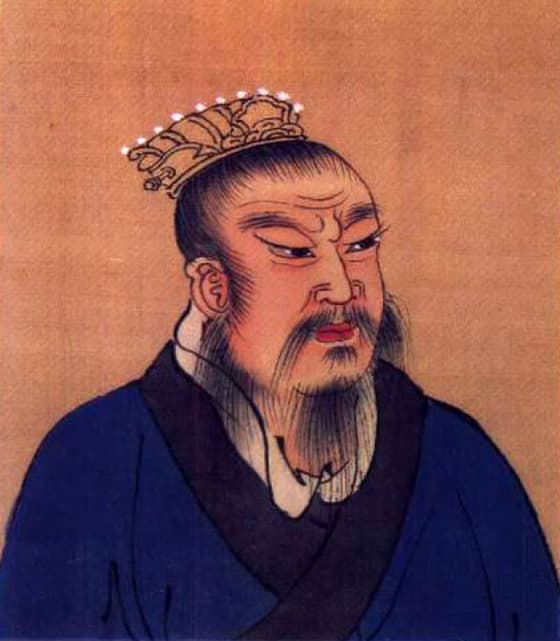
Before he founded one of the most enduring dynasties in Chinese history, Liu Bang was known to his father as a little rascal who showed little interest in education, work, or the law.
In the final years of the third century BCE, the roads of central China were thick with the dust of forced labor. Thousands of men, bound by the unforgiving codes of the Qin dynasty, marched toward Mount Li to construct the colossal mausoleum of the first emperor, Qin Shi Huang. Among those tasked with driving this human herd was a minor law enforcement officer from Pei County named Liu Bang. He was a man of peasant stock, possessed of an easy charisma and a well-documented distaste for hard labor or study. On the road, as prisoners slipped away into the night, Liu realized the math of his predicament: under Qin law, the escape of his charges carried a single, non-negotiable penalty—death. Rather than march to his execution, Liu halted the column, dissolved the bonds of his remaining prisoners, and offered them a choice: disperse, or follow him into the wilderness. Many chose to follow. Seeking refuge on the mist-shrouded slopes of Mount Mangdang, this band of outlaws became the seed of a new empire, and their leader—a man once dismissed by his own father as a "little rascal"—began his unlikely ascent to the throne of China.
History and myth quickly blurred in the forests of Mangdang. The story arose that while traveling drunk one night, Liu encountered a monstrous white serpent blocking his path. With a single stroke of his sword, he slew the beast. The following morning, his men discovered an old woman weeping by the roadside; she claimed her son, the child of the White Emperor, had been slain by the son of the Red Emperor, before she mysteriously vanished into the air. This tale, heavy with cosmological portent, spread rapidly through a population suffocating under the draconian weight of Qin rule. When the empire fractured into chaos following the death of Qin Shi Huang in 210 BCE, the citizens of Pei County rose up, executed their imperial magistrate, and invited Liu and his band of outlaws back to take command. Now styled the Duke of Pei, Liu aligned himself with the broader anti-Qin rebellion emerging from the old state of Chu, serving under the nominal banner of King Huai II.
The race to dismantle the Qin heartland of Guanzhong became a duel of temperaments between Liu Bang and his formidable rival, the aristocratic warrior Xiang Yu. King Huai II had promised that whoever first entered the passes of Guanzhong would be crowned its king. While Xiang Yu engaged the main Qin armies in brutal, attritional warfare, Liu managed to slip through the southern defenses. In 207 BCE, his forces arrived at the gates of the capital, Xianyang. Ziying, the last ruler of the short-lived Qin dynasty, surrendered without a fight. Urged by his pragmatic advisers Fan Kuai and Zhang Liang, Liu resisted the temptation of immediate plunder. He sealed the imperial treasuries, forbade his troops from mistreating the citizenry, and abolished the labyrinth of cruel Qin laws, replacing them with three simple statutes: death for murder, and proportional punishment for bodily harm and theft. His administrator, Xiao He, went about the quiet but crucial business of seizing the imperial archives, securing the maps, census data, and legal records that would eventually allow Liu to govern the realm.
+ 12 further connections to entries not yet ingested
This bloodless triumph nearly proved fatal. Xiang Yu arrived at the mountain passes soon after, enraged to find himself anticipated by a peasant-turned-sheriff. With an army vastly outnumbering Liu's, Xiang Yu invited his rival to a banquet at the Swan Goose Gate—a meeting that has lived in Chinese historical memory as the archetype of lethal political theater. Prompted by his advisor, Xiang Yu’s kin initiated a ceremonial sword dance, gradually closing the distance to assassinate Liu. The plot was frustrated only when Liu’s ally, Xiang Bo, joined the dance to shield him, and his bodyguard Fan Kuai burst into the tent in full armor, delivering a fierce speech that shamed the host. Under the pretext of relieving himself, Liu slipped away from the banquet and fled back to his camp. Shortly thereafter, Xiang Yu’s forces sacked Xianyang, reduced the imperial Epang Palace to ashes, and carved the empire into Eighteen Kingdoms. Denied his promised crown, Liu was exiled to the remote, mountainous southern basin of Hanzhong as the "King of Han." To signal his submission and convince Xiang Yu that he had no intention of returning, Liu ordered the burning of the wooden gallery roads suspended along the cliffs behind him as he retreated into the south.
Yet the peace was short-lived. The mountain air of Hanzhong bred deep homesickness among Liu's lowland troops, leading to rampant desertion. Among those who fled was a brilliant, underutilized military strategist named Han Xin. Realizing the gravity of the loss, Xiao He pursued Han Xin through the night and brought him back, presenting him to Liu as the indispensable key to reclaiming the north. Convinced of Han Xin's genius, Liu appointed him supreme commander. In 206 BCE, the Han forces launched a surprise counter-offensive, quickly reclaiming the Three Qins and igniting the four-year civil war known as the Chu-Han Contention. It was an asymmetric conflict: Xiang Yu was a military prodigy who rarely lost a battle, but he lacked political subtlety; Liu Bang was a mediocre commander who lost repeatedly, but he possessed an uncanny ability to listen to his advisers and win the peace.
By 202 BCE, the momentum had shifted. Surrounded at the Battle of Gaixia, his troops demoralized by the sound of their own native songs sung by the Han besiegers, Xiang Yu took his own life beside the Wu River. Liu Bang emerged from the ashes of the civil war as the undisputed master of China. He established the Han dynasty, adopting the title of Emperor Gaozu, and set about the monumental task of constructing a sustainable state from the ruins of two decades of war. Having witnessed the sudden collapse of the highly centralized Qin, Gaozu chose a middle path of governance. He retained direct imperial control over the western half of the empire, but appeased his military allies by granting vast, semi-autonomous kingdoms in the east to non-relative vassal kings. Over time, recognizing the threat these independent rulers posed, he systematically suppressed their revolts, replacing them with members of his own Liu clan to ensure dynastic loyalty.
To heal a devastated economy, Gaozu drastically reduced taxes and lightened the heavy burdens of corvée labor that had triggered the collapse of his predecessors. While he had once famously shown his contempt for scholars by urinating into a Confucian hat, the realities of ruling an empire forced a change in perspective; he gradually began to patronize Confucianism to provide the moral and ritual framework necessary for administrative stability. On the northern frontiers, facing the formidable nomadic confederation of the Xiongnu, Gaozu experienced a stinging military defeat at the Battle of Baideng in 200 BCE. Recognizing the limits of his military reach, he initiated the pragmatic policy of heqin—a system of state alliances secured by marrying Han princesses to Xiongnu chieftains, accompanied by regular tributary gifts of silk and wine. It was a humiliating but necessary concession that bought the young dynasty the time it needed to mature.
Emperor Gaozu died in 195 BCE from a wound sustained during a campaign against a rebellious vassal, leaving the throne to his young son, Liu Ying, under the watchful eye of the formidable Empress Dowager Lü Zhi. He was buried in the Changling mausoleum, not far from the capital of Chang'an that his administrators had built. Gaozu’s legacy was not merely the survival of a peasant who rose to wear the imperial yellow, but the creation of an enduring civilizational template. By tempering the administrative efficiency of the Qin with a more humane, pragmatic approach to governance, his dynasty cemented a cultural and political identity so profound that, for more than two millennia, the dominant ethnic group of China would continue to refer to themselves simply as the people of Han.