Person · 1879 CE – 1919 CE · Post Colonial Americas
Emiliano Zapata
- Also known as
- Aemilianus Zapata
- Aemilianus Zapata Salazar
- Caudillo del Sur
- Emiliano Zapata Salazar
- Emiliano Zapata Salazar
- Emiliano Zapata Salazar
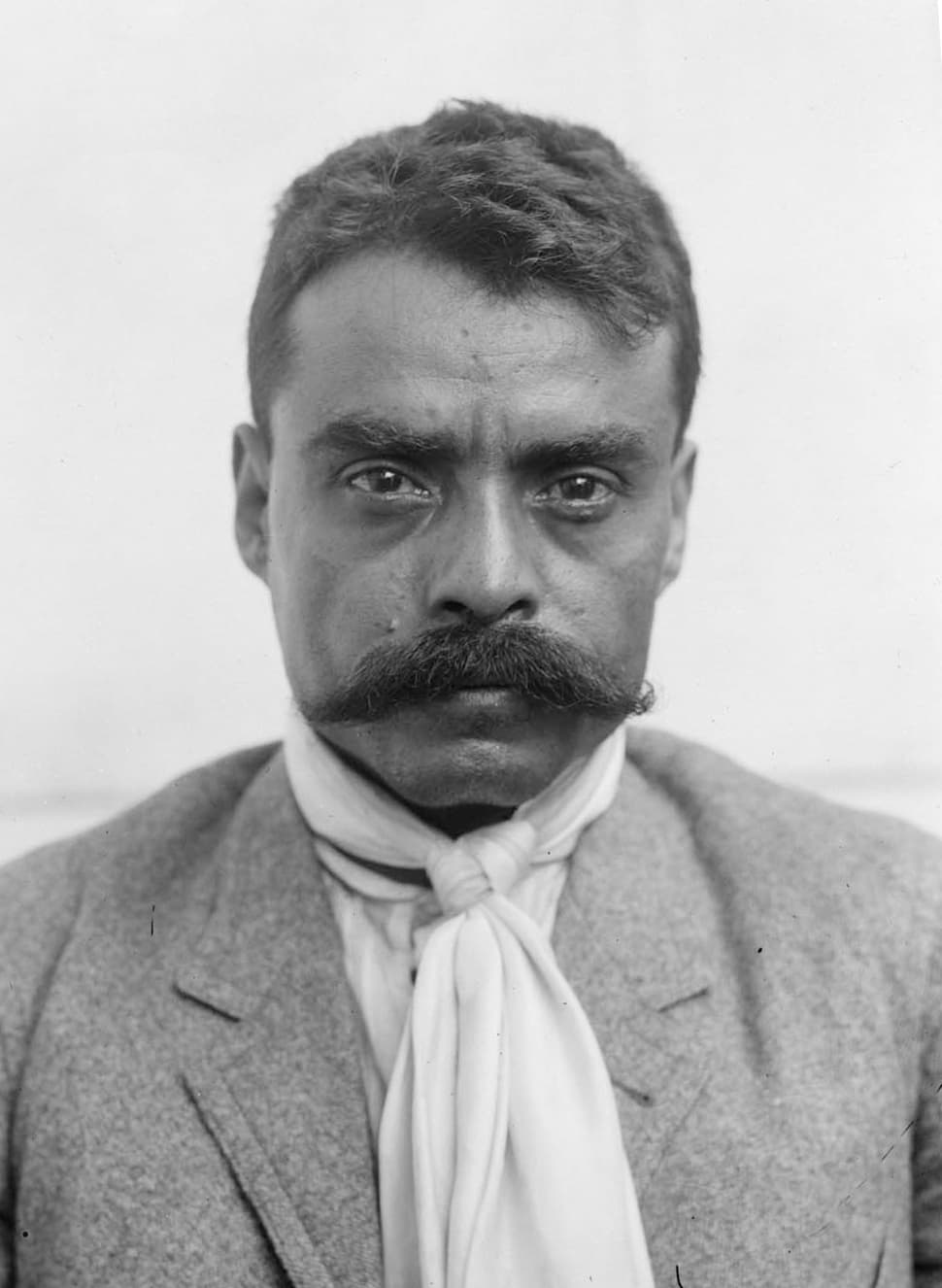
The sugarcane fields of Morelos were fertile ground for a revolution.
The sugarcane of Morelos grew thick, tall, and insatiable, watered by streams that the great haciendas had systematically diverted from the ancient villages of the valley. By the late nineteenth century, under the long, developmentalist dictatorship of President Porfirio Díaz, these commercial sugar estates had swallowed the communal lands of the peasantry, transforming self-sufficient farmers into landless day laborers. In the small, mixed mestizo and Nahuatl-speaking village of Anenecuilco, the elders kept their colonial-era land titles wrapped in cloths, preserving the legal proof of their heritage like sacred relics. It was into this landscape of agrarian dispossession that Emiliano Zapata was born in 1879. He was not the impoverished peon of later legend, but the son of a well-off family of horse trainers and farmers who had fought for Mexico against foreign invaders and domestic elites alike. Zapata wore the elegant, silver-buttoned charro outfit of a skilled horseman, kept a meticulously groomed mustache, and earned a living hauling maize with his own team of mules. Yet, his prosperity did not detach him from the soil or the grievances of his neighbors. He knew that without land, the people of Morelos were nothing more than fuel for the modernizing engines of the sugarcane mills.
In the autumn of 1909, the elders of Anenecuilco gathered to select a successor to their aging council president, José Merino, who had grown too frail to carry on the village’s endless, exhausting legal battles against the encroaching haciendas. The elders bypasses older candidates and elected the thirty-year-old Zapata, whose quiet resolve and previous political resistance to the state’s gubernatorial candidate had earned their trust. Zapata did not take the prestigious title of Don, preferring to remain "Miliano" to his neighbors. He took custody of the village's colonial titles and soon realized that the courts of the Porfiriato would never offer justice to the dispossessed. When the wealthy landowner and politician Francisco I. Madero launched a rebellion against the aging dictator in 1910 under the Plan of San Luis Potosí, Zapata saw an opportunity. Madero’s plan contained vague but promising language about the restoration of usurped village lands. Seizing the moment, Zapata raised a peasant army, which would evolve into the Liberation Army of the South. Guided by his intimate knowledge of the local terrain and a fierce devotion to his community, Zapata’s forces besieged and captured the key city of Cuautla in May 1911. The fall of Cuautla broke the back of the federal forces in the region and hastened the resignation and exile of Porfirio Díaz.
Yet, the departure of the dictator did not bring peace to the valleys of Morelos. Madero, representing the moderate, urban liberalism of Mexico’s northern elites, assumed the presidency with a desire for political reform but a deep hesitation toward social revolution. To Madero, land reform was a matter of slow, formal adjudication in the courts; to Zapata and his armed followers, it was a matter of immediate survival and historical justice. Madero demanded that Zapata’s peasant forces disarm before any land disputes were resolved, a demand Zapata flatly refused. Sensing trouble, Madero dispatched the ruthless federal general Victoriano Huerta to Morelos to enforce order. Huerta’s thousand-man army marched into the state, an action Zapata viewed as a direct provocation. "I won't be responsible for the blood that is going to flow if the Federal forces remain," Zapata warned. By November 1911, the fragile alliance had shattered. Fleeing into the rugged mountains of southwest Puebla with his close advisor, the former schoolteacher Otilio Montaño Sánchez, Zapata officially broke with the new president.
In those mountains, Zapata and Montaño drafted the Plan of Ayala, a document that would become the sacred text of the southern revolution. The plan was uncompromising: it denounced Madero as a traitor who had abandoned the principles of the revolution to feed his own political ambitions. It called for the immediate restoration of all lands stolen by the haciendas, declaring that one-third of the monopolized lands of the great estates should be expropriated and redistributed to landless peasants, while the property of those who opposed the revolution would be seized entirely. "We are not downcasts," the Zapatistas declared, but men demanding what was rightfully theirs. Madero responded by unleashing the Federal Army upon Morelos. Under the command of federal generals, the campaign turned into a war of devastation. Government troops employed scorched-earth tactics, burning entire villages to the ground, forcibly relocating populations to break the insurgency's support network, and conscripting peasant men into federal service or sending them to forced-labor camps in the south. Rather than crushing the rebellion, this brutality deeply solidified the peasants' loyalty to Zapata. Under his leadership, the guerrilla forces of the south managed to drive Huerta’s forces out of Morelos.
The kaleidoscopic nature of the Mexican Revolution shifted violently again in February 1913, when Huerta turned on Madero, executing him in a bloody coup and seizing the presidency. Suddenly, Zapata found himself fighting a common enemy alongside a northern coalition of Constitutionalists led by Venustiano Carranza, Álvaro Obregón, and the legendary Francisco "Pancho" Villa. By July 1914, this uneasy alliance had successfully ousted Huerta. Yet, the victory only exposed the deep ideological chasm between the northern constitutionalists and the southern agrarians. At the Convention of Aguascalientes in late 1914, an attempt to forge a unified revolutionary government collapsed. Zapata and Villa, representing the agrarian, populist wing of the revolution, broke with the more conservative, state-centered Carranza. As the country slid back into civil war, Zapata withdrew to his stronghold of Morelos, disillusioned by the power struggles in Mexico City.
For a brief, extraordinary window of time, Morelos became an autonomous laboratory of agrarian reform. With the hacienda owners gone and Zapata's forces in control, the Plan of Ayala was put into practice. Communal lands were surveyed, mapped, and returned to the villages; sugar mills were nationalized to fund the revolutionary administration; and local communities began to govern themselves according to ancient customs. Zapata, wearing his trademark charro suit and silver spurs, remained a local figure, accessible to the humblest farmer. But this radical experiment in agrarian democracy could not survive in isolation. To the north, Carranza consolidated his power and decisively defeated Pancho Villa’s forces in 1915. With the northern threat neutralized, Carranza turned the full weight of the modernized Constitutionalist army toward the south.
Once again, Morelos was subjected to the horrors of a scorched-earth campaign. Constitutionalist troops invaded the state, burning crops and destroying villages in an effort to starve out the Zapatistas. Though Zapata managed to retake most of Morelos in 1917 and preserve his rebellion, his forces were gradually worn down by years of uninterrupted warfare, isolation, and economic exhaustion. He refused to compromise on the core tenets of the Plan of Ayala, even as Carranza’s government drafted a new Mexican Constitution in 1917. While Article 27 of that constitution incorporated many of Zapata’s agrarian demands on paper, the armed struggle on the ground continued.
By 1919, Zapata’s position had grown precarious, and the Constitutionalists realized they could not easily defeat the southern guerrilla leader in the mountains through conventional warfare. They resorted to treachery. Jesús Guajardo, a federal colonel serving under Carranza's general Pablo González, feigned a desire to defect to the Zapatista cause. To prove his sincerity, Guajardo even staged a mutiny and executed some of his own men. Zapata, desperate for allies and ammunition, agreed to meet Guajardo at the Hacienda of San Juan de Chinameca on April 10, 1919. As Zapata rode through the gates of the hacienda with a small escort, a guard of honor stood at attention. At the signal, the soldiers raised their rifles and fired two volleys of treason at point-blank range. Zapata fell from his horse, dead before he hit the ground.
Though Zapata was gone, the movement he inspired could not be extinguished by a single betrayal. In the year following his death, Carranza was overthrown and killed in a revolt led by Álvaro Obregón. Recognizing that they could never stabilize Mexico without pacifying the south, the new rulers of the republic integrated Zapata’s surviving generals into the government of Morelos. In 1920, these Zapatistas secured key administrative positions and finally began the official, legally sanctioned redistribution of land that Zapata had fought for throughout his adult life. The sugar haciendas that had once choked the valley were dismantled, replaced by the ejidos—communal land holdings owned and worked by the villagers. Emiliano Zapata’s life ended in the dust of a hacienda courtyard, but his legacy was woven into the very fabric of modern Mexico. He transformed the local, centuries-old grievances of the Morelos peasantry into a national creed of agrarian justice, leaving behind an enduring symbol of resistance that would inspire future generations of reformers and revolutionaries who, like him, believed that the land belongs to those who work it with their hands.
Connected to
- in conflict · had as participantMexican Revolution1910 CE
+ 10 further connections to entries not yet ingested