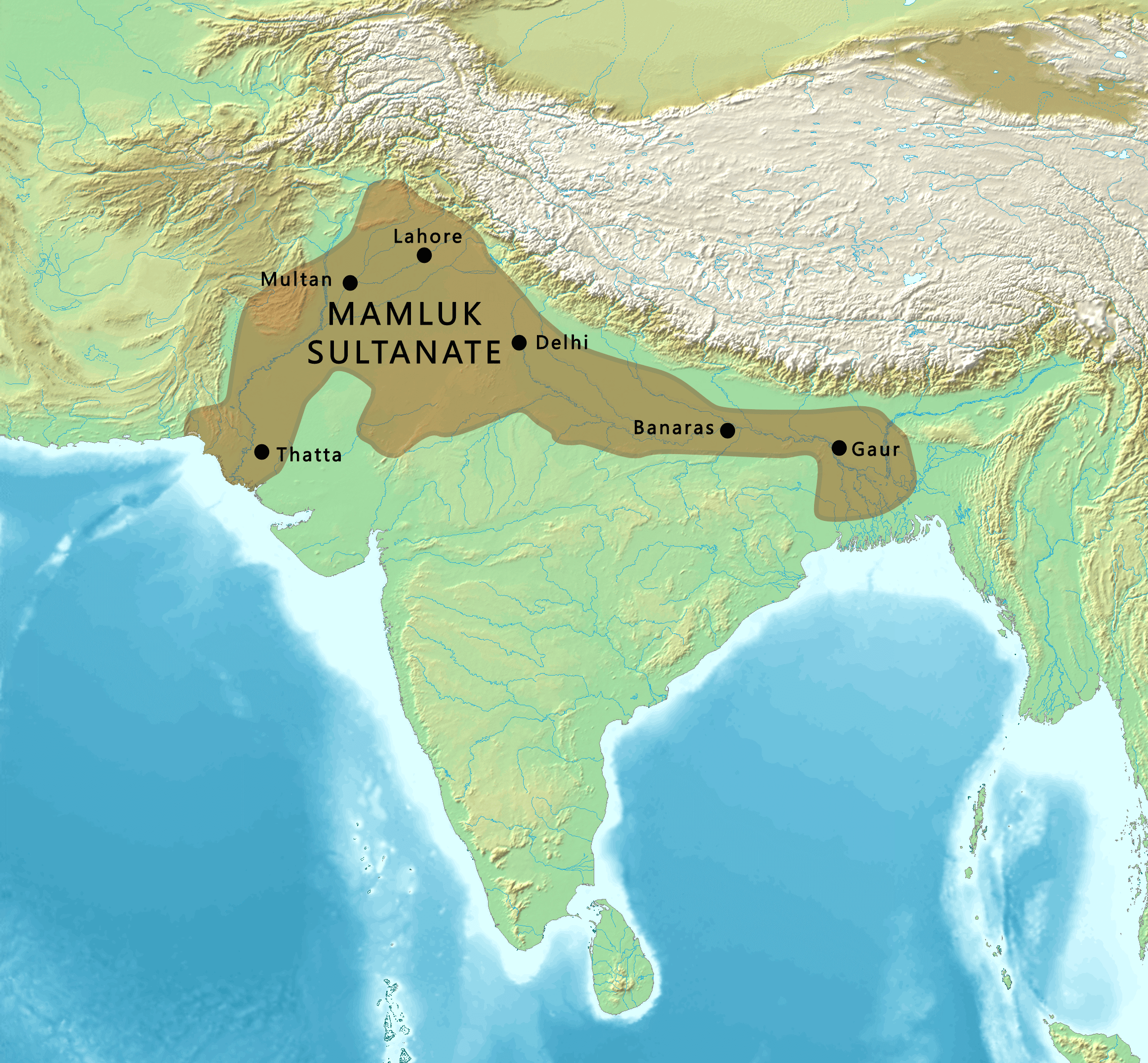
In 1192, near the town of Tarain, the Ghurid conqueror Muhammad Ghori routed the Rajput Confederacy, setting in motion a political transformation that would reshape the Indian subcontinent for over three centuries.
The rise of the Delhi Sultanate was not a sudden rupture, but a violent acceleration of a deep geographic pattern. For a thousand years, the rich, agrarian plains of northern India had acted as a gravity well for the nomadic and semi-nomadic tribes of the Central Asian steppes. The northwestern corridors of the subcontinent had long felt the thundering advance of those seeking plunder or pastures. But by the late twelfth century, the character of these incursions shifted from seasonal raids to permanent, systematic conquest. In 1192, near the town of Tarain, the Ghurid ruler Muhammad of Ghor routed the Rajput Confederacy led by the Ajmer ruler Prithviraj Chauhan, reversing a previous defeat and breaking the primary military bulwark of northern India. When Ghor was assassinated in 1206 by Ismaili Shia Muslims, his vast conquests east of the Indus River did not dissolve. Instead, they were claimed by his Turkic slave-generals. These military slaves, or Mamluks, had been purchased from the steppes, Islamicized, and trained to the highest echelons of command. It was one of these former slaves, Qutb ud-Din Aibak, who assumed power in Delhi, inaugurating a three-hundred-year empire that would tether the subcontinent to the vast, interconnected world of medieval Islam.
To understand this new state, which contemporary writers called the Mamalik-i-Delhi or the Empire of Hindustan, one must understand the unique institution of the Mamluk. This was an era when the line between property and power was blurred; slave-generals were not mere servants but the vital organs of the state. Aibak, praised by his contemporaries as Lakhbaksh—the giver of lakhs—for his legendary generosity, ruled for a mere four years before dying, but his successor and son-in-law, Shams ud-Din Iltutmish, consolidated these fragmented conquests through a mixture of brutal executions and shrewd diplomacy. Iltutmish subdued rival Muslim warlords in Multan and Bengal, seized Ranthambore and Sivalik from Hindu rulers, and executed Taj al-Din Yildiz, his chief rival to the Ghurid legacy. It was under Iltutmish that the iconic Qutb Minar complex, begun by Aibak as a soaring statement of the "Might of Islam" (Quwwat-ul-Islam), was completed and expanded. Yet the stability he built was fragile. Following his death in 1236, the Sultanate descended into decades of factional violence, characterized by short-lived reigns, assassinations, and the machinations of the "Corps of Forty"—a powerful council of Turkic slave-nobles who functioned as kingmakers. Even this volatile period produced remarkable anomalies: the brief, contested ascension of Razia Sultana, one of the exceptionally rare female sovereigns in Islamic history, who ruled from 1236 to 1240 before succumbing to the factional tides.
+ 9 further connections to entries not yet ingested
While Delhi’s elites slaughtered each other for the throne, a larger catastrophe beyond the Hindu Kush shaped the destiny of the Sultanate. The thirteenth century saw the unstoppable westward expansion of the Mongol Empire. As the cities of Central Asia and Persia were reduced to ash, a desperate, brilliant tide of refugees fled south into the relative safety of northern India. Soldiers, poets, administrators, Sufi mystics, and artisans poured into Delhi. This massive influx of intellectual and cultural capital transformed the Sultanate from a frontier military outpost into a sophisticated, cosmopolitan center of Persianate Islamic culture. The Chagatai Mongols pursued their prey to the borders of the Sultanate, launching repeated, devastating raids across the northwest. It was under the iron-fisted rule of Ghiyas ud-Din Balban, who destroyed the Corps of Forty to centralize royal authority, and later the rulers of the Khalji dynasty, that the Sultanate achieved its greatest military triumph: successfully repelling the Mongol armies and saving the subcontinent from the wholesale destruction that had befuddled the Middle East.
This defensive resilience laid the groundwork for the Khalji Revolution of 1290, which brought an end to the Mamluk dynasty. The Khaljis, though Turkic in origin, had resided so long in Afghanistan that they had adopted Afghan customs, making them outsiders to the old Turkic elite of Delhi. The dynasty’s second ruler, Ala ud-Din Khalji, who took the throne in 1296 after ordering the assassination of his mild-mannered uncle, transformed the Sultanate into an aggressive, totalitarian war machine. To fund his massive standing army and defend against the Mongols, Ala ud-Din restructured the economic life of northern India with terrifying efficiency. He raised agricultural taxes on the peasantry to an unprecedented fifty percent, payable directly in grain. He eliminated the traditional commissions of local Hindu chiefs, slashed the salaries of court poets and scholars, and banned socializing or intermarriage among his nobles to prevent conspiracies from taking root.
Ala ud-Din’s domestic policy was one of absolute, suffocating control. He established state-monopolized markets, the shahana-i-mandi, where licensed Muslim merchants traded at fixed official prices. Anyone caught violating these price controls faced severe punishments, including mutilation. During famines, the state grain collected from taxes was released from royal storehouses, ensuring the army remained fed while the rest of the country endured scarcity. Ala ud-Din’s suspicion was lethal; when he suspected a threat, he ordered the extermination of entire families—men, women, and children. In 1298, fearing a conspiracy, he ordered the massacre of between 15,000 and 30,000 newly converted Mongol settlers living near Delhi. Yet, this domestic tyranny funded an unparalleled era of southern expansion. Led by brilliant, loyal generals—many of them Indian slaves, such as Malik Kafur and Khusro Khan—the Sultanate’s armies pushed deep into the Deccan and southern India, returning with unimaginable wealth, including the famous Koh-i-Noor diamond seized from Warangal.
This aggressive southward push reached its zenith under the subsequent Tughlaq dynasty, particularly during the reign of Muhammad bin Tughluq, under whom the Sultanate’s borders briefly encompassed almost the entirety of the Indian subcontinent. Yet this vast geographical reach was unsustainable. The rapid expansion strained the administrative capacity of Delhi, and the empire began to fracture under its own weight. The late fourteenth century witnessed the rise of independent rival powers: the Hindu kingdom of Mewar and the great Vijayanagara Empire in the south asserted their independence, while wealthy Muslim breakaway states, such as the Bengal and Bahmani Sultanates, severed their ties with Delhi. The final, catastrophic blow to the old Sultanate order came in 1398, when the Central Asian conqueror Timur swept through the mountain passes and sacked Delhi, leaving the capital in ruins and its political authority shattered. Though the Sayyid and Afghan Lodi dynasties would continue to rule a diminished territory from Delhi for another century, the grand imperial project of the early Sultanate was gone, replaced by a fragmented landscape of regional powers.
For more than three centuries, the Delhi Sultanate stood as a complex, contradictory monument of medieval statecraft. It was characterized by moments of immense violence and cultural destruction; during the early conquests, generals like Bakhtiyar Khalji desecrated grand Hindu and Buddhist temples and razed ancient universities and libraries. Yet, contrary to later historical narratives, the Sultanate did not survive on mass forced conversions; Hindu vassals, officials, and merchants were integrated into the administrative fabric of the state, and the vast majority of the population retained their dharmic faiths. Instead, the true legacy of the Sultanate lay in the fertile, often unintended synthesis of two civilizational streams. It was within this crucible that the Hindustani language was born, weaving Persian and Arabic vocabulary into the grammatical structure of regional Prakrits. It was here that Indo-Islamic architecture developed, marrying the dome and the arch of the west with the intricate stone-carving traditions of Indian builders. When the Timurid prince Babur invaded from Kabul in 1526, defeating the last Lodi sultan at Panipat, he did not find an isolated land, but a highly sophisticated, deeply integrated world—one ready to be transformed into the Mughal Empire.