Person · 550 BCE – 486 BCE · Persian Empires
Darius I
- Also known as
- Daarjaves I
- Darayavahus I
- Darayavahush I
- Darayavaush
- Darayavaush Đại đế
- Dareios
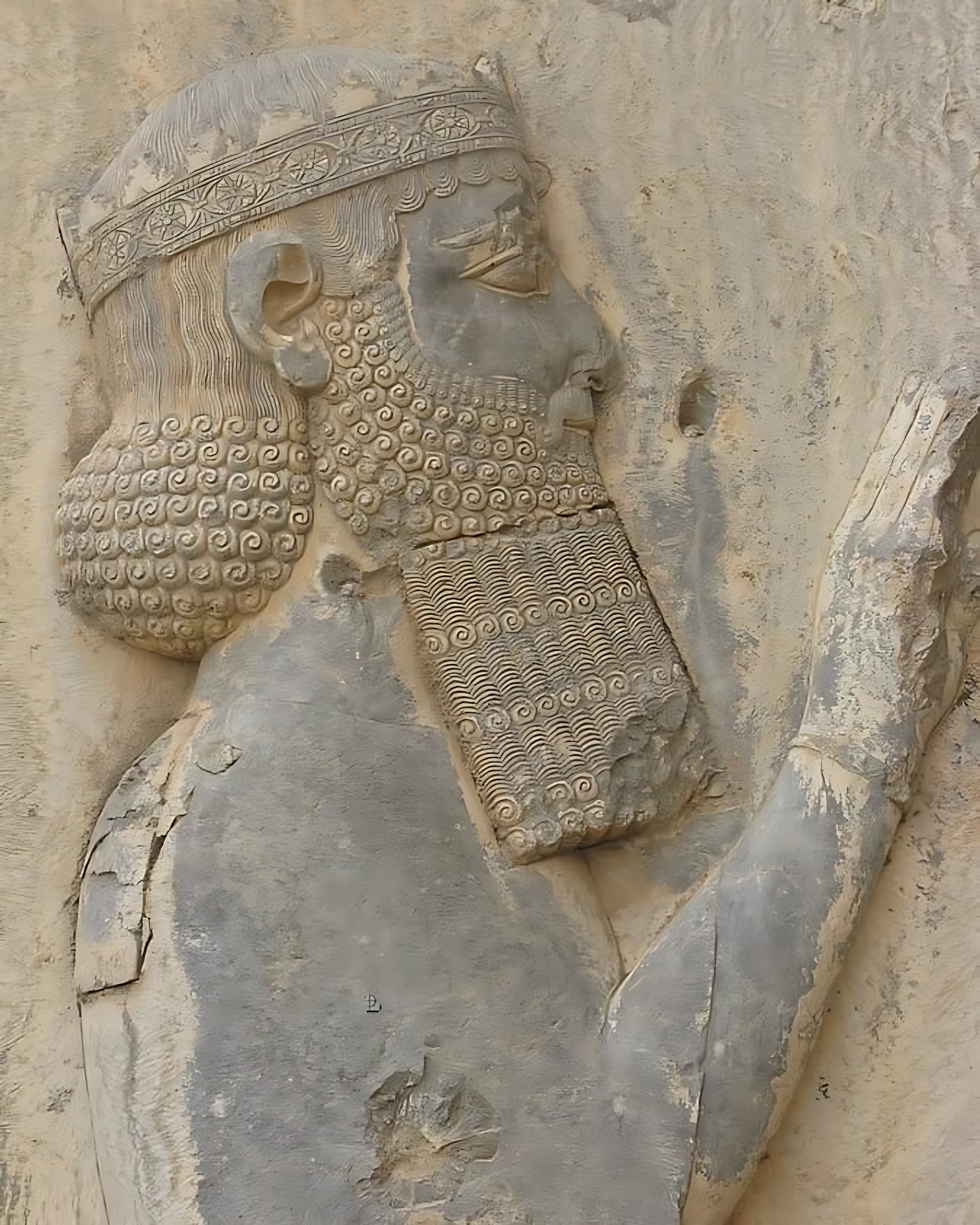
The climb to the throne of the Achaemenid Empire required a grand redirection of history, one that began with a dead king and a claim of imposture.
High upon a sheer limestone cliff in the Zagros Mountains, along the ancient caravan route that linked Babylon to Ecbatana, a colossal relief looks down over the plains of western Iran. This is Mount Behistun. Carved into the living rock, a larger-than-life figure stands with his left foot planted firmly on the chest of a fallen man who stretches his hands upward in desperate supplication. Behind this triumphant figure stand two of his spear-bearers; before him, bound by a single rope around their necks, cringe nine captive "lying kings." The central figure is Darius I, and the monument is not merely an assertion of victory, but one of history’s most audacious works of political public relations. Written in three languages—Elamite, Babylonian, and Old Persian—the inscription screams a single, desperate truth to any traveler who passes below: that the man who held the empire was its rightful lord, chosen by the supreme deity Ahura Mazda, and that every voice raised against him was a lie.
The urgency of the Behistun Inscription betrays the precarity of its author's crown. Darius was not born to rule. In 522 BCE, the vast Persian Empire forged by Cyrus the Great was inherited by his son, Cambyses II, who soon died under mysterious circumstances—by some accounts from an infected accidental wound to his thigh—while returning from his conquest of Egypt. What happened next is a labyrinth of ancient spin. The official narrative championed by Darius, and later recorded by the Greek historian Herodotus, claims that before his death, Cambyses had secretly murdered his own brother, Bardiya. In the power vacuum that followed, a scheming Magian priest named Gaumata, who possessed an uncanny resemblance to the dead prince, stepped into the light, claiming to be Bardiya and seizing the throne. For months, this impostor ruled unchallenged, promising tax relief and winning the favor of the provinces. Darius, then serving as a royal lance-bearer, claimed to be one of the few who knew the truth.
The coup that brought Darius to power was a midnight affair of steel and conspiracy. Banding together with six other Persian noblemen, Darius penetrated the fortress of Sikayauvati, where the pseudo-Bardiya was residing, and put him to death. Yet, the story of the impostor priest was almost certainly a brilliant fabrication designed to cover up a more brutal reality: that Darius had assassinated the genuine, rightful heir of Cyrus. Darius belonged to a collateral, minor branch of the clan. To bridge the genealogical chasm between himself and his predecessors, he had a shared lineage invented, designating a semi-mythical ancestor named Achaemenes as the founder of their common dynasty. Herodotus preserved a more whimsical, perhaps legendary, postscript to this bloody usurpation. He wrote that the seven conspirators, having debated the merits of democracy, oligarchy, and monarchy, agreed to let the cosmos decide who should rule. They gathered on horseback outside the palace at sunrise; the man whose stallion neighed first at the rising sun would be king. Through the cunning of his groom, Oebares, who had rubbed his hand over the scent of a favored mare and placed it to the nostrils of Darius’s stallion, the horse neighed, lightning cracked in a clear sky, and the others knelt in recognition of divine providence.
Divine providence or not, the empire did not accept its new master quietly. The moment the news of the assassination spread, the fragile fabric of the Achaemenid realm tore apart. From Elam and the ancient, wealthy heartland of Babylonia to the rugged highlands of Media, Parthia, Assyria, and the newly won satrapy of Egypt, rebellions flared like wildfires in a drought. For a year, Darius’s world was a crucible of constant war. Although he lacked the immediate affection of the populace, he possessed the loyalty of the professional army and the fierce support of the six nobles who had helped him seize the crown. With ruthless efficiency, Darius and his generals marched from province to province, stamping out the insurrections one by one, capturing the revolutionary leaders, and executing them. In his own triumphal reckoning, Darius boasted of vanquishing nine "lying kings" in a single year, restoring order to a shattered world, and centralizing authority in his own hands.
With the rebellions crushed, Darius set about transforming a loosely bound conquest-state into a highly organized, bureaucratic machine. He realized that an empire stretching from the Danube to the Indus could not be governed by military terror alone; it required administrative genius. He carved the empire into vast provincial governorships called satrapies, each ruled by a satrap who was often a relative or close confidant of the royal house. To prevent these governors from growing too powerful and launching their own rebellions, Darius established a system of dual administration, appointing independent military commanders and treasury officials who answered directly to him. He made Aramaic the administrative lingua franca of the empire, ensuring that a scribe in Memphis could read a decree written by a bureaucrat in Susa.
To bind these distant lands together, Darius built a network of roads that became the marvel of the ancient world. Foremost among them was the Royal Road, stretching over fifteen hundred miles from Ephesus on the Aegean coast to Susa near the Persian Gulf. Along these routes, the king established post stations equipped with fresh horses and riders, creating a postal system so efficient that messages that once took months to deliver could now cross the empire in a matter of days. To fuel the trade that flowed along these arterial routes, Darius introduced a uniform monetary system, minting the gold daric and the silver siglos, while standardizing weights and measures across his domains. The wealth of the ancient world began to pool in his treasuries, funding monumental building projects that reshaped the landscapes of Mesopotamia, Egypt, and Persia. He erected grand palaces at Susa, Pasargadae, and Babylon, and began construction on the ceremonial heart of the empire: the spectacular palace complex of Persepolis.
Yet for all his administrative triumphs, the western frontier remained a source of persistent irritation. When the Ionian Greek cities of Asia Minor rose in rebellion against Persian rule, they received ships and troops from Athens and Eretria. Though the Ionian Revolt was eventually suppressed, the insolence of the Greek mainlanders could not be ignored. Darius, determined to punish the upstarts and secure his European borders, launched a punitive expedition across the Aegean. In 490 BCE, his fleet destroyed Eretria and landed an army on the plain of Marathon, just north of Athens. There, the Persian forces met an unexpected, crushing defeat at the hands of the Athenian hoplites. Though Marathon was a minor setback on the periphery of an empire that ruled tens of millions, it rankled the Great King. Darius spent his remaining years preparing for a massive, decisive invasion of Greece, but the campaign was halted before it could begin by a sudden rebellion in Egypt, followed shortly by his own failing health.
Darius I died in 486 BCE, leaving the crown to his son Xerxes. He had ruled for thirty-six years, taking a fractured, illegitimate usurpation and forging it into the largest empire the world had yet seen—a colossus that spanned West Asia, parts of the Balkans, the Caucasus, Central Asia, and Northeast Africa. His legacy was not merely one of conquest, but of structure. Long after the Achaemenid dynasty fell to the armies of Macedon, the administrative framework Darius created—the satrapies, the roads, the standard currencies, the multilingual bureaucracies—survived as the blueprint for imperial rule. He was the man who held firm the goodness of his empire, not by birthright, but by the sheer, unyielding force of his will and the indelible lines of his story carved into the cliffs of Behistun.
Connected to
- citizen ofAchaemenid Empire550 BCE
- child · father ofXerxes I519 BCE
- religionZoroastrianism1500 BCE
+ 12 further connections to entries not yet ingested