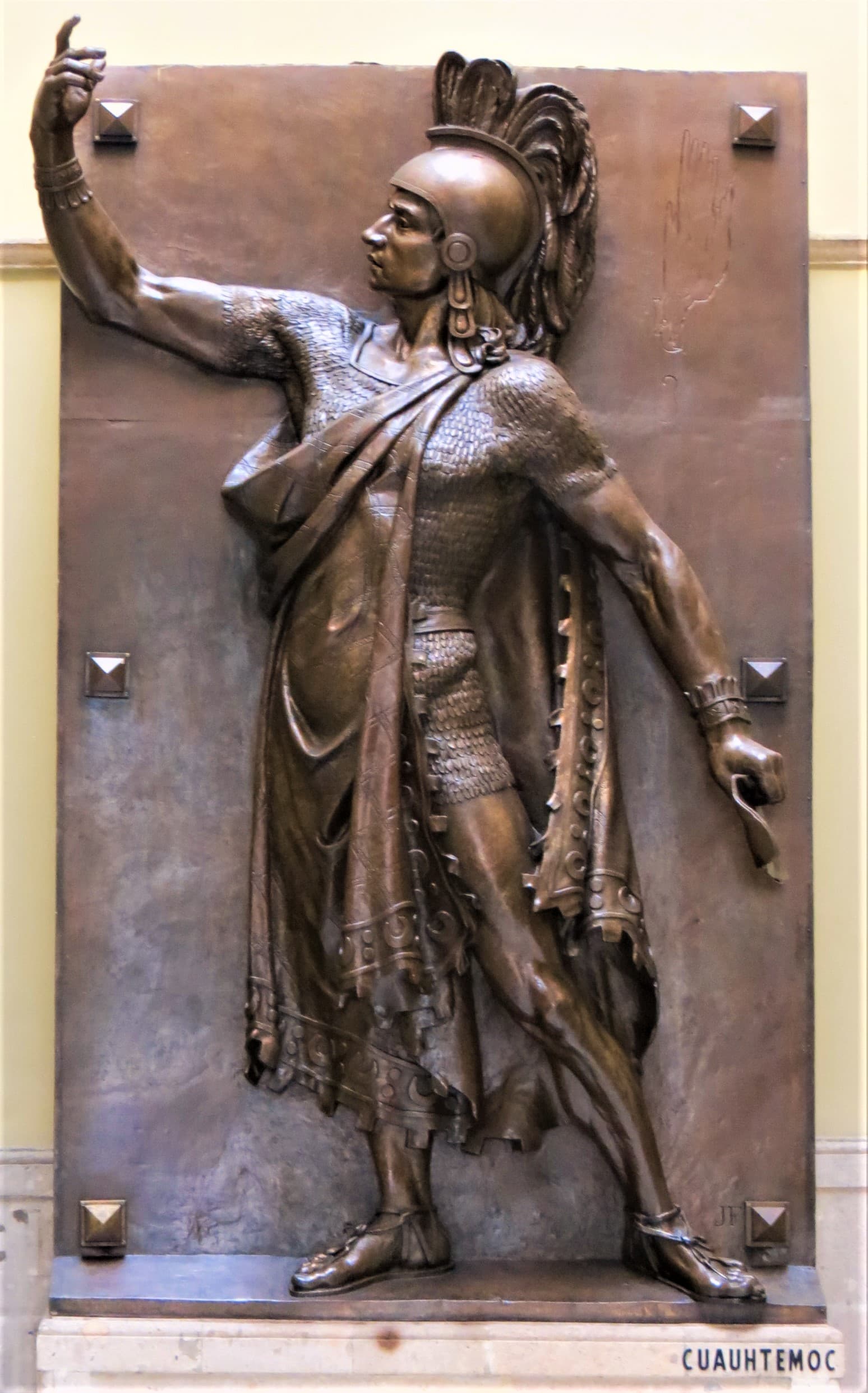
An eagle diving toward its prey is the image carried in the name of Cuauhtémoc, the last tlatoani of Tenochtitlan, who inherited a Mesoamerican empire already fracturing from within and besieged from without.
An eagle does not merely descend; in classical Nahuatl, the name Cuauhtémoc evokes a raptor folding its wings mid-flight, diving straight toward its prey with absolute, lethal intent. Yet when the twenty-five-year-old warrior ascended to the throne of Tenochtitlan in the bleak winter of 1520, the prey had already breached the gates, and the empire was consuming itself from the inside out. He was elected tlatoani—the speaker, the sovereign—not during a time of triumph, but in the suffocating silence that followed a cataclysm. The city was isolated, its tributary provinces were deserting to join the Spanish invaders, and a devastating smallpox epidemic was sweeping through the population, leaving a trail of rotting corpses in the canals. His predecessor, Cuitláhuac, had ruled for a mere eighty days before succumbing to the imported disease. In the smoke-choked calm of the imperial palace, the surviving high noblemen cast their votes for the eldest son of the late Emperor Ahuitzotl. He was young, he was a battle-hardened former ruler of Tlatelolco, and unlike his cousin Moctezuma II, he harbored no illusions about the men who had come from the sea.
To understand Cuauhtémoc is to understand his rejection of Moctezuma’s ghost. Where Moctezuma had believed in negotiation, in the delicate and ultimately fatal diplomacy of containment, Cuauhtémoc believed only in the sharp edge of an obsidian blade. One of his first imperial acts was to oversee Moctezuma’s funeral. It was stripped of the legendary, suffocating pomp that had defined the height of Mexica power. By denying his predecessor a grand departure, the young emperor sought to actively diminish Moctezuma’s memory, signaling to a desperate populace that the era of compromise was dead. War was the only language left. Cuauhtémoc summoned reinforcements from the surrounding countryside, but the response was a hollow echo. The structural joints of the Triple Alliance were fracturing. Of all the Nahua peoples, only the citizens of Tlatelolco remained fiercely, stubbornly loyal. When the Spanish and their indigenous allies pressed their siege, the surviving Tenochcas fled across the causeways to seek refuge in Tlatelolco, where the defense became so desperate that even the women took up arms, hurling stones and spears from the rooftops.
The end of the defense came on August 13, 1521, after eighty days of relentless, bloody warfare. The grand lacustrine metropolis of Tenochtitlan was reduced to rubble, its canals choked with debris and the dead. Cuauhtémoc, recognizing that the defense had collapsed, attempted to escape across the gray waters of Lake Texcoco in a canoe, accompanied by his young wife—a daughter of Moctezuma—and a small circle of family and noblemen. Captured by a Spanish brigantine, he was brought before Hernán Cortés. The encounter, preserved in the self-serving memoirs of the conquerors, was charged with the high drama of tragic chivalry. Cuauhtémoc, standing before the Spaniard alongside his surviving (nobles), pointed to the dagger at Cortés’s belt and asked to be struck down on the spot. "Strike me dead immediately," he reportedly said, offering his life as a sacrifice for a city that had already perished. Cortés, playing the part of the magnanimous victor, refused, praising his enemy's valor and promising that a Spaniard knew how to respect bravery. At Cuauhtémoc’s request, the surviving Mexica were permitted to leave the ruined capital unmolested.
+ 9 further connections to entries not yet ingested
The chivalric mask, however, was quickly discarded. When the gold recovered from the ruins of Tenochtitlan failed to match the wild expectations of the conquistadors, the Spaniards turned to violence. Suspecting that the Aztec treasury had been hidden, they subjected the captured emperor to "torture by fire." The soles of Cuauhtémoc’s bare feet were slowly bathed in oil and broiled over red-hot coals. He survived the ordeal, but the torture yielded little; the vast, mythical hoards of the empire did not exist, or remained forever lost beneath the mud of the lake. Baptized under the Spanish name of Fernando Cuauhtémotzín, the crippled sovereign was allowed to retain his title of tlatoani, but he was a king in name only, a living trophy kept under tight, paranoid surveillance.
For nearly four years, Cuauhtémoc lived in this twilight state, a captive sovereign of a vanished world. The end came in the dense, humid jungles of Central America. In 1525, Cortés embarked on a grueling expedition to Honduras to punish a rebellious lieutenant. Fearing that if he left Cuauhtémoc behind in the valley of Mexico, the former emperor would serve as the rallying point for a massive indigenous insurrection, Cortés dragged the captive lord and several other high-ranking nobles along on the march. It was a miserable journey through swamp and forest, fueled by hunger and mutual suspicion. When the expedition halted at the Chontal Maya capital of Itzamkanac, the tension broke. Cortés claimed he received word from an Aztec informant named Mexicalcingo that Cuauhtémoc, along with the rulers of Texcoco and Tlacopan, was plotting to slaughter the Spaniards and escape.
The accounts of what followed diverge into a bitter historical argument. Cortés wrote to his king that he interrogated the lords until they confessed, after which he promptly hanged Cuauhtémoc, Tetlepanquetzal of Tlacopan, and another noble named Tlacatlec, boasting that the execution would terrify the remaining native lords into submission. Yet Bernal Díaz del Castillo, a soldier on the march who genuinely liked the young emperor, recorded a far darker scene. According to Díaz, the conspiracy was a fabrication based on flimsy rumors, and the executions were entirely unjust. He recorded Cuauhtémoc’s final, bitter speech to Cortés, delivered through the interpreter Malinche: "Oh Malinzin! Now I understand your false promises and the kind of death you have had in store for me... May God demand justice from you." The execution hung heavily over the camp; Díaz wrote that Cortés was so consumed by guilt and insomnia that he wandered into the dark that night, fell, and badly injured himself. Decades later, the indigenous historian Fernando de Alva Cortés Ixtlilxóchitl wrote that the three lords had merely been joking among themselves about a rumor of returning home when a Spanish spy misreported their conversation, prompting Cortés to invent the plot out of pure paranoia.
Though Cuauhtémoc’s body was left to swing from a tree in the tropical wilderness, his story refused to settle into the earth. Four centuries later, in 1949, the small Mexican town of Ixcateopan in Guerrero became the epicenter of a bizarre national drama. An archaeologist named Eulalia Guzmán, fueled by a passionate indigenist nationalism, announced she had excavated the genuine bones of the last emperor. Coming on the heels of the discovery of Cortés’s authenticated bones in Mexico City, the find was greeted with initial euphoria by a public eager for a national counterweight to the conqueror. However, the triumph soon dissolved into controversy. Anthropologists from the Instituto Nacional de Antropología e Historia examined the remains and concluded they belonged to several different individuals, including several women, suggesting the grave was an elaborate local hoax designed to bring publicity to the town. Despite the scientific consensus, nationalist fervor and government panels clashed over the bones for decades, illustrating how deeply the memory of the last emperor remained entangled with the modern Mexican identity.
Ultimately, Cuauhtémoc’s legacy survived the ruin of his body and the loss of his grave. In modern Mexico, he has been elevated to the absolute symbol of indigenous resistance—the one ruler who did not bend, who chose the fire and the noose over submission. His likeness graces coins, banknotes, and a massive bronze monument on the Paseo de la Reforma, where he stands in quiet defiance, looking out over the modern metropolis built upon the bones of his empire. Unlike Moctezuma, whose name is often associated with tragedy and capitulation, Cuauhtémoc remains perennially alive in the names of Mexican boys, in the names of subway stations, and in the cultural imagination of a nation that views him not as a defeated king, but as the first hero of its long, unfinished struggle.