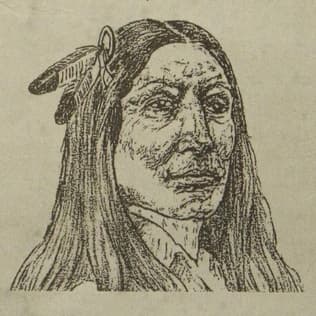
The boy born into the Oglala Lakota band in the early 1840s did not look like the others; his hair was notably lighter than the near-universal black hair of his people, earning him the childhood nickname Zizi, or Light Hair.
The hair was the first thing that set him apart. Among the Lakota of the northern plains, hair was almost universally black, thick, and straight. But the boy born in the early 1840s near the Powder River had hair that was strangely light, wavy, and tinged with brown, prompting his family to call him Žiží, "Light Hair," and later Pehin Yuhaha, "Curly Hair." He was born into a world already fracturing under the pressure of white migration, the son of an Oglala father also named Crazy Horse and a Miniconjou mother, Rattling Blanket Woman. His childhood was shadowed by sudden, silent tragedies. When he was only four years old, his mother’s brother was killed during a horse-raiding expedition against the Crow; consumed by grief, Rattling Blanket Woman hanged herself from a sturdy cottonwood tree. It was a trauma the family kept quiet, but it left the young boy—initially named Čháŋ Óhaŋ, "Among the Trees"—with a quiet, melancholic temperament that would define his entire life.
This natural reticence hardened into a profound gravity during his adolescence, catalyzed by the rising tide of American expansion. In 1854, when the boy was roughly twelve years old, a dispute over a stray cow belonging to a Mormon emigrant train escalated into a bloody confrontation near Fort Laramie. A young, inexperienced U.S. Army lieutenant named John Lawrence Grattan marched into a Brulé Lakota camp with twenty-nine soldiers and an interpreter to arrest the man responsible. When negotiations broke down, Grattan ordered his men to fire, mortally wounding the Brulé head chief, Conquering Bear. In the immediate, furious retaliation, the Lakota annihilated Grattan’s entire detachment. The sudden violence and the agonizing death of Conquering Bear deeply affected the teenage Crazy Horse, driving him to seek answers in the solitary, grueling spiritual traditions of his people.
His vision did not come easily. He fasted for two days on the open plains, placing sharp stones beneath his body to keep from falling asleep. When no revelation arrived, he walked down to his hobbled horse near a lake, where exhaustion finally overtook him and he collapsed into a trance. In the spirit world, a man rode out of the water on horseback, floating above the ground. The rider wore no war bonnet, his face was unpainted, and a single eagle feather hung in his long brown hair, with a small brown stone tied behind one ear. The rider’s horse and everything around him seemed made of spirit, floating and soft. Arrows and bullets flew toward the rider but dissolved into nothingness; though enemies reached out to grab him from behind, he broke free every time. A storm raged around him, lightning flashing across his cheeks and hailstones striking his body, before the vision faded to the scream of a hawk.
12 links to entries not yet ingested in the Library.
This vision became the blueprint for his existence. Under the guidance of his spiritual mentor and medicine man, Wóptura—whom the white authorities later called Old Man Chips—the young warrior learned to access this spirit world before entering battle. Wóptura interpreted the vision and provided Crazy Horse with his sacred talismans: a single feather to wear in his hair, an eagle-bone whistle, and a small, round stone with a hole in it, which he wore on a leather thong beneath his left arm. He was instructed never to wear a war bonnet, never to tie up his horse’s tail, and to rub dust over his hair and body before fighting. Crucially, the spirit world demanded absolute selflessness; he was never to take anything for himself. When he went into battle, Crazy Horse did not need to brave the danger; he simply had to think of the spirit world to place himself back inside it, walking unharmed through a shadow-world where bullets and arrows had no power to pierce him.
His father, recognizing the immense power of his son’s vision and his burgeoning prowess as a warrior, bestowed his own name, Tȟašúŋke Witkó—His-Horse-Is-Crazy—upon the young man, taking the name Waglúla, or Worm, for himself. Armed with his new name and his spiritual armor, Crazy Horse’s reputation grew rapidly throughout the late 1850s and 1860s. His first kill was a Shoshone raider who had killed a Lakota woman along the Powder River, and he soon became a dominant presence in the ongoing, cyclical warfare against traditional rivals like the Crow, Pawnee, and Blackfeet. Yet, despite his rising fame, he remained an anomaly among his own people. He was a heyoka, a "dreamer of thunder," marked by a deep, introspective sadness. While other Lakota leaders loved to sing and dance, Crazy Horse was never heard to sing and never joined the dances. In the camp, he walked around silently, barely noticing the adults, though he was deeply gentle with children, the poor, and the elderly. He had few ponies, despised the introduction of alcohol, and never sought wealth or prestige.
His leadership was entirely of a different kind: he did not command, but led by absolute example. This quiet authority made him a devastatingly effective war leader during the escalating conflicts with the United States. In December 1866, during Red Cloud’s War over the Bozeman Trail, Crazy Horse played a crucial decoy role in the Fetterman Fight near Fort Phil Kearny. He and a small group of decoys lured Captain William Fetterman and eighty-one soldiers into an ambush, where a waiting force of Lakota, Cheyenne, and Arapaho completely destroyed the detachment. A decade later, during the Great Sioux War, his tactical genius reached its zenith. On June 25, 1876, at the Battle of the Little Bighorn, Crazy Horse helped lead the combined Native forces that overwhelmed and wiped out Lieutenant Colonel George Armstrong Custer’s 7th Cavalry. To his enemies, he was a ghost—a brilliant, invisible strategist who refused to be photographed, refused to sign treaties, and refused to step foot on a reservation.
But the victory at the Little Bighorn was the twilight of the free Lakota. The U.S. military responded with a relentless winter campaign, pursuing the bands through the freezing plains, burning villages, and destroying food supplies. Facing starvation and the destruction of his people, Crazy Horse chose survival over pride. In May 1877, he surrendered to U.S. forces at Fort Robinson in Nebraska, leading his band of Oglala in a solemn, dignified march into the agency.
The transition to reservation life was fraught with immediate, toxic tensions. Military authorities remained deeply suspicious of his influence, while rival Lakota leaders, jealous of his enduring prestige and wary of his silence, spread rumors that he intended to return to the warpath. In September 1877, after leaving the reservation without permission to take his sick wife to her parents, Crazy Horse was arrested and brought back to Fort Robinson. As soldiers attempted to lead him into the post guardhouse, he realized he was being confined. He struggled, drawing a knife, as his friend Little Big Man tried to pin his arms. In the chaos, a soldier ran him through with a bayonet. He died that night, September 5, 1877, at the age of thirty-seven, refusing to lie on a white man's cot, choosing instead to die on the floor. His parents took his body, burying it in an undisclosed location in the hills, leaving his legacy to float, like his vision, untouched by the world that sought to claim him.