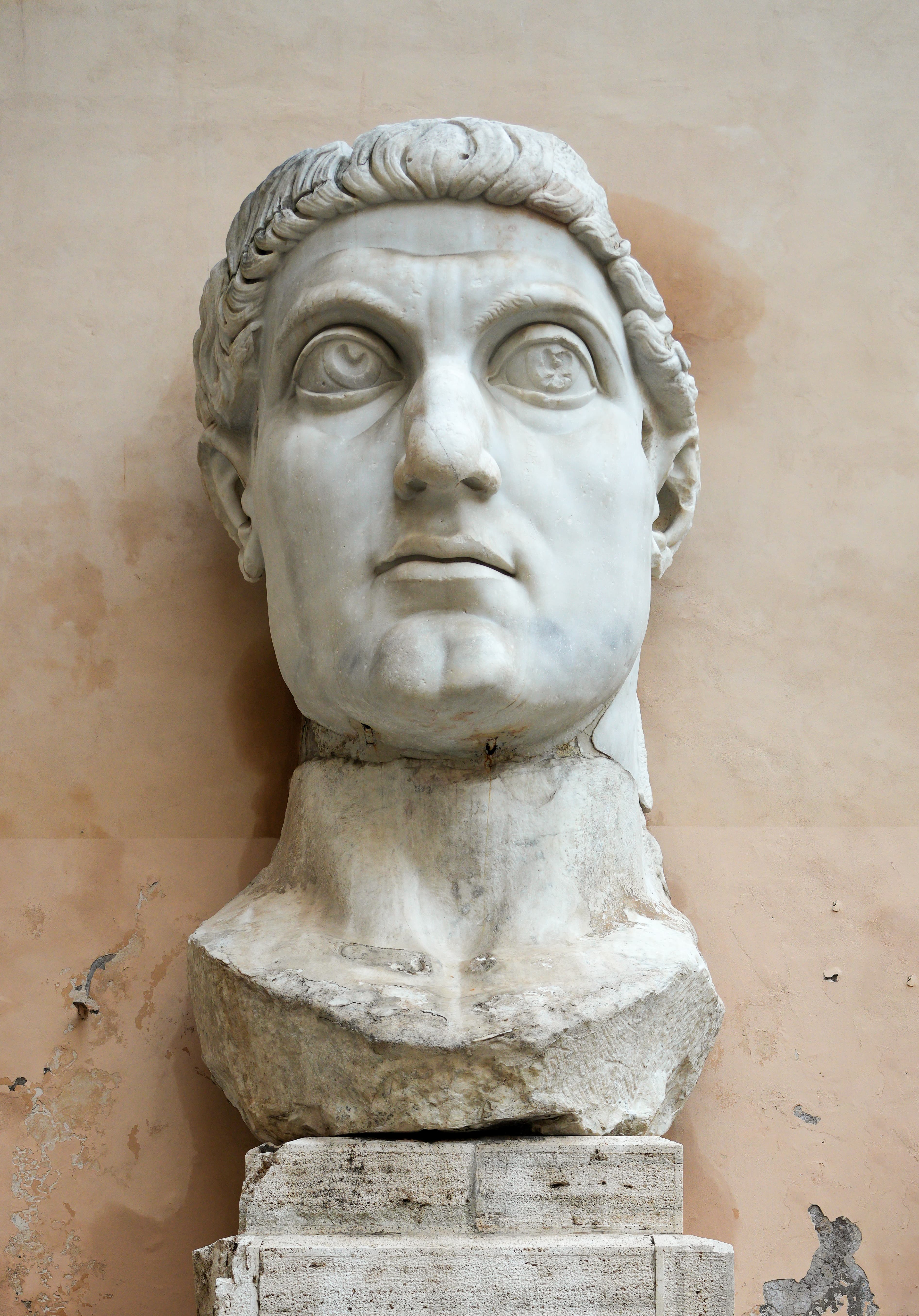
On 25 July 306 CE, in the remote Roman outpost of Eboracum—modern-day York—the soldiers of the Western Empire proclaimed Constantine I their emperor.
In the spring of 303 CE, a young tribune named Constantine stood in the eastern imperial capital of Nicomedia and watched the world of his youth begin to burn. He was roughly thirty-one years old, a tall, highly educated officer of Illyrian descent who had spent more than a decade living at the court of the Emperor Diocletian. There, in a culturally fluid environment, Constantine had studied Latin literature, Greek, and philosophy, likely attending the lectures of the Christian scholar Lactantius. Yet, in late 302, Diocletian and his fiercely pagan junior emperor, Galerius, dispatched a messenger to the oracle of Apollo; shortly thereafter, the imperial machinery initiated the "Great Persecution," the most systematic and violent attempt to eradicate Christianity in Roman history. Constantine, whose own mother Helena was a Greek woman of low social standing from Bithynia, witnessed these horrors firsthand. Though technically a favored member of the court who had fought with distinction against barbarians on the Danube and the Persians in Mesopotamia, he was also, in truth, a gilded hostage. Diocletian did not fully trust Constantine’s father, Constantius, who ruled the far western provinces of the empire. Keeping the son in Nicomedia ensured the father’s loyalty.
The political architecture housing Constantine was the Tetrarchy, a radical experiment designed by Diocletian to end the chaotic civil wars of the third century. Instead of a single ruler, the Roman world was divided among four: two senior emperors styled as augusti, and two junior successors styled as caesars, governing from regional capitals linked by a pragmatic, indivisible peace. In 305 CE, this delicate balance shifted when Diocletian and his co-emperor Maximian abdicated, elevating Constantine’s father, Constantius, to the rank of augustus in the West. Sensing his precarious position under the volatile new Eastern ruler Galerius, Constantine fled Nicomedia under the cover of night, riding hard across Europe to join his father’s court in Gaul. Together, father and son crossed the English Channel to campaign against the tribal populations of Britannia. When Constantius died the following year in the remote northern outpost of Eboracum—modern-day York—the soldiers of the western legions did not wait for the complex succession rules of the Tetrarchy to dictate their future. They bypassed the system entirely, acclaiming the young, battle-tested Constantine as their augustus.
This unilateral acclamation ignited nearly two decades of civil war as the Tetrarchy splintered into bloody rivalries. To secure his grip on power, Constantine systematically dismantled his rivals through strategic military campaigns and political maneuvers. His first major hurdle was Maxentius, who held Rome. In 312 CE, Constantine marched his mobile, highly disciplined field armies across the Alps. It was during this campaign that Constantine’s relationship with paganism began to irrevocably fracture, pivoting toward the growing, resilient faith he had seen persecuted in his youth. Though he remained a catechumen for the rest of his life and was only baptized on his deathbed by the Arian bishop Eusebius of Nicomedia, 312 CE marked the moment he began to openly favor Christianity. After defeating Maxentius’s forces, Constantine disbanded the legendary Praetorian Guard, which had supported his rival, and consolidated his control over the western half of the empire.
+ 12 further connections to entries not yet ingested
With the West secured, Constantine co-authored the Edict of Milan in 313 CE with his eastern counterpart, Licinius. The edict did not establish Christianity as the official state religion, but it did something historic: it legalized Christian practice, returned confiscated church properties, and brought an end to the era of state-sanctioned martyrdom. The uneasy peace between Constantine and Licinius did not last. By 324 CE, Constantine had defeated Licinius in another series of civil conflicts, uniting the fractured Roman world under a single, absolute ruler.
To govern this vast, newly unified empire, Constantine initiated a series of sweeping structural reforms. He separated civil and military authorities to prevent ambitious provincial governors from launching rebellions. He reorganized the imperial military, splitting it into two distinct branches: the comitatenses, mobile field units that moved with the emperor to strike deep threats, and the limitanei, border-garrison troops tasked with countering frontier raids. While these frontier forces grew increasingly less capable of stopping full-scale barbarian invasions, Constantine used his field armies to launch successful campaigns against the Franks, Alemanni, Goths, and Sarmatians, eventually reclaiming and resettling abandoned borderlands with Roman citizens. To curb the runaway inflation that had crippled the third-century economy, he introduced the solidus, a new gold coin of reliable purity. It was an economic masterstroke; the solidus became the economic bedrock of the Mediterranean, serving as the standard currency for Byzantine and European merchants for more than a thousand years.
As sole emperor, Constantine increasingly cast himself as a patron and arbiter of the Christian church, though modern historians continue to debate the depth of his theological comprehension. Confronted by bitter doctrinal divisions within the faith, particularly the Arian controversy regarding the nature of Christ’s divinity, Constantine summoned bishops from across the Roman world to the First Council of Nicaea in 325 CE. He was not interested in theological minutiae so much as imperial unity, and the council eventually produced the Nicene Creed, a foundational statement of Christian orthodoxy. His patronage manifested physically across the landscape of the empire. He ordered the construction of the Church of the Holy Sepulchre in Jerusalem on the site believed to be the tomb of Jesus, transforming the province of Judea into the holy center of a rapidly Christianizing world. Yet even as he elevated the church, he navigated a deeply pagan Roman society. His secular biographers, writing in brief historical epitomes, often omitted his religious policies entirely, painting him simply as a victorious, traditional Roman emperor.
Constantine’s most enduring legacy was his decision to shift the center of gravity of the Roman world permanently eastward. Recognizing that Rome was too far from the wealthy, populous eastern provinces and the critical frontiers of the Danube and Euphrates, he selected the ancient Greek city of Byzantium as his new imperial residence. He rebuilt the city on a monumental scale, renaming it New Rome, though it quickly became known as Constantinople. Dedicated in 330 CE, the new capital was designed to match the architectural grandeur of Rome, but without its deep pagan associations.
When Constantine died on May 22, 337 CE, he left the empire not to the meritocratic framework of the Tetrarchy, but to his sons, establishing a principle of dynastic succession that would characterize the medieval world. His historical shadow is immense and polarized. To the medieval church, he was a saintly protector, a paragon of virtue whose mother Helena had helped steer the empire toward salvation. To the writers of the Renaissance, who rediscovered critical, anti-Constantinian sources, he was a more complicated figure—an autocratic reformer who had permanently altered the classical Roman state. By choosing to tolerate, patronize, and integrate Christianity into the imperial administration, and by founding the great fortress-city on the Bosporus, Constantine bridged two distinct eras. He did not merely preserve the Roman Empire; he reshaped its soul, ensuring that when the western provinces eventually crumbled, the Roman name, treasury, and faith would endure at Constantinople for another eleven centuries.